Right Time, Wrong Place
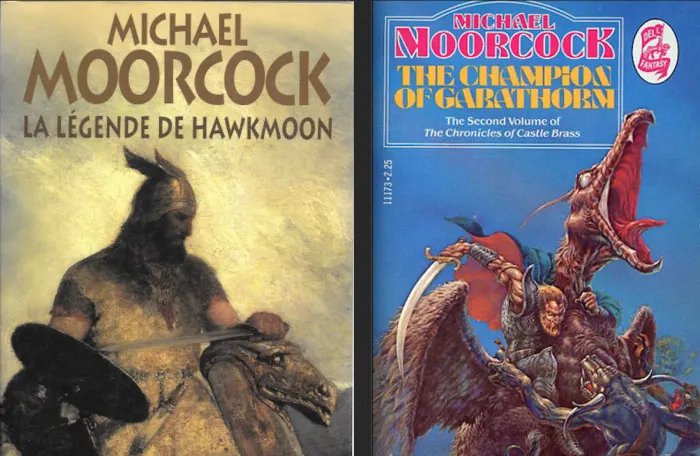
Following the events of Count Brass, Dorian Hawkmoon finds himself in a world similar to his own, but different in many catastrophic, personal ways. He defeated Granbretan, the Dark Empire, saving the lives of many of his best friends, but in this world, the peaceful life he knew with his wife and children never came to pass. Everyone thinks he is insane because of his insistence that Yisselda survived the war and became his wife, but everyone points out that Yisselda died years ago in the struggle against the Dark Empire. On the verge of mania and suicidal despair, Hawkmoon finds a reprieve with the arrival of Katinka van Bak, a famous warrior woman from the frontier lands. She claims to need Hawkmoon’s help because her land has been invaded by an impossible army consisting of people known to be dead. Believing this situation gives him a chance to answer the maddening situation in which he finds himself, Hawkmoon agrees to journey with her, joining with the eccentric wanderer Jhary-a-Conel in pursuit of a rumored bandit legion comprised of the deceased.
Line of Demarcation
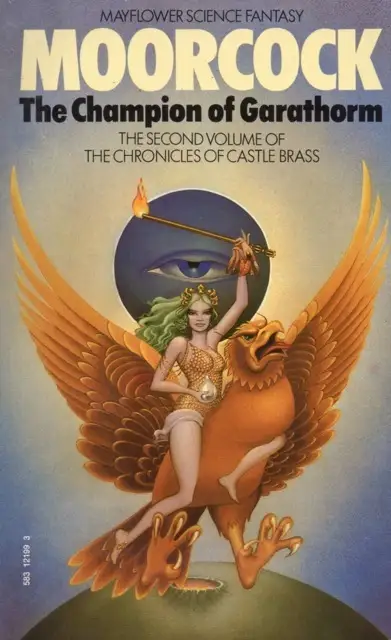
Only about the first third of the novel deals with the Hawkmoon’s situation. After that point, the plot leans hard into the Eternal Champion storyline and is tangled firmly within the Moorcockian Multiverse. On the one hand, it can be enjoyable for readers of Michael Moorcock’s other books to spot the references and connections to Elric, Corum, and other manifestations of the Eternal Champion. On the other hand, readers looking to continue with the story of Dorian Hawkmoon might be disappointed that he is effectively benched for a novella about Ilian and her efforts to recover her homeland during upheaval in the multiverse. The latter two thirds of the novel are not bad as a fantasy adventure story, but it can feel like a bait-and-switch to anyone invested in the problems of Hawkmoon.
This shift in the story can feel jarring since the early chapters are cerebral and existential. Even when the action gets underway, a reader might think The Champion of Garathorm is an exercise in subverting fantasy standards as the heroes are a physically and psychologically reduced Hawkmoon, a middle-aged woman, and a rustic odd-ball. On a similar note, to anyone unfamiliar with this author’s multiverse and the long running saga of the Eternal Champion, these parts of the book can become a confusing cacophony rather than a pulpy jaunt of speculative fiction.
Tragic Millennium
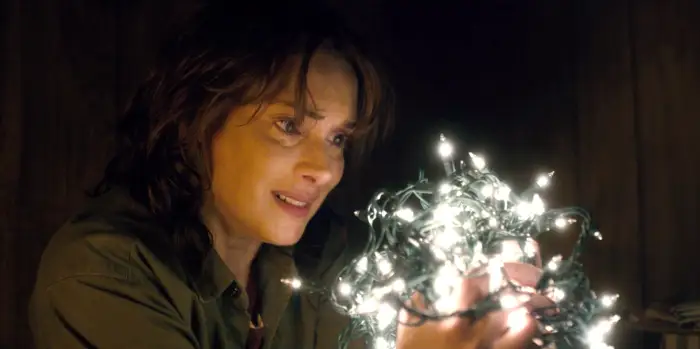
Hawkmoon finds himself in a situation similar to Joyce (Winona Ryder) in the first season of Stranger Things. Everyone thinks this character is insane, but the audience knows better. The irony creates another kind of tension that cannot be resolved with swords and sorcery while driving a wedge between them and everyone around who wants to help. The frustration in the early chapters is palpable as Hawkmoon maintains a belief in something that everyone else knows cannot be true. The readers, however, know that he is correct to some degree, even if he is uncertain as to why. This heaviness is only alleviated with the introduction of Jhary who comes across as a trickster character or like an actor having fun playing his part. To readers who want a rip-roaring fantasy adventure, though, the early part of the book can feel like a depressing slog.
Sweet Battle, Triumphant Vengeance
The Champion of Garathorm often seems like a novel in conflict with itself. No part of it is bad, but it reads like a fix-up novel of two different stories forced to inhabit the same book. It does manage to connect the History of the Runestaff and the Eternal Champion. How much a reader will want or appreciate that connection will vary. In either case, while there will be parts of the story that resonate, it likely will not feel like a strong and coherent whole. Nevertheless, the novel makes for an interesting entry in Moorcock’s bibliography.
Source
Moorcock, Michael. The Champion of Garathorm. Berkley, 1985.
© 2024 Seth Tomko