Chronicles of Castle Brass
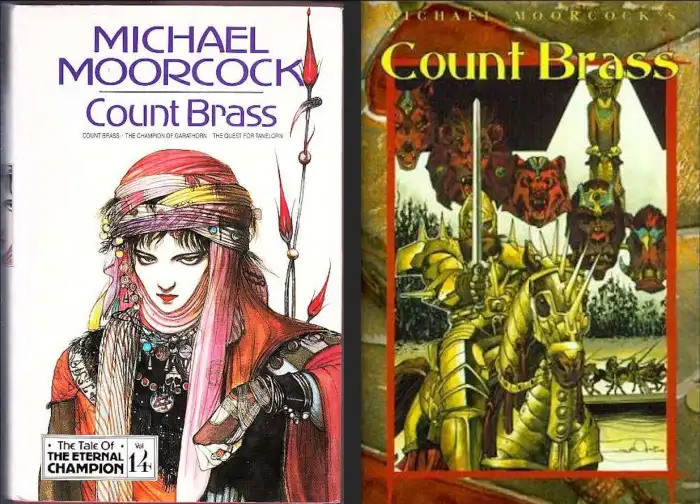
In the years following the defeat of the Dark Empire of Granbretan, Dorian Hawkmoon is living in semi-retirement as a country gentleman. His peaceful life of marriage, children, and pastoral work is interrupted by rumors concerning the ghost of Count Brass—his friend, ally, and father-in-law—appearing throughout the land, accusing him of treachery and murder. Knowing that Count Brass died at the Battle of Londra, Hawkmoon goes into the marshes at night to confront what he believes to be a malicious imposter. What he discovers is a plot of science-sorcery concocted by remnants of the Dark Empire not only taking revenge on Hawkmoon but also reshaping the world with reality-warping supernatural power, leading to a perilous adventure into distant lands and across dimensions.
The Haunting of Dorian Hawkmoon
As a follow up to The History of the Runestaff and a bridge to other works in Michael Moorcock’s Eternal Champion Multiverse, Count Brass does a fine job of setting up a specific plot where the characters, even though they do not understand what is happening to them or why, embark on a journey with clear goals and aims. The prose style is precise and focused, so even readers who have not read any previous stories concerning Hawkmoon can jump in and follow along without much difficulty. Outside of the early pages of exposition, almost no time is wasted, giving the audience a focused story with a small cast of distinct characters. Though a tale of adventure, this book does not have the sword and sorcery atmosphere of Moorcock’s earlier stories of the Elric Saga, which was channeling Robert E. Howard’s Conan tales. Instead, Count Brass is more elegiac in tone and set in a world not long removed from apocalyptic catastrophe, like The Dying Earth series by Jack Vance or Viriconium by M. John Harrison.
The Loot of Time
As with many of Moorcock’s stories, how much the audience will enjoy Count Brass will depend, to some degree, on how much they embrace or at least tolerate his use of multiverse shenanigans. Unlike more contemporary deployments concerning the concept of the multiverse, which come across as lazy and/or cynical in ways that would astound even P. T. Barnum, Moorcock has pertinent, thematic reasons for his using the multiverse and parallel dimensions. For Hawkmoon and the villains, it ties into a longing to try correcting past mistakes. Hawkmoon is both saddened and energized by the appearance of friends and allies that he knows died during the great struggle to liberate his world from tyranny. Through this multiverse adventure, he gets to relive some of that glory while also contemplating if he can affect better outcomes in different dimensions. The villains want the same thing: a chance to triumph over their adversary while restoring their lives and the glory of their fallen civilization. This thematic richness means the multiverse here is not a cash-grab or sign of creative desperation, and the dark unexpected twist at the end—echoing the beginning of the book—also reinforces the novel’s mournful undercurrent.
Old Dreams and New
Because it is brief and well-written Count Brass is worth reading, even to someone who has not gotten into the previous History of the Runestaff. It is certainly a welcome addition to the library of anyone who has read and enjoyed Moorcock’s other books. While it may lack some of the narrative complexity and shifting points of view found in other stories from the Moorcockian Multiverse, the novel is still a strong fantasy story with a tone and mood not often replicated.
Source
Moorcock, Michael. Count Brass. Ace, 1988.
© 2024 Seth Tomko