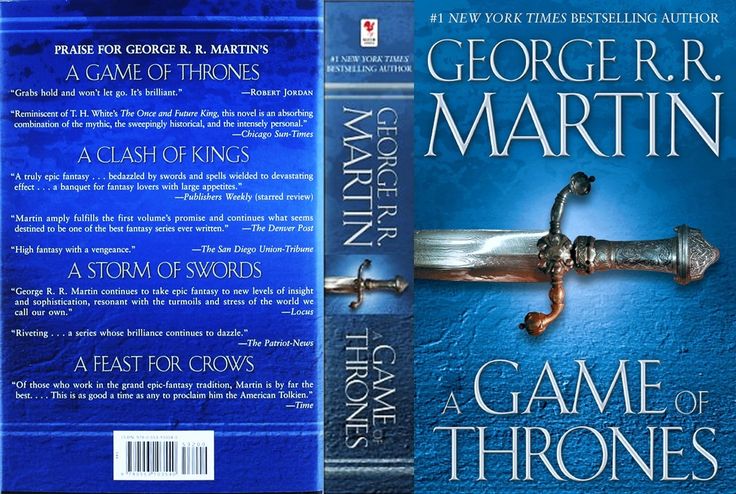
Though slow moving and intricate, A Game of Thrones successfully marries old and new elements of fantasy writing.
Most of the book focuses on the noble House Stark as the king summons his old friend Lord Eddard “Ned” Stark to be his new advisor. As the Starks leave the simplicity of their home in the north, they are drawn into a complex network of shifting alliances and rival houses in King's Landing, all vying for the chance to sit their heir on the Iron Throne. As betrayal and disaster strike, the Starks are scattered across the Seven Kingdoms, seeking justice or simple survival.
A secondary plot concerns the remaining two children of the deposed royal family as they attempt to raise an army to reconquer their former lands and retake the Iron Throne. Similarly, the guards along the Wall—the barrier that protects the Seven Kingdoms from the wild lands—find themselves facing supernatural foes and barbarous refugees coming in the vanguard of a monstrous winter.
The Size of the Throne
What first might appear to be the novel’s weakness—its enormous size—becomes a strength. The high page count gives Martin the time he needs to develop many of his characters and allow the plot to unfold slowly. Much of the novel is spent in pursuit of a few key mysteries that lead to the climactic violence of the last book’s last quarter. This development builds enough tension to maintain a reader's interest the whole time, but the ending of this novel will certainly prove devisive.
Although there are a host of characters, Martin focuses on a few—most of the Starks—to tell the story from their perspective with limited third person points of view. This development humanizes the characters and their actions, allowing the reader to care about the characters when it would be easy to lose them in the shuffle of so many others. In a similar manner, this point of view style binds a reader to particular characters, so he or she is invested as these narrative characters encounter triumph and tragedy.
Martin’s Fantasy Forbearers
The size of the novel is meant to signal the author’s intention of creating an epic storyline to rival The Lord of the Rings and The Once and Future King. Since there is so much about political maneuvering, statesmanship, and ambitious power plays, the novel actually has more in common with the Dune Series, political thrillers, and history books about the Middle Ages than it does with most fantasy novels. In fact there are only a few instances where anything magical happens. The bulk of the novel deals more with human interactions and the ways they use and misuse their authority, intellect, or physical power to help and hinder one another all while grasping to hold onto their own interests. The ethical actions of the characters are rarely black and white.
The most fantastical element is the setting itself. Winters and summers can last decades in the Seven Kingdoms, and this magical relationship of the seasons affects everything that happens in the novel. Readers who come to A Game of Thrones looking for orcs and wizards in pointy hats will be largely disappointed, but keeping an open mind about what constitutes a fantasy novel will make the book a rewarding experience. The ending, however, suggests the rest of the Song of Ice and Fire will see and increase in elements of the fantastic.
Return of the Long Winter
A Game of Thrones makes for an engaging if somewhat lengthy read. Martin not only keeps readers interested and caring about what happens over the course of the long novel but also convinces them to read the rest of his Song of Ice and Fire whenever he gets around to finishing it.
Source
Martin, George R. R. A Game of Thrones. New York: Bantam Spectra, 1996.
© 2010 Seth Tomko