What Tolkien and Lewis Have to Say on the Beauty of Wickedness
To both authors evil is a corrupting and destructive force, but Lewis argues for evil as seductive while Tolkien claims evil to be repugnant and coercive. The goals of the antagonists are the same for both authors: the annihilation of everything he or she cannot control. The means to this end, however, are different in the worlds of Narnia and Middle-earth. Jadis reverts to violence only when her charm cannot achieve her desired results. Sauron, however, has no beauty, so deception and conquest are his primary tools.
The White Witch
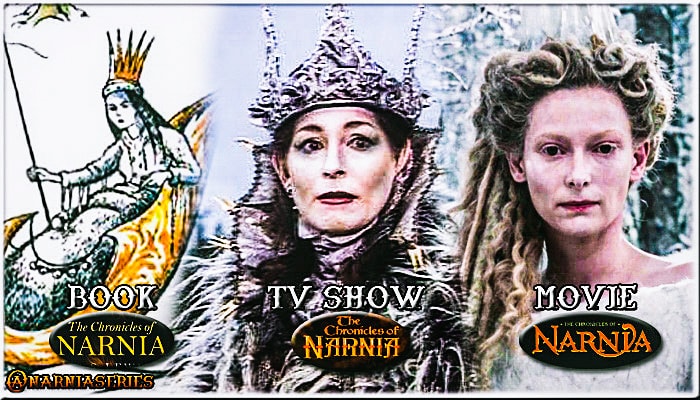
Jadis is a queen of Charn, a world she killed while vying for the throne with her sister. In The Magician’s Nephew she says that she uses the deplorable word—a word that extinguishes all life—only as last recourse. Despite her selfishness and nihilism, her fierce beauty clouds the minds of Digory, Uncle Andrew, and in The Lion, the Witch, and the Wardrobe, Edmund. She charms men into servitude, suggesting that evil is beguiling and something people accept because it appears attractive and noble.

The Eye of Mordor
The Silmarillion says that Sauron because of his treachery “could never again appear fair to the eyes of Men” (280). People are not seduced into his service by beauty since he has none; they follow him because they believe in the lie of Sauron’s omniscience and omnipotence. Sauroman, despairing of victory, joins his enemy, betraying the White Council until he can find an opportunity to seize power for himself. Boromir believes there is no hope against an immortal foe and attempts taking the One Ring for himself. Denethor sees what Sauron wants him to see, which inspires the Steward’s suicidal mania. In each instance Sauron succeeds by threats and deception rather than seduction.
The One Ring, as an extension of Sauron, operates the same way. It is not a beautiful piece of jewelry just as its maker is not beautiful. The Ring makes its wearer into a slave by offering the wearer exactly what he or she wants. Through these desires, it turns all intentions to evil. Bilbo, for instance, has trouble letting go of the Ring even though he is not an evil hobbit. As with Sauron, the Ring and its deception need not be beautiful to make people into desperate slaves.
Kingdoms of the Wicked
Despite the different roads, the ending destination is the same. Jadis destroys one great empire, and her other is a static, frozen world without happiness. Mordor, similarly, is a blasted wasteland with nothing green or growing within miles of either Barad-dûr or the volcanic Mount Doom. Evil disfigures the world around it. Isengard becomes such a blight the Ents are mobilized to take vengeance for the deforestation, and the Shire, too, suffers under filth and smoking gloom when it falls into evil hands. Unlike in Narnia, where Aslan’s breath restores the life of the land and people in it, Middle-earth suffers with its scars. For instance, while Galadriel’s magic can make a special mallorn tree grow in the Shire, she cannot replace or repair the old Party Tree that was cut down just as the dead cannot be restored to life.
Rewards of Sin
In their fantasy novels Tolkien and Lewis show the different paths evil may take. For Tolkien evil has its own lies but beauty and seduction are not among them, while Lewis contends that evil can have a pretty face to use to its advantage. No matter how divergent those paths, though, the results are always the same: oppression and ruination.
Sources
Lewis, C. S. The Lion, the Witch, and the Wardrobe. The Chronicles of Narnia. New York: Harper Collins, 2001. 107-198.
Lewis, C. S. The Magician’s Nephew. The Chronicles of Narnia. New York: Harper Collins, 2001. 7-106.
Tolkien, J. R. R. The Lord of the Rings. Boston: Mariner Books, 2005
Tolkien, J. R. R. The Silmarillion. Boston: Houghton Mifflin, 1977.
© 2010 Seth Tomko