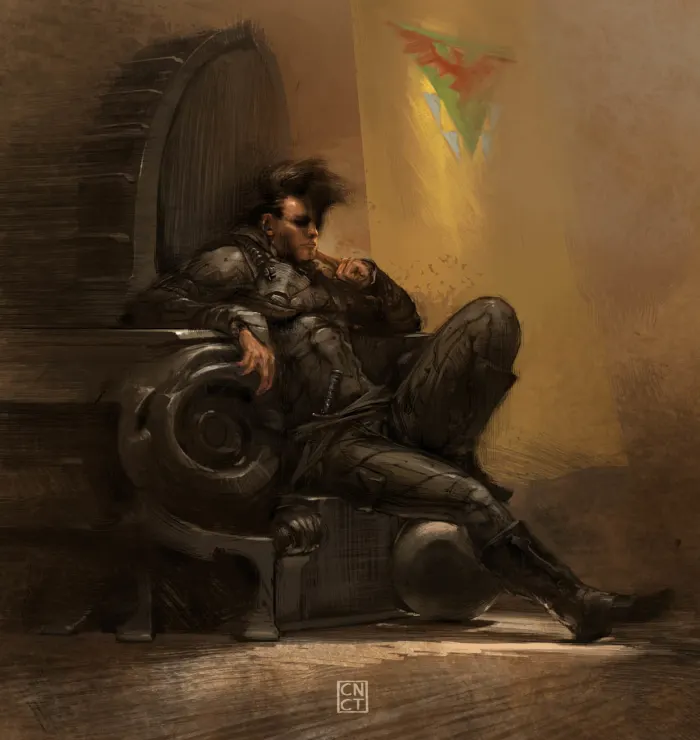
The Sleeper Has Awakened
As Dune closes, all seems well: a dictator is usurped, the Fremen control the spice and their own destiny, and Paul Muad’Dib has justice for the injuries against his family. Many readers are understandably shocked then as Dune Messiah opens with a conspiracy against Emperor Paul and that there is dissatisfaction even among the Fremen at the course their culture has taken. Paul Muad’Dib is not only venerated as a messiah but also despised by many who fear his prescience abilities and his autocratic theocracy.
The Wheel of Myth
Joseph Campbell’s studies show that a common mythic motif is a hero who essentially overstays his or her welcome. Someone who once brought a great boon becomes a tyrant by both their increased and dangerous stature and that he or she fights against upcoming heroes who act to revitalize society as they once did. Campbell points to King Minos who was once a good king, but through abuses of his divine relationships, he is cursed to care for the bestial and insatiable Minotaur. Minos becomes a fearsome tyrant as he forces his citizens and conquered people into slavery and has them sacrifice themselves to the Minotaur’s ravenous hunger. It takes another hero—Theseus—to undo the oppressive carnage Minos brings.
Muad’Dib the Messiah Devil
Paul finds himself in a situation similar to Minos as the church he built to secure his power grows monstrous. Led by his psychologically fractured sister—Alia—Paul Muad’Dib’s church establishes creeds and ossified rituals in place of the dynamism and adventurous spirit he showed by becoming leader of the Fremen in the first place, helping them liberate themselves and taking revenge against their oppressors. The heroism of his leadership sours, threatening to turn him into the same hated figure as the emperor he overthrew.
Paul is slightly better off than Minos because he sees what is happening, but he believes he is trapped in these circumstances by his prescient visions. He gambles greatly on the birth of his children to free him by becoming the kind of hero he once was. The tragedy is that Paul loses everything trying to undo the tangle of self-serving institutions that have become Dune’s equivalent to the carnivorous Minotaur. The very people he saved are becoming slaves and victims of his own institutions, and despite his power and authority, he feels unable to prevent this decline.
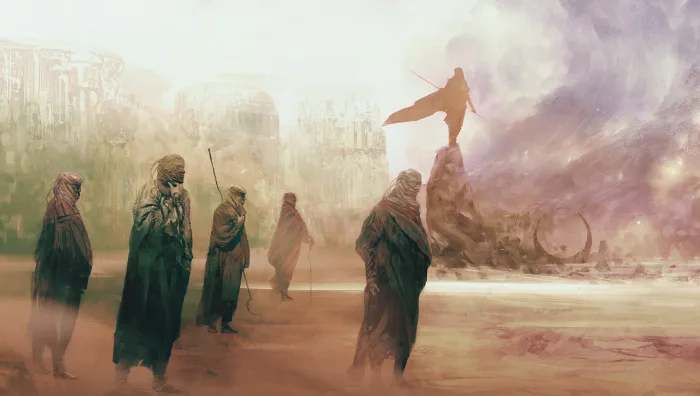
Children of Dune
The stage is set for Paul’s children to succeed where he failed. Alia takes power and turns the empire into an unbearable theocracy ruled by observance to empty rituals, suggesting institutional necrophilia; the love of heroic actions and deeds is replaced by deadening fanaticism that stifles creative growth and turns the population fearful. Paul’s hyper-intelligent children know the trap their father fell into by trying to replace one dictatorship with another. Their situation will require an unthinkable extreme or the cycle will continue. Leto, believing he sees where Paul failed, decides that the only way to break free of Campbell’s mythic savior-oppressor cycle is to embrace it and synthesize the two roles. Through symbiosis with sandworms, he becomes more and less than human—as the Minotaur was—and takes his place as god-emperor. His goal is to be so oppressive and crushingly omnipresent that when his reign is undone, all the subjects of his vast empire will never again trust allegedly heroic men such as himself or his father. Essentially everyone must become his or her own hero.
Sources
Campbell, Joseph. The Hero with a Thousand Faces. Princeton, New Jersey: Princeton University Press, 1973.
Herbert, Frank. Children of Dune. New York: Ace Books, 1976.
Herbert, Frank. Dune. New York: Ace Books, 1965.
Herbert, Frank. Dune Messiah. New York: Ace Books, 1969.
© 2009 Seth Tomko