Back to the Front
Still separated from the main forces, Guts and Casca take a moment to recover, and she finishes explaining how she came to join Griffith and the Band of the Hawk. Casca also reveals to Guts about the time she saw Griffith in a vulnerable moment. Seeing they are still pursued, the two of them attempt finding a path through the forest to rejoin the others, only to be ambushed. Guts launches himself into the fray, taking on 100 mercenaries so that Casca has the chance to escape the bring help. She does find a rescue party but not before Guts is injured in his single-handed defeat of all 100 sell swords. Recovering later at the army encampment, Guts admits to Casca that he is planning to leave the Band of the Hawk and find his own dream and his own purpose in life. Griffith is commanded, however, to capture the impenetrable enemy stronghold of Doldrey. His plan rests on putting his loyal followers, Guts and the rest of the Band of the Hawk, in a disadvantageous position with no escape route in order to lure the enemy army into committing to an attack that will leave the fortifications open to infiltration by Casca and a smaller force. As the saying goes: no plan survives contact with the enemy.
A Man Chooses
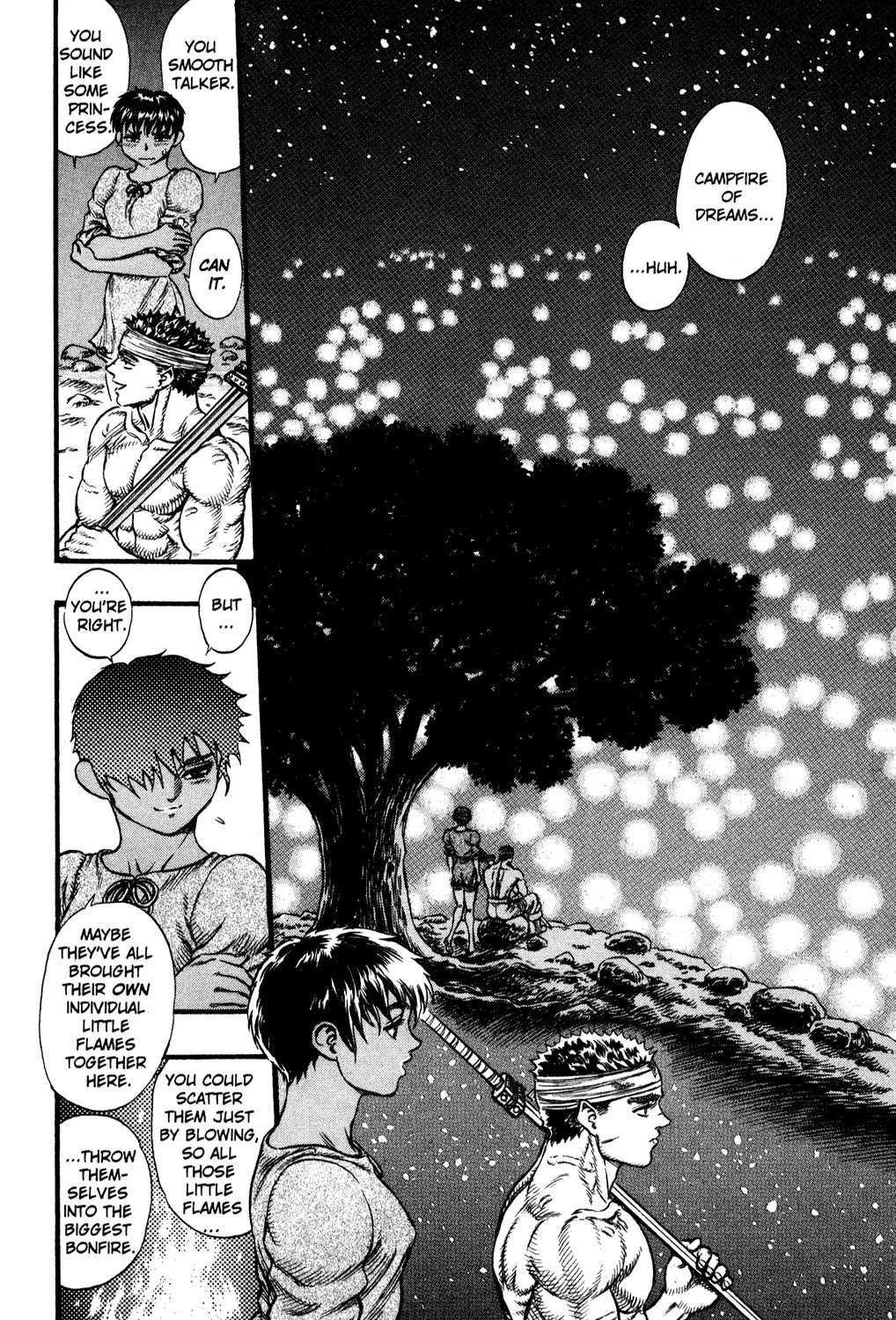
The bulk of the heavy lifting in terms of characterization comes from Guts and Casca engaging in sincere if sometimes brusque dialogue. It is clear to the reader that Casca’s admitted idolizing of Griffith makes her an unreliable narrator, and sets her up as a tragic character. As learned earlier, Griffith uses people to achieve his own dream, and he does not care for or respect the very people who so loyally serve his cause. Casca, therefore, will never be more than a tool to Griffith, whereas Guts, who plans to leave and discover his own destiny, will gain a level of respect with Griffith that Casca cannot hope to achieve. The continued manipulation and willingness to use everyone to achieve his own ends is again revealed in Griffith’s actions, and Guts even remarks on it while looking down at all the campfires at night, commenting how it is all a single blaze for one man’s dream.
Action Bloat
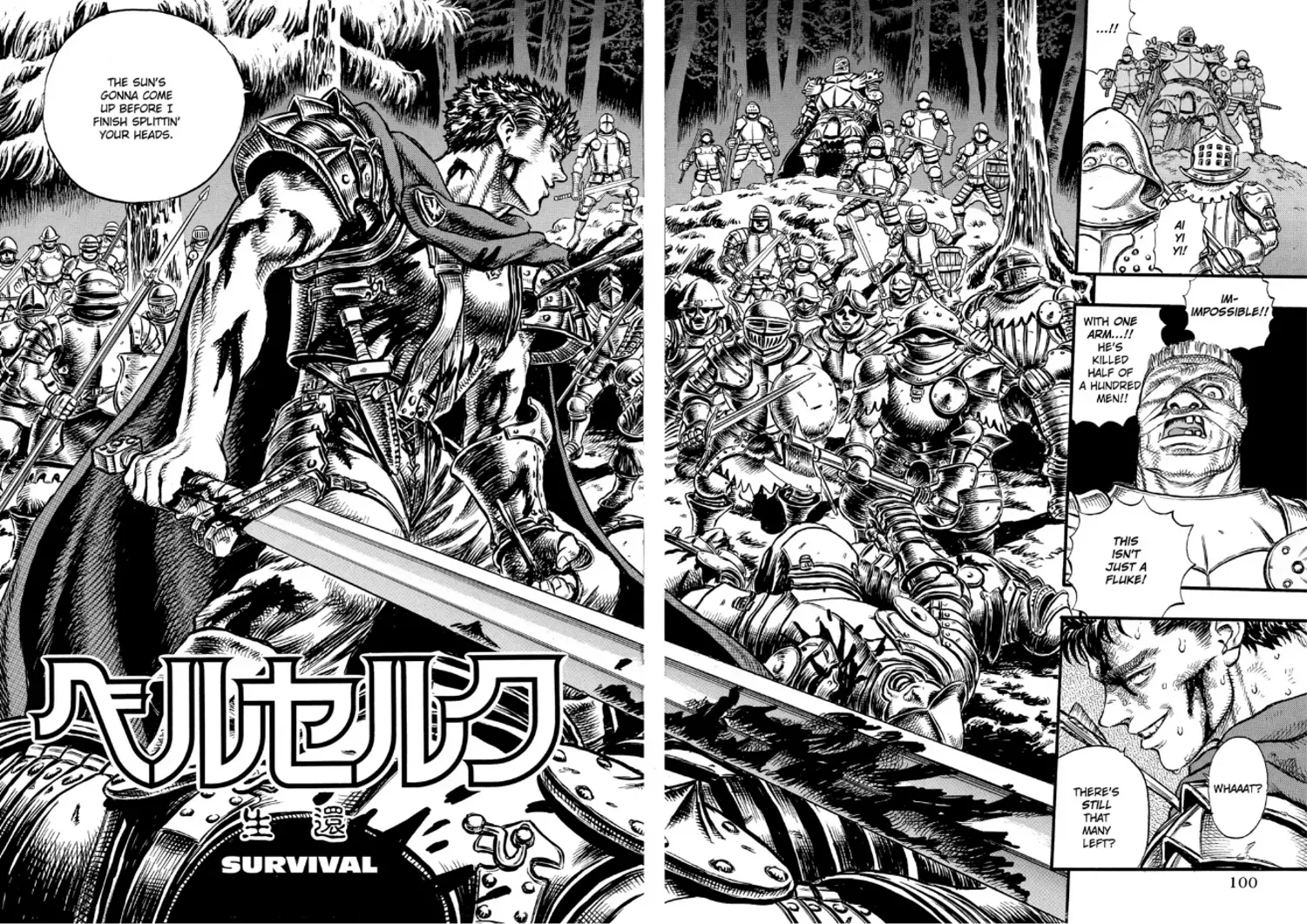
Miura’s art is high quality with plenty of impressive detail in the action. There are also several fine pieces of visual foreshadowing, such as when Guts takes an injury to his left arm and fights many of the mercenaries one-handed. The problem is starting to become to prolonged fighting sequences. The fights themselves could be significantly more economical in presentation. An action sequence should be transformative, meaning the situation for the characters would be different after the action than it was before. Some of the fights here do not really accomplish that, and since there is not much new characterization accomplished through the violence either, the only real purpose of the combat is to show off Miura’s talents and detailing. While this is important for a visual medium, the story needs more. One wonders if this situation is more a result of manga production schedules than artistic, storytelling choices.
Campfire of Dreams
Overall, Berserk remains and visually and narratively interesting story. Ironically, the pacing problem now stems from the action sequences rather than the quiet character moments. The audience knows this whole situation has to end badly, and that somewhere along the line, Guts changes from a cocky mercenary driven by an instinct for survival into a whirlwind of barely suppressed rage driven by revenge. The story sure is taking the long way to get there, especially since when the story does finally catch up to where it started in volume one, there is a lot more story to be told going forward.
Source
Miura, Kentaro. Berserk, vol. 7. Translated by Duane Johnson. Dark Horse, 2005.