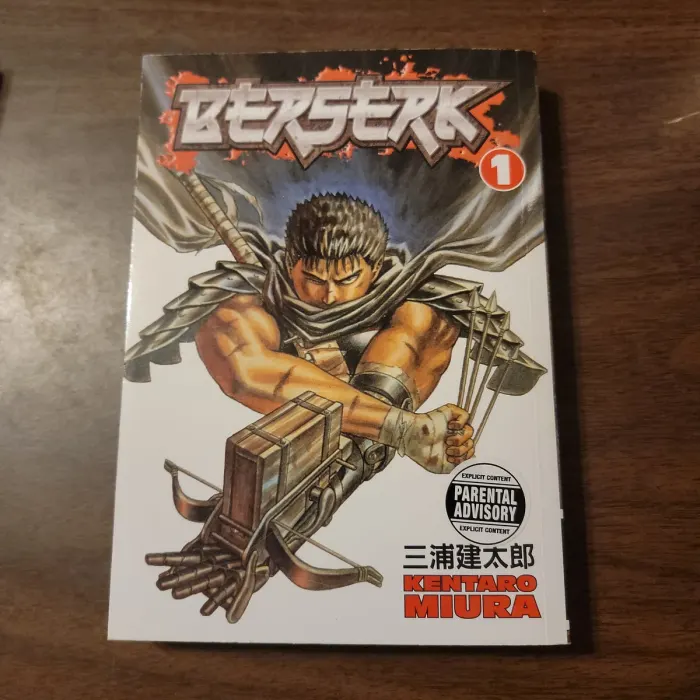
The Black Swordsman
These three loosely connected stories follow Guts, the Black Swordsman. He is a wandering warrior with and iron prosthetic arm and a giant sword that puts Cloud Strife’s Buster Sword to shame. In the dark fantasy setting, he pits himself against malicious humans and corrupting, abusive supernatural forces, fighting against them with his own relentless, destructive hatred. His motives remain unknown, even to Puck, the tiny elf he inadvertently saves and insists on following him. What is known, however, is the slaughter that follows when Guts sets his sights on an enemy. Guts has a mysterious Brand that makes him the target of dark and supernatural creatures, and he defends himself by going on the offense, aggressively hunting them down and destroying them first.
You Got to Have Guts
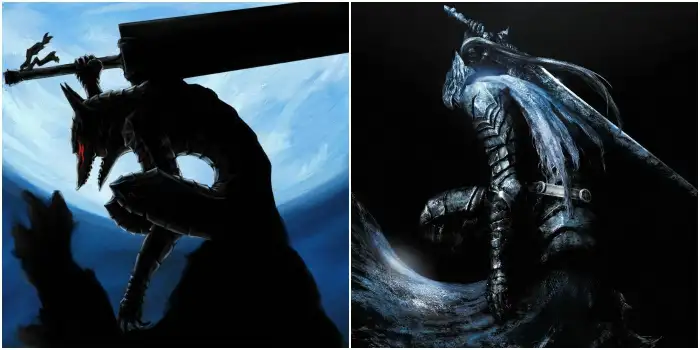
These early stories are engaging but not impressive. With the oppressive dread and suffering in the setting, it would be easy to mistake Berserk as a horror manga. Perhaps in some ways it is, only Guts is also one of the terrifying monsters prowling the world. The bleakness and negativity of the story can tread close to edgelord nihilism. About the only lightness—in the art and the tone—comes from Puck, and while the elf can be annoying, that slight change in tone is essential to keep the manga from becoming overbearing. There are hints at the inner complexity and turmoil of Guts, however, that also prevent a slide into juvenile pointlessness. Those moments indicate the thematic and stylistic richness to come in the series. For those who do not know, Berserk is an influential manga that has been cited not only as laying the groundwork for other manga and anime like Full Metal Alchemist and Attack on Titan but also influencing creators in other mediums such as the video games in the Dark Souls series, Elden Ring, Fear and Hunger, and Devil May Cry just to name a few.
Art of Grimdark Violence
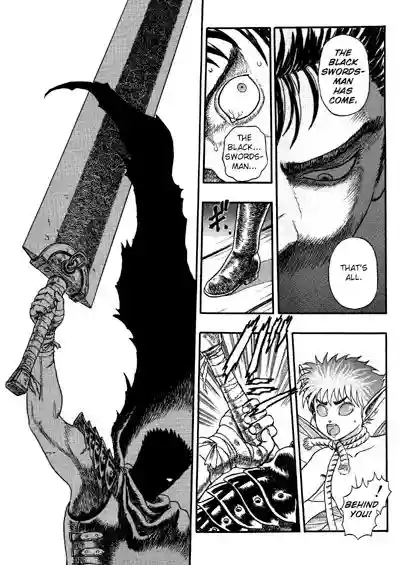
Kentaro Miura’s artwork is detailed and exaggerated. The violence is extreme, and so are its consequences, physical and mental, for everyone involved. Guts, himself, is injured repeatedly just over the course of these stories, and he begins as an amputee, clearly aware of the frailty of the human body, especially when matched against inhuman forces. The art makes the world of Berserk and everything in it feel weighty and grotesque, and Miura’s attention to detail is impressive. He knows how to give characters unique silhouettes, making them identifiable after a single viewing. Some of the art across the series is so iconic, it may be already recognizable to people who have never read Berserk.
Pulp Horror Fantasy
The basic of the episodic plots are straightforward, but there is always a sense of a larger, dangerous, and fantastical world lurking just off the edge of the pages. Berserk can, in many ways, feel like a throwback to pulp fantasy stories from Robert E. Howard, Lin Carter, and Michael Moorcock only suffused with gruesome, horror story darkness, sometimes rendered in extreme detail by Miura.
Anyone interested in seeing what all the fuss is about can pick up the first volume of Berserk. It may not be a revelation, but it also will not disappoint for anyone in the mood for a dark and violent fantasy story.
Source
Miura, Kentaro. Berserk, vol. 1. Translated by Jason DeAngelis. Dark Horse, 2003.
© 2024 Seth Tomko