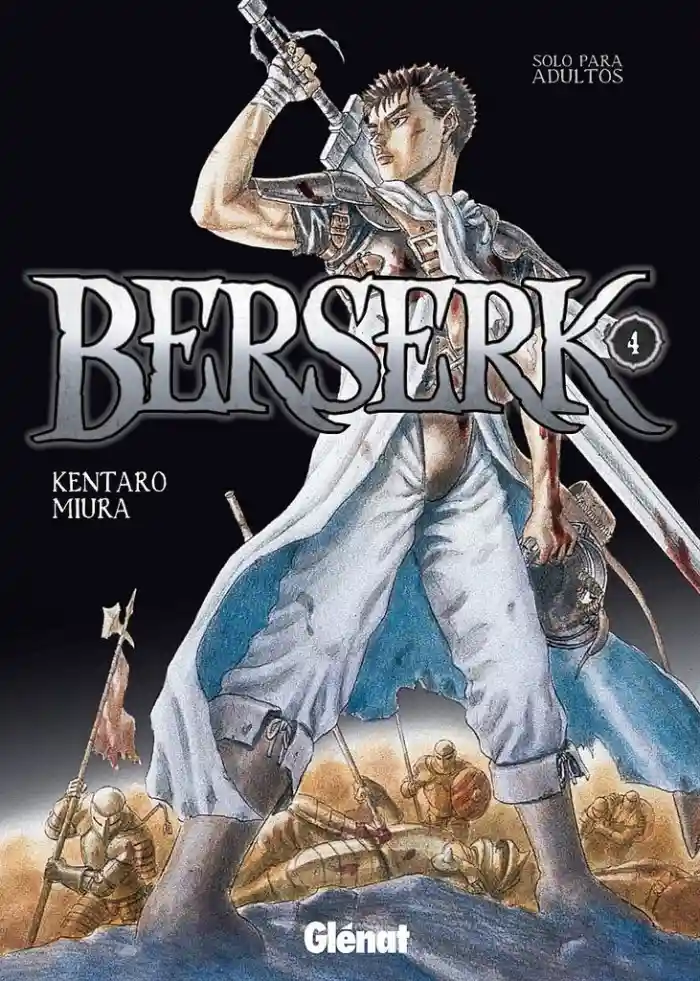
Arc of the Golden Age
The early life of Guts is explored in these chapters. Having already seen the tragic circumstances of his birth, readers now see his early life as a child soldier, raised among ruthless mercenaries and indoctrinated into an existence of warfare and nihilism. His relationship with Gambino, his adoptive father, is irrevocably broken, and Guts flees, barely surviving on his own before being taken in by a different group of roving mercenaries. Years later, Guts is living the only life he knows as a soldier of fortune, taking enormous risks, and making a name for himself as a dangerous young man. This is when he meets Griffith, the young, ambitious leader of a mercenary company. Despite an adversarial start to their relationship, Guts joins the Band of the Hawk, much to the chagrin of many of Griffith’s other followers like Casca. Nonetheless, they take on a new mercenary contract where Griffith’s plans hinge on Guts proving his swordsmanship and his commitment to the mercenary group.
Grimdarkness
Perhaps even more than the previous volumes, the early parts of the Golden Age chapters are especially grimdark in tone. Almost nothing positive happens to Guts: routinely abused physically and mentally, humiliated, forced to participate in combat, raped, chased, undervalued, and left for dead. In spite of or because of the constant suffering he endures, Guts develops an almost feral will to survive against all odd, which is strange because he is also ready to risk his life at a moment’s notice for trivial gains. This barrage of misfortune will be too heavy for some readers and can come across as sadistic. The whole sequence teeters on the precipice of juvenile nihilism, rescued only by the humanizing touches seen through Guts and how he develops, the way enduring these disasters shapes him as a person.
On a related note, apparently, in the grim darkness of the past there is only war. In earlier volumes, readers saw, at least in passing, aspects of the setting that were not fixated on what must be the perpetual state of large-scale armed conflict. There are no characters who are not part of this military-industrial complex, not even noncombatants or people otherwise victimized by all the armies and mercenary companies. This absence flattens the setting and makes it much less interesting. There does not need to be a series of chapters examining the lives of other people, but it would help to see them if for no other reason to give some context to the martially-oriented characters.
Character Drama
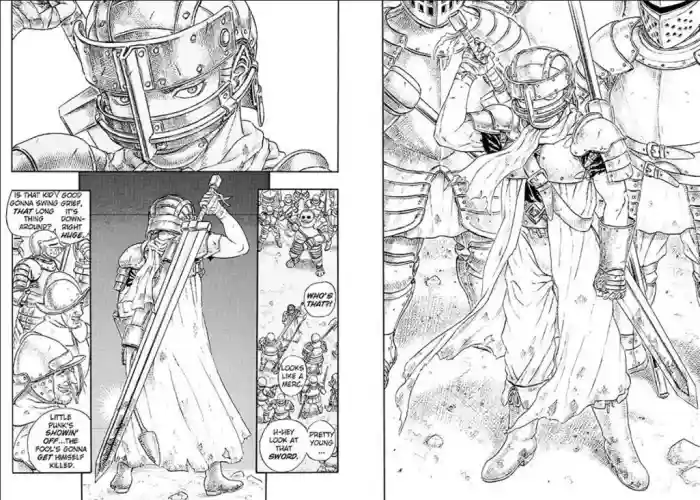
Aside from the nearly constant violence, a lot of the tension in the chapters comes from interpersonal conflict. The push and pull between Guts, Griffith, and Casca is obvious. Guts wants to be his own man, but he is obviously drawn to Griffith’s charisma and inner strength. For his part, Griffith sees the potential in Guts and wants to control him, as he wants to control everything, for his own ends. Casca is enthralled by Griffith, perhaps even more than she realizes, and does not understand what he sees in Guts. These conflicts and psychological dilemmas do add some texture to the story. Such human interactions and glimpses into the psychology of Guts take the place of the supernatural and otherworldly elements that are almost entirely absent from these chapters.
It is also interesting to see how Guts and Griffith are physical and psychological foils. Large, brooding, masculine, violent, and uncouth, Guts cuts a different figure to the pale, elegant, androgynous, and calm Griffith. Of course, so much of Guts is a reactionary mask, hiding that the abused and unloved boy he truly is. Griffith appears refined and innocent while being dangerous, manipulative, and coldblooded. Guts only wants to be master of himself while Griffith wants to be master over others. Their natures are evidenced in how they treat Casca. Guts speaks plainly with her and is fair, while Griffith, likely aware of her fixation with him, controls her and casually degrades her.
Band of the Hawk
This volume is a solid continuation of Berserk, but it is challenging for many reasons. It sets up the relationship between Guts and Griffith that readers know will grow, strain, and ultimately break. The road to that end will likely be traveled in coming chapters of the Golden Age series, but hopefully there will also be events to keep those chapters from becoming one-note.
Source
Miura, Kentaro. Berserk, vol. 4. Translated by Jason DeAngelis. Dark Horse, 2004.
© 2025 Seth Tomko