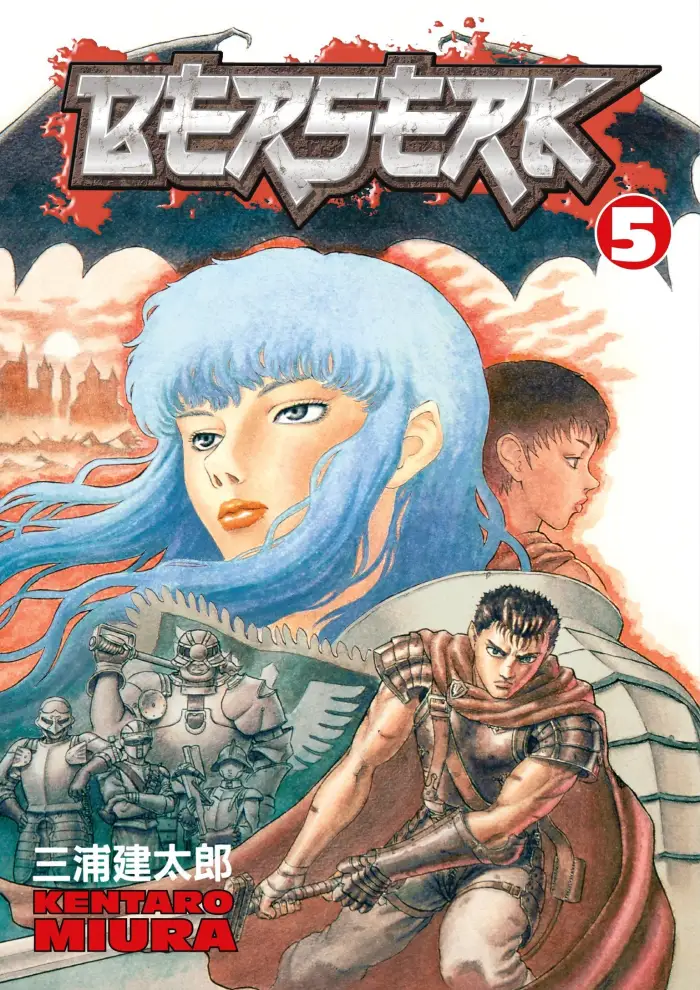
Band of the Hawk
Now an official member of Griffith’s Band of the Hawk, Guts finds himself with allies and, in a new development for him, a few people that seem to care about him as a person. Over the next few years, the mercenaries find success thanks to Griffith’s tactical thinking and the nearly matchless sword skill of Guts, but not everything is harmonious. Outside the mercenary company, many nobles and leaders are concerned that Griffith—someone of no social standing or aristocratic lineage—is gaining fame, fortune, and titles. While inside the Band of the Hawk, not everyone is pleased with how close Griffith and Guts become, especially as their leader seems to grow more distant with their greater success. All the mercenaries are put to the test, however, when they come up against Nosferatu Zodd, a legendary warrior of such skill and power it is said that he is inhuman.
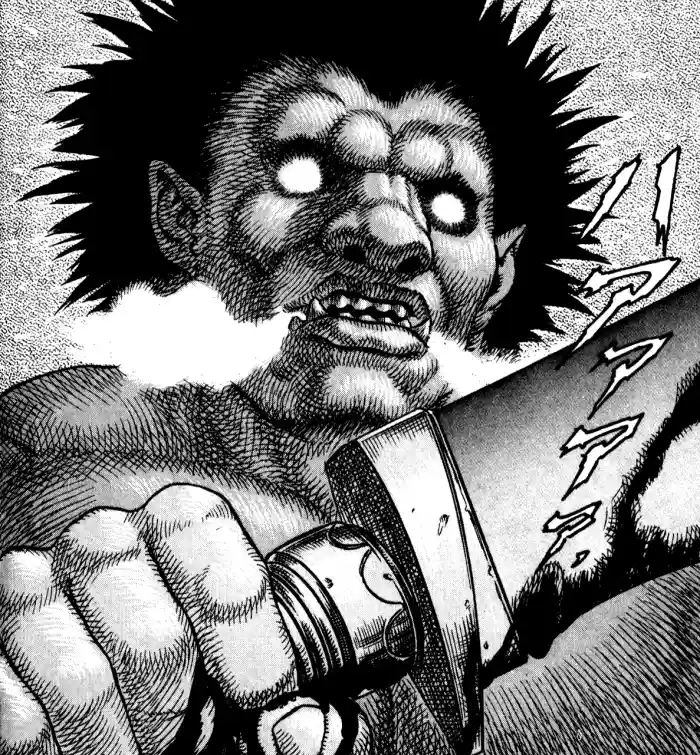
Nosferatu Zodd
The conflict with Nosferatu Zodd is the centerpiece of this volume. Readers see the first time Guts encounters a demon and his physical struggle along with a struggle to simply believe what he is seeing and experiencing. This sequence is to juxtapose with the image of the man readers know he will become—a jaded, relentless, mutilated slayer of monsters—just as readers also know Griffith will become a literal monster. The inclusion of this duel with a demon is also part of Kentaro Miura increasing the number of supernatural elements like omens, prophetic warnings, and the Behelit. In particular, the Behelit—the Egg of the King—readers know is a source of chaos and malice, and in Griffith’s hands the audience can see the outlines of how it is entwined with his ambition and child-like sense of anything being possible.
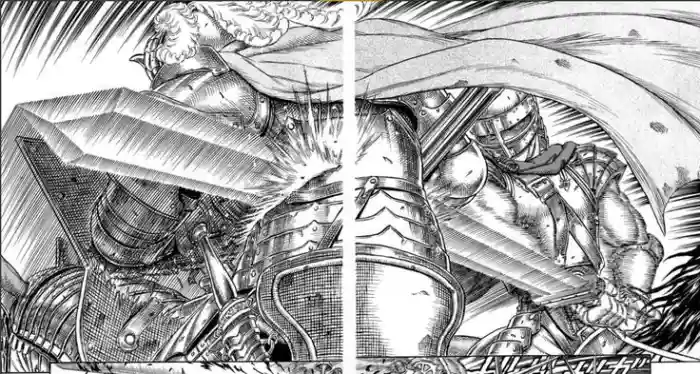
A Wind of Swords
Paired with the supernatural elements are the various human aspects of the story. There is friction between some of the Hawks and Guts becoming a part of the crew, and there is friction Guts feels in himself and whether he’s capable of opening himself up to having honest, trusting relationships with other people. Part of the setting not previously explored that starts to intrude in the story is that of the political leadership. The rumormongering, jockeying, and back-stabbing among the nobility is not something that featured into the lives of the characters. With Griffith’s rise in status, however, and his ambitions of kingly lordship that he confides in Guts, it only makes sense that such a thing comes into play now as characters move into the orbit of people with greater authority. This is especially the case as Griffith’s charisma is openly discussed along with his sense of determination, a trait he shares with Guts.
I’ll be your foil. -Hamlet 5.1
The audience also sees the continuing situation of Griffith and Guts as foils. Griffith’s life is aimed at one goal, and everything he does is part of his plan to reach it. His sense of purpose and destiny is an obvious contrast to the aimlessness of Guts. Most of the time, Griffith delegates and commands others because that is his understanding of leadership, whereas Guts puts himself in danger rather than having someone else do it. Griffith knows how to play “the game of thrones” so to speak, while Guts is blunt, uncouth, and has no regard for social status or sophisticated manners. Caught in between these two men is Casca. Her adoration of Griffith and disdain for Guts takes on a new, more personal understanding as the audience also sees the overt, homoerotic tension between Griffith and Guts. In truth, Casca is envious of the favoritism and affection Griffith shows Guts, aching for it herself but possibly also aware that Griffith is desirous of Guts on multiple levels.
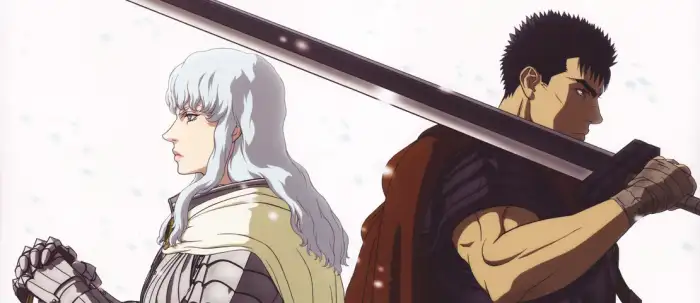
One Woe Doth Tread upon Another’s Heel
These chapters of Berserk serve as a transition point as the principle characters move into a new phase of their mercenary careers, accompanied by the uptick in the presence of the supernatural. The action remains generally well done, but is clearer in the smaller-scale fights and duels than it is in the larger battle scenes. The manga remains a dark but compelling fantasy story that is tinged with doom as readers know these characters are on a trajectory toward an as yet known tragedy.
Source
Miura, Kentaro. Berserk, vol. 5. Translated by Duane Johnson. Dark Horse, 2004.
Shakespeare, William. Hamlet. Riverside, 1998.
© 2025 Seth Tomko