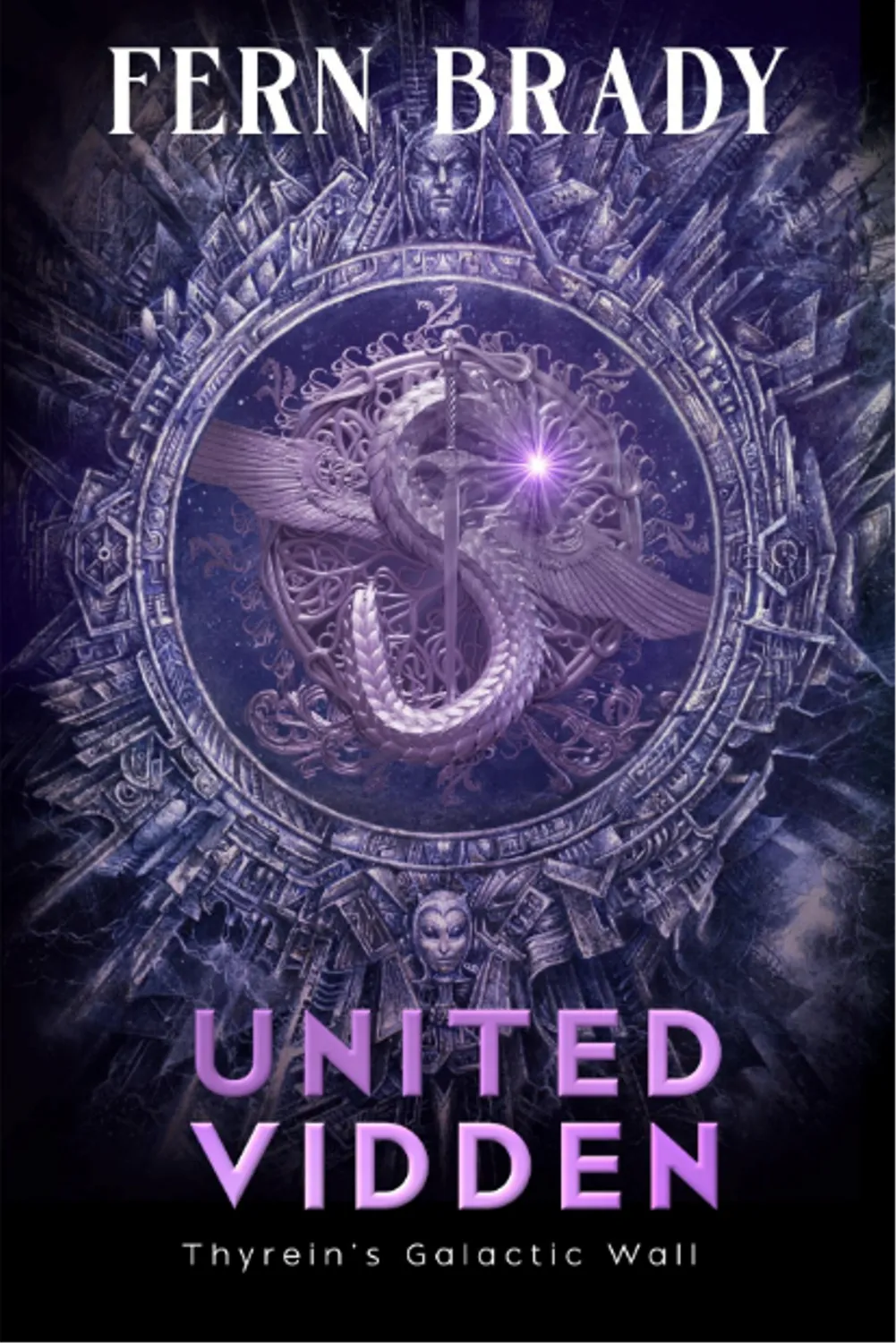
Aviso: I received an advanced reader copy of United Vidden from Ellysian Press.
Planets of the Galactic Wall
On her 21st birthday, Verena is set to inherit the throne Dravida only to have her position undercut by her father, the King Dekkyle, who effectively sidelines her and forces a betrothal to Amiel, the Prince of Aulden, a rival nation. The king’s plan is for a united world against the Gortive, an enemy people destabilizing their planet. Since he explains none of this to his daughter, Verena chooses to escape from an intolerable situation by fleeing to Earth and hiding as a human. Once she leans Amiel used the occasion of her disappearance as a pretext to invade and conquer her people, Verena returns home, finding herself trapped into a marriage to save her kingdom all while various factions and conspirators take advantage of the situation for their own ends. Increasing isolated, Verena maintains what contacts she can as she attempts to bring about a better future for her people and possibly a united Vidden.
Space Opera and Scandal
This novel is a start of a series, and many of the major plot threads are unresolved as the book is not a self-contained story. The novel is carried by its characters, their goals and motivations. The principle leads are Verena and Amiel. In many ways this book is a tragedy for Verena. Some of her early actions might come across as petulant, but they are fitting with what readers see of her character. She spends the first quarter of the book trying to escape from an arranged marriage, feeling betrayed because she totally is. Her rights and authority are stolen from her and given away by her father, the man she trusted the most. She spends the remaineder of the book being deceived, exploited, and undermined, and her eventual “love” of Amiel is the product of prolonged abuse, coming across just like Winston’s love of Big Brother in George Orwell’s 1984.
Although Amiel is presented as the male lead of the novel, he is the villain. His violent outbursts are allegedly part of his personality, but he is also gullible, paranoid, needy, and controlling, with a sense of entitlement that starts out grating and only increases as the story continues. He has also engaged in slavery and genocide, which makes accepting him as a protagonist and potential love interest a difficult proposition, to say the least. He is also abusive and a rapist. The insistence by other characters that he is important and necessary to the creation of a stable country and can somehow be redeemed is an absurd fabrication and an injustice to his many victims, including Verena.
Do you think the occult space fascist might be a bad guy?
The Extended Cast
The expansive supporting cast of characters provides a lot to expanding the scope of the novel. Dekkyle is a bad king and a worse father. His poor reasoning, poor choices and inability to delegate make him a walking advertisement for the perils and inherent flaws of absolute monarchy. A few lines of sensible dialogue from him could clean up most of the problems in the first half of the book, yet the story refuses to provide this. His inattention extends so far that he seems to have missed the last 21 years where his daughter was prepared daily to take on a role of absolute authority, not to mention generations of precedent among his own people. Godar is a narcissistic manipulator, but he is so obviously evil that he might as well be cackling manically as he enacts his plans. Of course, this does not say much for the observational powers of everyone he tricks. Andross doesn’t show up until the second half, but his quest through the “united” Vidden is interesting in that it gives a sense of adventure and a man-on-the-street view of how the events of the plot are affecting ordinary people. Eldor and Arwace seem like they’ll be important, but they drop out of the narrative for large stretches at a time when it seems like they should be the most active. Most likely, they are being held back for later books in the series.
Bring on Those Concepts
It is consistently surprising what Brady chooses to put in focus. For instance, Verena’s time and life on Earth could be a whole novel, but it is handled in two pages. In a similar manner, the quest of Andross is like an unexpected Arthurian-influenced novella within the larger framework of the book. Even readers familiar with conventions of the various genres at play won’t be able to guess where the story is going nor how it will get there. Everything moves quickly, which is welcome. Some readers may find the pace breathless, but that is generally preferable to moving too slow or bogging down the story with exposition.
Intergalactic Alliance Council
At its heart, the book is similar to Dune or even A Game of Thrones in space. It contains plenty of political machinations along with science-fantasy elements, giving everything an exaggerated, operatic atmosphere, which is almost certainly the intended outcome. Given the historic and current popularity of books with similar elements and genres, there is almost certainly an audience for United Vidden.
Source
Brady, Fern. United Vidden. Ellysian Press, 2026.