Picture two students, same age, same city, graduating in the same year. One spent their school years building AI projects, earning globally recognised certifications, and getting mentored by people who have worked at Google and OpenAI. The other went through a standard curriculum — decent grades, decent prospects, no particular edge.
Five years later, which one do you think is fielding job offers?
The conversation around AI for schools in India has been growing louder, but most of it stays at the policy level — NEP mandates, government initiatives, think-tank reports. What gets far less attention is the very personal, very practical question that every parent should be sitting with right now: What happens to my child if they reach adulthood without these skills?
The Job Market Your Child Will Actually Enter
Here's a number worth holding onto: the World Economic Forum estimates that a significant portion of today's primary school students will work in job types that don't yet exist. That sounds abstract until you consider how quickly it has already happened. Jobs built around data science, machine learning engineering, and AI product management barely existed as formal career tracks fifteen years ago. Today they are among the most sought-after and highest-compensated roles globally.
The trajectory isn't slowing down. If anything, it's accelerating. AI is no longer a specialised domain that belongs only to people with computer science PhDs. It is becoming embedded in healthcare, agriculture, law, architecture, finance, media, logistics — essentially every field your child might eventually enter. The question isn't whether they'll encounter AI in their careers. They will. The question is whether they'll be the person in the room who understands it, shapes it, and leads with it — or the one who feels vaguely anxious about it and hopes someone else handles it.
Why Starting Early Actually Matters
There's a temptation to think: They're only in Class 7. There's time. And while that instinct comes from a good place, it misunderstands how compound learning works.
A child who begins exploring AI concepts at 10 or 11 — through age-appropriate projects, foundational digital literacy, and guided experimentation — is not just getting a head start on content. They're building a relationshipwith this technology. Familiarity that accumulates over years. Confidence that deepens with each project. An intuition for how AI systems behave that no crash course at age 22 can fully replicate.
Think about language learning. A child who grows up bilingual doesn't just know two languages — they think differently, code-switch effortlessly, and carry an ease with the second language that adult learners spend decades chasing. Early AI education works on a similar principle. The students who start building projects in middle school aren't just ahead on technical skills. They've made AI a natural part of how they think about problems.
By the time they're applying to universities or interviewing for internships, that accumulated familiarity is visible. In how they talk about what they've built. In the portfolio they can actually show someone. In the confidence with which they engage technical conversations. These things are hard to fake and impossible to compress into a last-minute preparation sprint.
Also Read: Artificial Intelligence in Education
The Portfolio Problem Nobody Is Talking About
University admissions and early hiring have quietly undergone a shift. Grades still matter. Board exam scores still count. But increasingly, the differentiator — especially for competitive programs and forward-thinking employers — is evidence of doing.
What has this applicant actually built? What problems have they tried to solve? Is there anything in their background that suggests they can take initiative, work with complex tools, and produce something tangible?
For most students, the honest answer to these questions is: not much. They've attended class, completed assignments, and perhaps participated in a few extracurriculars. The academic transcript tells evaluators what subjects they studied, not what they can do.
Students who have spent years on genuine AI projects — who have trained models, built classifiers, exhibited their work at project fairs, and earned certifications backed by names the admissions committee recognises — have something genuinely different to present. A portfolio that signals capability, not just effort.
This is especially significant for students eyeing programs in the US, UK, and other international destinations where holistic evaluation has been the norm for longer. But even within India, the pressure on admissions to IITs, NITs, and top private universities is pushing evaluation criteria toward demonstrated skill and aptitude, not just marks.
The Certification Advantage — And Why It Travels
Not all certifications are created equal. The kind of global AI certifications that actually shift the needle are ones linked to institutions and individuals that the global tech industry takes seriously — Google for Educators collaborations, connections to OpenAI, mentors who have actually built products at Apple, Meta, and Scale AI.
When a student from Madhya Pradesh holds a certification with that kind of pedigree, a few things happen. First, it signals that they've done something rigorous — not a cosmetic course, but structured learning that meets international standards. Second, it provides credibility in an environment where a student's school name or hometown might otherwise create unconscious bias. A certification doesn't care where you grew up. It attests to what you can do.
Programs like AI for Schools, which operates across 250+ partner schools and is led in collaboration with mentors from Google AI, OpenAI, Meta, Apple, and Scale AI, are structured precisely around this logic. The goal isn't to give students a line on their CV. It's to ensure the learning that sits behind that line is real, verifiable, and transferable to whatever they choose to do next.
What "Hands-On" Looks Like vs. What Schools Usually Do
The phrase "hands-on learning" gets deployed so often it has almost lost its meaning. Every brochure says it. Not every program delivers it.
Genuine hands-on AI education looks like this: a student in Class 10 receives a problem — perhaps something mundane, like detecting whether crops in an image show signs of disease, or categorising customer feedback by sentiment. They work through it. They try approaches that don't work. They get feedback from a mentor who knows what they're talking about. They iterate. Eventually, they produce something functional, something demonstrable, something they can explain to a room full of people at a project exhibition.
That process — wrestling with a real problem, failing, adjusting, producing — is what builds the kind of deep understanding that stays. It also builds the kind of story that makes for compelling university essays and job interviews: I built this thing, it didn't work the first time, here's what I changed and why.
Compare that to the alternative most schools are still running: a textbook chapter on artificial intelligence, some MCQs at the end, and a test score that disappears into the academic transcript never to be seen again. One of these prepares students for actual careers. The other ticks a box.
The Mentor Gap and Why It's Bigger Than You Think
Here's something parents in smaller cities and towns often don't fully account for: access to mentorship is deeply unequal in India, and it compounds over time.
A student in Bengaluru or Mumbai who's interested in AI has informal access to a web of engineers, startup founders, and tech professionals — through relatives, through their school's alumni network, through chance encounters at events. They absorb vocabulary, get pointed toward resources, and receive casual guidance that they probably don't even consciously register as mentorship.
A student in a Tier 2 or Tier 3 city typically has none of this. They might be equally curious, equally capable — but they're operating in an information vacuum about what a career in AI actually looks like, what skills it requires, and how to start building toward it.
Structured programs that bring Silicon Valley-level mentorship directly into the school environment — to students in Bhopal, Indore, Nagpur, and beyond — are doing something more than teaching AI. They're levelling a playing field that has historically been very steeply tilted. A 13-year-old in a government school in Madhya Pradesh who receives genuine guidance from someone who has worked on AI systems at the world's leading tech companies is getting access that most metro students don't get either.
That's not a small thing. That's potentially life-changing.
A Progression That Actually Makes Sense
One of the more thoughtful aspects of well-designed AI education programs is the idea that learning should build — not be a single isolated course.
Starting with digital literacy and foundational technology concepts at Class 3 and 4. Moving into AI awareness and computational thinking by Class 5 and 6. Understanding machine learning concepts by Class 7 and 8. Applying AI to real-world problems in Classes 9 and 10. And reaching genuine specialisation — with portfolio projects and career pathway planning — by Classes 11 and 12.
This kind of scaffolded progression mirrors how expertise actually develops. You don't understand gradient descent before you understand what a function is. You don't build a meaningful ML project before you understand why pattern recognition matters. The sequence matters enormously, and programs that respect that sequence produce students who genuinely understand what they're doing — not students who have memorised syntax without comprehension.
The Conversation Worth Having at Home
If you're a parent reading this, the most useful thing you can take away isn't a list of programs to research (though that's worth doing). It's a shift in how you think about your child's education.
The question is no longer just: Are they doing well in their subjects? It's: Are they being prepared for the world those subjects will lead them into?
That world will be shaped by AI in ways none of us can fully anticipate. The children who enter it with genuine capability — who know how these systems work, who have built things, who have certifications and portfolios and the quiet confidence of people who have actually done something — will have an advantage that no amount of last-minute preparation can replicate.
Starting early isn't about pressure. It's about compound interest — of skills, of confidence, of opportunity. The earlier you begin, the more interest you earn.
The Window Is Open, But It Won't Stay That Way
Five years ago, a school that introduced AI learning was ahead of the curve. Three years from now, it will be expected. The schools and students who move now get to shape the curve. The rest get to catch up.
The same logic applies at the individual level. A child who starts building AI skills today — genuinely, through projects and mentorship and real learning pathways — enters each subsequent grade with more than their peers. That advantage doesn't disappear. It accumulates.
The broader conversation around AI for schools in India tends to focus on what institutions should do. But the more urgent question might be what youcan do — as a parent, today — to make sure your child is among the ones who are ready.
That decision doesn't have to wait for a policy. It doesn't have to wait for your school to figure it out. It just has to start.
Useful Links:
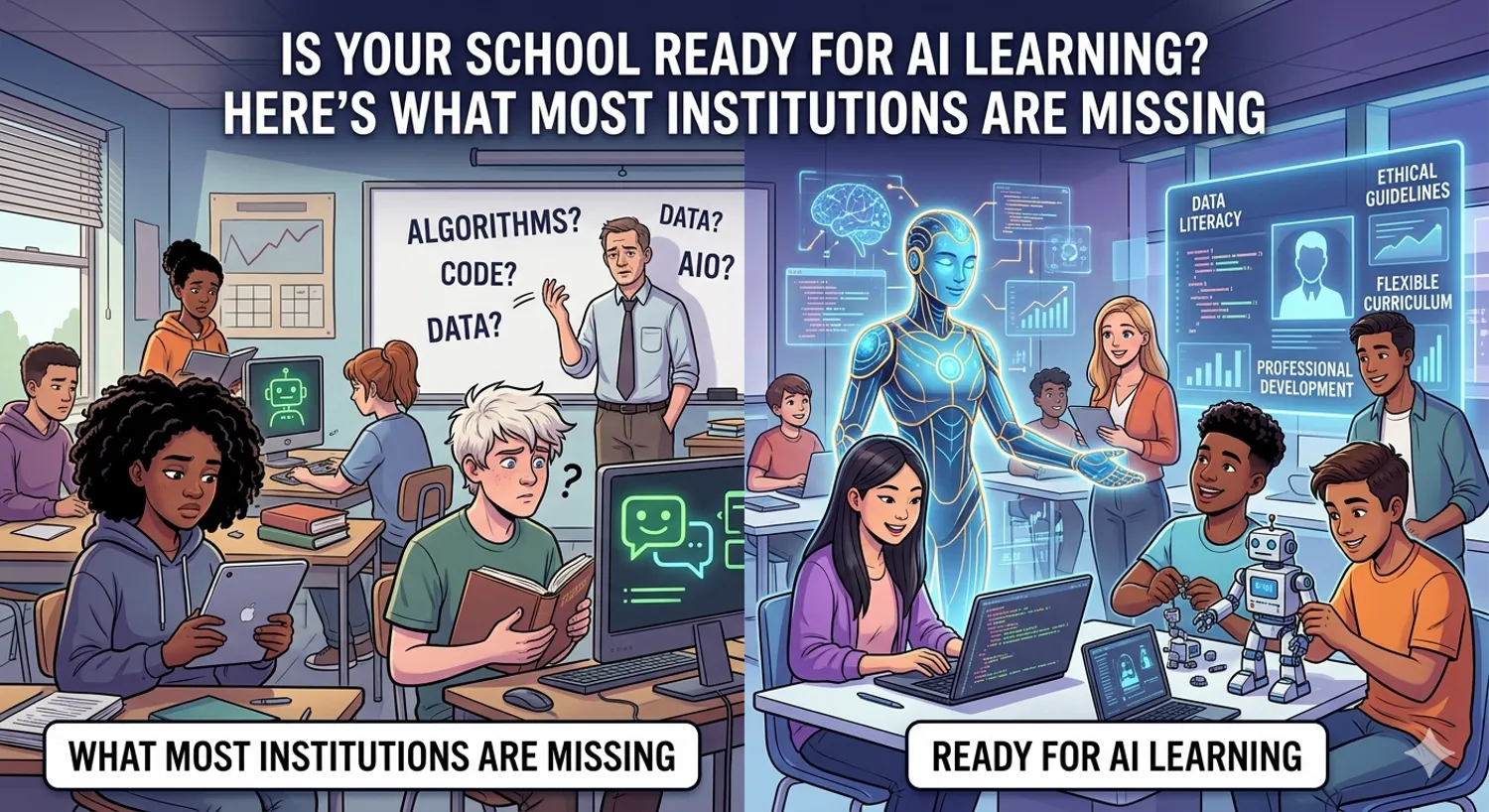
Is Your School Ready for AI Learning? Here's What Most Institutions Are Missing
What Does a Class 6 Student Need to Know About Artificial Intelligence?
Why NEP 2020 Makes AI Literacy a Must for Every Indian Student