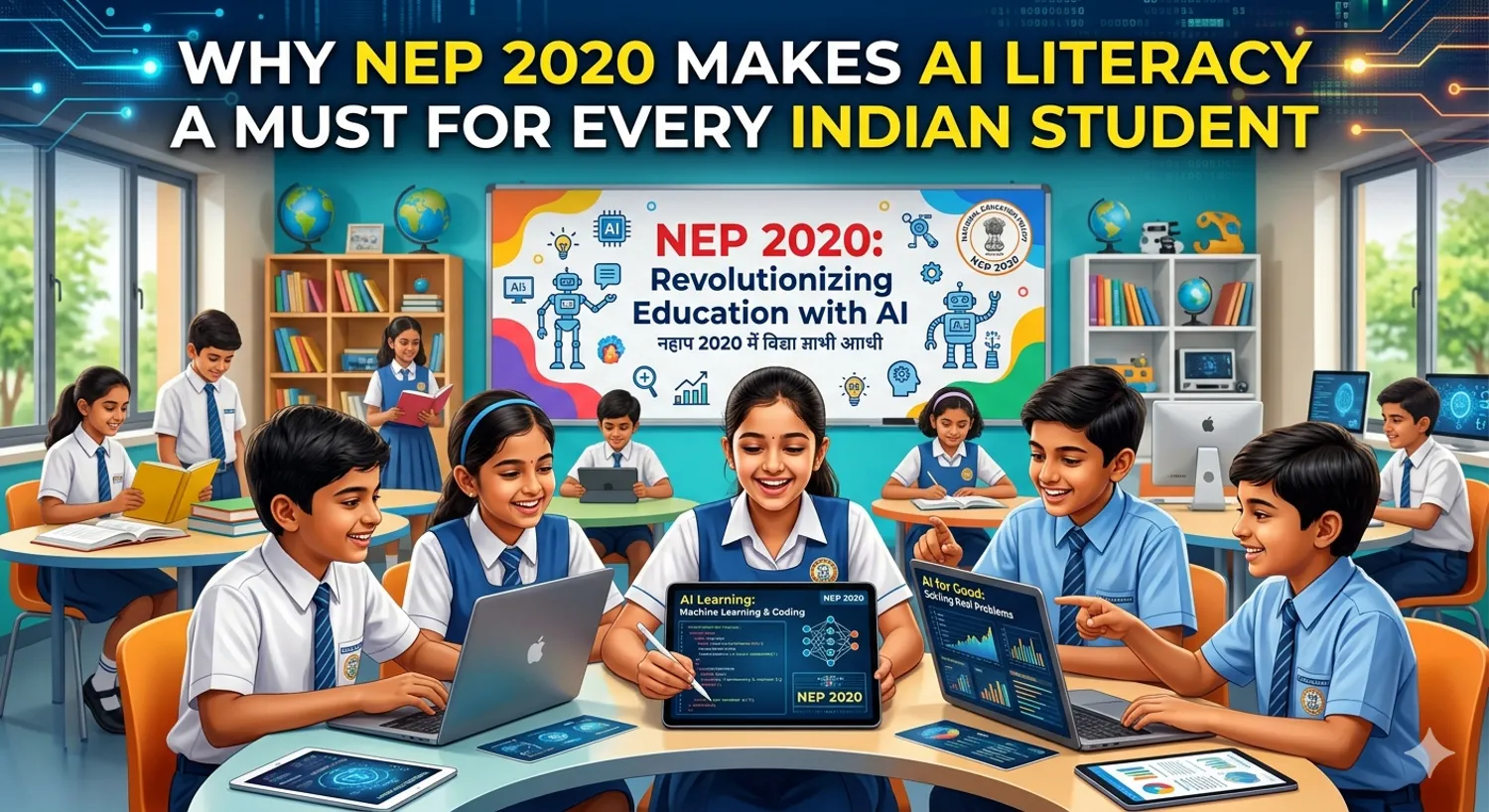
India's education system just got its biggest makeover in decades. The National Education Policy 2020 didn't just tweak a few syllabi — it fundamentally rethought what learning should look like in a country that's racing toward becoming a global technology powerhouse. And right at the heart of that vision? Artificial Intelligence.
But here's the thing — talking about AI in education is easy. Actually making it accessible to every student, whether they're in a well-funded private school in Mumbai or a government school in rural Madhya Pradesh, is where the real challenge begins. That's exactly the gap that AI for schools initiatives are now stepping up to fill.
What NEP 2020 Actually Says About Technology
Most people know NEP 2020 for scrapping the rigid 10+2 structure or pushing for mother-tongue instruction in early grades. Fewer people talk about its strong stance on technology and future-readiness.
The policy explicitly calls for integrating AI, coding, and computational thinking into school curricula — not as electives or after-school clubs, but as core components of how students learn and engage with the world. It emphasizes skill-based education over rote memorization, and it recognizes that the jobs India's students will walk into don't look anything like the jobs their parents held.
That's a significant shift. For generations, Indian schooling was built around textbooks, board exams, and the pressure to score. NEP 2020 is asking something different — it wants students who can think, create, and adapt. And in 2025, that means understanding AI.
Why AI Literacy Isn't Optional Anymore
Let's be honest about where the world is headed. The World Economic Forum has consistently flagged AI literacy as one of the most critical skills for future employment. Industries from healthcare to agriculture, from finance to entertainment, are being reshaped by machine learning, automation, and data intelligence.
A student who graduates without any exposure to these concepts isn't just behind — they're starting a race without knowing the track exists.
This isn't fear-mongering. It's arithmetic. India produces millions of graduates every year, and the competition for meaningful, well-paying work is fierce. The students who will stand out are those who don't just consume technology but understand how it works and, better yet, know how to build with it.
That's the real promise of AI education companies that are working at the school level — they're not trying to turn every 14-year-old into a data scientist. They're giving students a foundational fluency, the kind that makes them comfortable, curious, and capable when they inevitably encounter AI in every corner of their professional lives.
The Problem NEP 2020 Highlights But Can't Solve Alone
Here's where policy meets reality. NEP 2020 sets the vision, but it doesn't automatically put trained teachers, updated curricula, or hands-on tools in every classroom. That infrastructure gap is enormous — and it hits hardest in Tier 2 and Tier 3 cities, where quality STEM education has always been harder to access.
A student in Indore or Bhopal shouldn't have a lesser shot at understanding neural networks than a student in Bengaluru or Delhi. Geography shouldn't determine intellectual opportunity. But without deliberate, ground-level intervention, that's exactly what happens.
This is the conversation that doesn't get enough airtime in the broader NEP 2020 discussion — implementation. Who's actually going to walk into classrooms and make this happen?
Where AI for Schools Fits In
Organizations building AI for schools programs have recognized something important: waiting for the system to catch up is not a strategy. The students sitting in classrooms today will be entering the workforce in five to ten years. That timeline doesn't allow for slow bureaucratic rollouts.
What effective AI education at the school level looks like, in practice, goes beyond showing students a few YouTube videos about robots. It means age-appropriate curricula — starting with digital literacy in Class 3 and gradually building toward machine learning concepts, real-world AI applications, and portfolio-worthy projects by Class 10 and beyond.
It means project-based learning, where a student in Class 9 isn't just reading about AI in agriculture — they're building a simple model that demonstrates the concept. It means certifications that carry weight beyond the classroom, connections to global mentors who work at companies actually shaping the AI landscape, and a learning experience that makes a student feel like a creator, not just a consumer.
That last part matters more than people realize. When a teenager builds something — even something small — using AI tools, their entire relationship with technology changes. The intimidation dissolves. The curiosity takes over.
NEP 2020 and the Equity Argument
One of the most compelling aspects of NEP 2020 is its emphasis on equity — ensuring that quality education isn't the exclusive privilege of students whose parents can afford premium coaching or international curricula.
AI literacy, if delivered only through expensive private programs, will simply become another marker of inequality. The students who get it will race ahead; those who don't will fall further behind in a job market that increasingly rewards technological fluency.
This is why the work being done by AI education companies at the school level — particularly those focusing on government schools and underserved regions — is so aligned with the spirit of NEP 2020. It's not charity. It's correction. It's acknowledging that talent is uniformly distributed but opportunity isn't, and then actually doing something about it.
What Indian Parents and Educators Should Take Away
If you're a parent, the takeaway is simple: AI literacy is no longer a bonus skill. It's baseline preparation for the world your child is going to inherit. The question isn't whether your child will encounter AI in their career — they will, regardless of what field they choose. The question is whether they'll be equipped to work with it confidently or feel left behind by it.
If you're an educator or school administrator, NEP 2020 has already given you the mandate. The policy framework is there. What's needed now is the right partner to help translate that framework into something students can actually experience, engage with, and walk away from feeling genuinely prepared.
The Bigger Picture
India has a rare opportunity right now. With one of the youngest populations in the world and a government policy that's actively pushing for AI integration in education, the conditions for building a genuinely AI-literate generation are better than they've ever been.
But opportunities have expiry dates. The students who are in Class 6 today will be in the workforce by the mid-2030s. If AI for schools programs reach them now — building curiosity, competence, and confidence — India won't just be producing AI users. It'll be producing AI builders. And that distinction, at scale, could define the country's position in the global economy for decades to come.
NEP 2020 pointed to the door. Now it's time to walk through it.