Selecting the correct Yaskawa variable frequency drive requires more than matching horsepower ratings. The most important factor is ensuring that the drive’s output current matches the motor’s full load amps while accounting for operating conditions such as altitude, duty cycle, enclosure type, and application load characteristics.
Choosing an incorrectly sized VFD can lead to nuisance trips, overheating, reduced service life, or unnecessary equipment costs. A drive that is too small may fail under normal operating conditions, while an oversized model may add expense without providing any practical benefit.
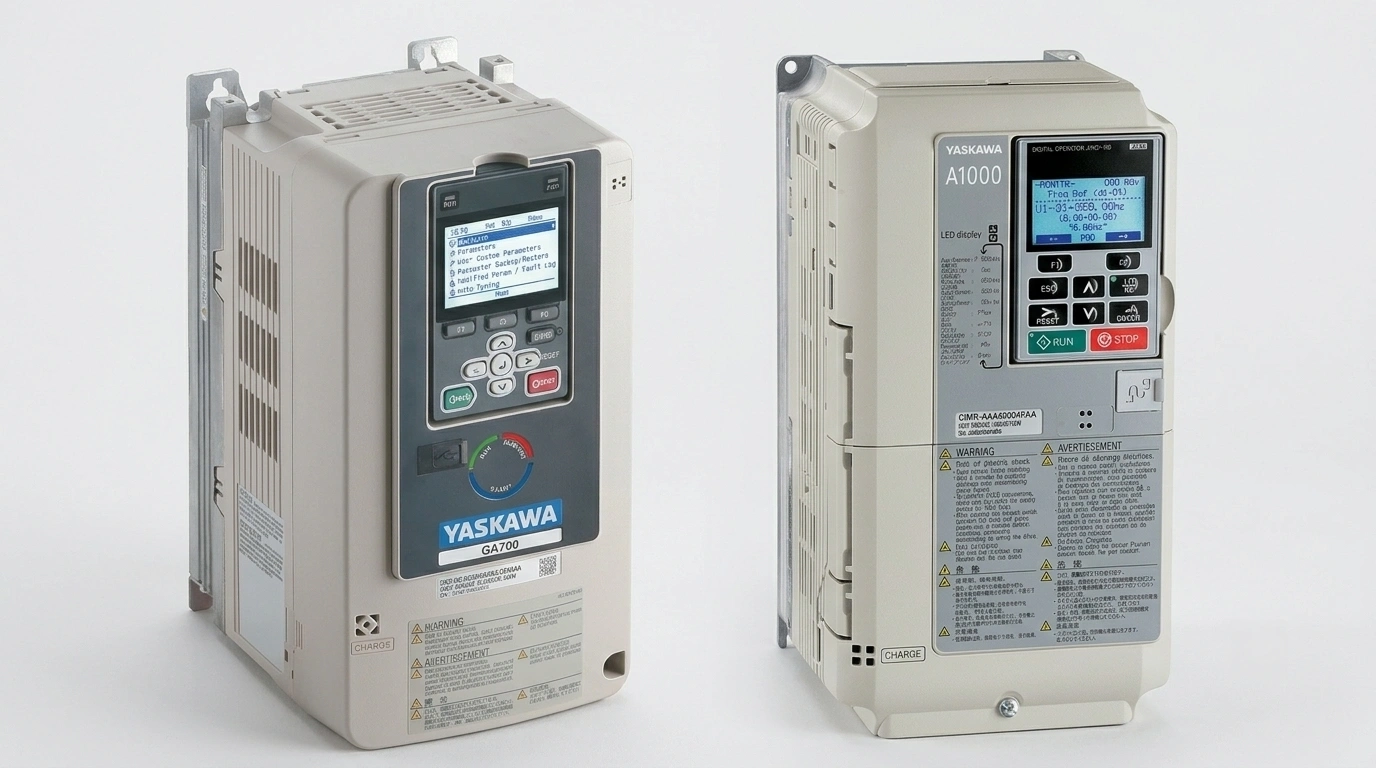
The Yaskawa GA700 and A1000 series are widely used across industrial facilities, especially in applications involving pumps, fans, conveyors, HVAC systems, and manufacturing equipment. Understanding the differences between these platforms and knowing how to properly configure them helps maintenance teams avoid costly replacement mistakes.
Understanding the Difference Between Yaskawa GA700 and A1000 Drives
The GA700 and A1000 represent two generations of Yaskawa industrial variable frequency drives. Both platforms are designed for reliable motor control and support a wide range of industrial applications, but they serve slightly different needs.
The GA700 is Yaskawa’s newer general-purpose vector drive, while the A1000 remains a proven solution that continues to operate in thousands of installations worldwide.
Both drives support advanced motor control, flexible configuration options, and similar parameter organization. This makes transitioning between the two easier than switching between completely different drive platforms.
However, replacing an A1000 with a GA700 is not always necessary. In many cases, maintaining the existing A1000 platform may be the most practical solution, especially when a facility already has trained technicians, existing programming, spare parts, and established maintenance procedures.