Oracle stands as a leading force in the enterprise database world, trusted globally for its unmatched performance, dependability, and security features. Powering critical operations in sectors ranging from banking to government, Oracle databases are designed for scalability and precision. But working with Oracle at a professional level demands more than just surface-level familiarity. It involves understanding its architecture, utilizing its tools effectively, and following best practices suited for both developers and database administrators (DBAs). This blog walks you through the key methods and insights needed to sharpen your Oracle skills and manage it like a pro.
Decoding Oracle’s Core Infrastructure
To work effectively with Oracle, one must begin with a solid understanding of how it functions internally. Oracle's architecture follows a client-server model that involves an instance (which includes memory structures such as the SGA and multiple background processes) and a database (which houses datafiles, control files, and redo logs). The System Global Area (SGA) serves as a shared memory space that stores critical runtime data, while background processes like LGWR, DBWR, and SMON carry out logging, data writing, and system recovery tasks. This fundamental framework is essential for both roles. DBAs depend on it to maintain optimal performance, storage efficiency, and stability. Developers benefit from this knowledge by writing code that aligns better with how Oracle handles data transactions, minimizing system strain and enhancing efficiency. The Oracle Certification Course provides essential skills and knowledge to master Oracle databases and advance your career in administration and development.

Practical Oracle Coding Tips for Developers
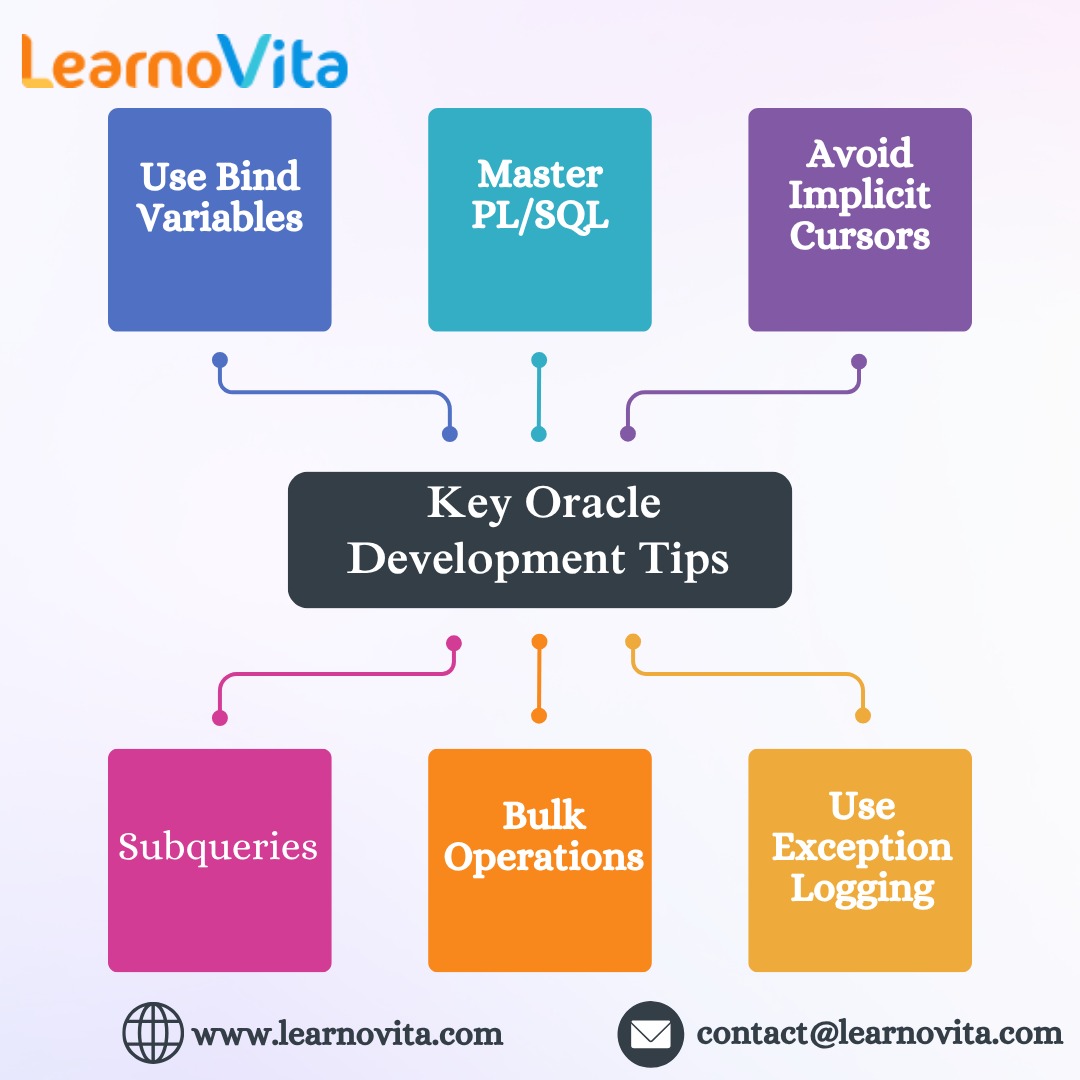
When developing in an Oracle environment, applying optimized coding techniques can drastically improve performance and application reliability. Below are several developer-centric practices to adopt:
- Use Bind Variables Thoughtfully: Replace hard-coded literals with bind variables to reduce parsing overhead and boost SQL reuse.
- Get Comfortable with PL/SQL: Utilize PL/SQL for building robust stored procedures and packages. Make full use of exception handling, cursors, and modular logic.
- Control with Explicit Cursors: While implicit cursors work for simple tasks, explicit ones offer more precision and are better for managing complex result sets.
- Design Efficient SQL Queries: Opt for the most appropriate join types and filter conditions. Avoid unnecessary nested subqueries that can slow down performance.
- Apply Bulk Operations: Use techniques like BULK COLLECT and FORALL to handle large data loads efficiently within PL/SQL blocks.
- Implement Centralized Logging: Build logging procedures that help capture error messages and transactional history for easier debugging and traceability.
These practices not only promote better performance but also lead to cleaner, more maintainable codebases.
Leveraging Indexes and Partitions for Scalable Performance
As Oracle databases grow in size and complexity, efficient data access becomes a top priority. Indexing is one of the most effective ways to boost query performance but only when applied strategically. Oracle offers several types of indexes: B-tree, bitmap, and function-based indexes. Over-indexing, however, can lead to slower writes and higher storage costs, so indexes should be created based on actual query needs and usage patterns. Bitmap indexes are especially suitable for low-cardinality columns in analytic workloads, while B-tree indexes perform well in high-transaction systems. Tools like EXPLAIN PLAN and AUTOTRACE help assess index effectiveness during development and troubleshooting. Partitioning, on the other hand, breaks large tables into manageable segments. Whether done by range, list, or hash, partitioning allows the database to process only relevant sections of data, leading to faster query execution, simpler maintenance routines, and more efficient data management overall.
Must-Follow Guidelines for Oracle DBAs
Oracle database administrators play a vital role in ensuring systems remain stable, secure, and high-performing. Here are essential strategies every DBA should apply:
- Use Roles to Manage Permissions: Granting roles instead of direct privileges makes access control cleaner and more scalable.
- Rely on RMAN for Backup & Recovery: Automate and schedule backup routines using Oracle’s Recovery Manager (RMAN) to reduce manual errors.
- Transfer Data with Oracle Data Pump: Use expdp and impdp to perform fast, reliable data exports and imports.
- Automate Tasks with Oracle Scheduler: Replace OS-based schedulers with Oracle’s built-in Scheduler to manage jobs with better tracking and flexibility.
- Enable Auditing Features: Keep tabs on who is accessing what with Oracle’s auditing tools, ensuring compliance and security visibility.
- Monitor Regularly Using AWR & ADDM: Review workload patterns using Automatic Workload Repository (AWR) and diagnostics from ADDM for proactive performance tuning.
- Keep Statistics Current: Update optimizer statistics frequently using DBMS_STATS to ensure the best query execution paths are chosen.
These practices help DBAs create resilient, responsive Oracle environments that can support demanding enterprise applications. Our Best Training & Placement Program ensures hands-on learning and career support, guiding you from skill-building to securing your dream job.
Prioritizing Security at All Layers
Oracle is packed with advanced security features but their effectiveness depends on proper setup and ongoing vigilance. DBAs must implement access controls, configure listener security, and enforce strict authentication policies. Techniques like Transparent Data Encryption (TDE), Data Redaction, and Virtual Private Database (VPD) ensure that data is protected at rest and in use. Developers must also contribute to security by validating input data, avoiding unsafe SQL construction, and adhering to secure coding principles. When both sides work together, organizations can achieve strong security postures that satisfy regulatory requirements and internal governance policies.
Optimizing Performance Through Monitoring and Tuning
Proactive performance management is key to keeping Oracle systems responsive. Developers should always examine execution plans, use the EXPLAIN PLAN utility, and rewrite inefficient queries. DBAs, meanwhile, need to monitor system trends and bottlenecks using Oracle’s diagnostic tools. Solutions like SQL Tuning Advisor, SQL Access Advisor, and Active Session History (ASH) provide deep insight into query behaviors and system workload. When paired with consistent tuning of memory allocation, I/O throughput, and indexing strategy, these tools ensure the system remains optimized—even under heavy usage.
Lifelong Learning and Cross-Functional Collaboration
As Oracle evolves with each new release introducing features like native JSON support, blockchain-secure tables, and AI-powered automation professionals must stay updated. Continuous learning through Oracle certification paths, forums, and webinars helps keep skills sharp and competitive. Moreover, seamless collaboration between DBAs and developers is critical. Developers should involve DBAs early in the design process, and DBAs should support developers with useful tools, feedback, and access to performance insights. When both roles collaborate effectively, performance, reliability, and delivery timelines improve dramatically.
Wrapping Up
Oracle expertise is not achieved overnight. It comes from a consistent investment in learning, refining techniques, and working in sync with other roles. Whether you’re maintaining backups, tuning SQL, writing business logic, or managing storage, every task contributes to the success of your database systems. By applying these time-tested practices, developers and DBAs alike can truly master Oracle and drive better outcomes for their organizations.