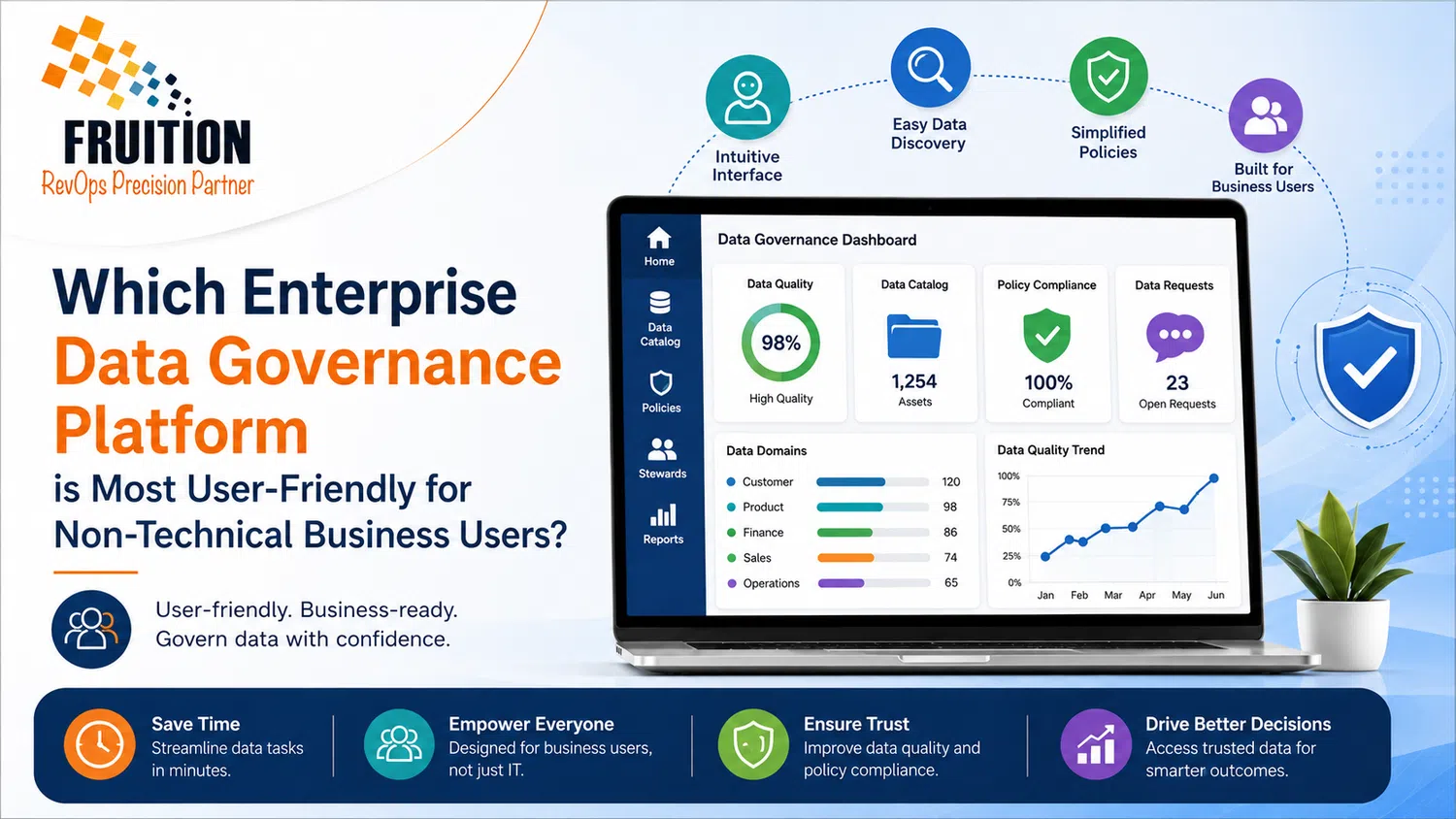
Enterprise data is the backbone of modern businesses. Customer analytics and personalization are made possible by making data accessible and trustworthy. However, enterprise data management can become complex due to poor design when governance platforms are made exclusively for engineering teams. Business users need to work with a variety of interfaces meant for different aspects of the data governance workflow that provide intuitive design, clear workflow, and understandable language, without the need for advanced technical skills. This is why when evaluating Enterprise Data Governance platforms, usability gets more priority than security, compliance, integration, and scalability.
The best Enterprise Data Governance platforms enable a good balance for all users (business and technical). It connects governance to processes, responsibilities, and organizational objectives and strategies. This makes Enterprise Architecture and Target Operating Models important considerations for selecting a Governance platform that supports all stakeholders.
Why Is User-Friendliness Important In Enterprise Data Governance?
The value that data governance strives to achieve is sustained engagement from all employees. Without engagement, users will continue to avoid the governance workflow to manage definitions, policies, and ownership. A platform that is easy to use helps a user understand their responsibilities in governance, even without advanced technical support.
A governing platform which is user friendly should incorporate simple navigation, relevant business terminology, searchable data, dashboards, automated prompts, and role specific restrictions. Departments are able to manage governed data with the correct level of restrictions. Governance should become second nature to the business as a part of everyday work activities to better the business as a whole and increase accountability.
What Features Should Business Users Look for in a Governance Platform?
A governance platform should incorporate easy to use business oriented interfaces. Data catalogs, business glossaries, data ownership records, policies, data quality frameworks, and workflow approvals should all be legible and easy to understand for business teams. Governance tasks should not require the use of database or programming skills, or an in-depth understanding of complex architecture.
A governance platform should also incorporate the use of automation to simplify tasks. Tasks should be assigned automatically along with notifications to data owners, approval requests should be automated as well as track Policy changes, and maintain governance records.
How Does Enterprise Architecture Impact Platform Usability?
Enterprise Architecture establishes how the business’ applications, data, processes, technology, and business capabilities are structured. A governance platform should be built within that architecture. Governance should align with the rest of the business architecture to enable users to retrieve consistent information across business functions and systems.
Additionally, architecture alignment has a big impact on how easy it is to integrate and scale a solution. In today’s business environment, organizations have a number of disparate CRM, ERP, marketing automation, analytics, customer data, and cloud offerings. A strong governance solution ought to make relationships between these systems visible while easing the burden of technical complexity on users. Strong architecture reduces the difficulty of technical complexity of a governance solution.
Why Is a Target Operating Model Important for Governance Usability?
A strong Target Operating Model lays out accountability for people, processes, technology, and governance, and how these elements collaborate to achieve business objectives. Absent an effective Target Operating Model, a user-friendly solution can still create relative confusion in a business unit. This may be due to unclear ownership for the data, unclear policy approval and enforcement, and accountability for the quality of data.
A strong Target Operating Model should establish accountability before the technology is implemented. This ensures the workflow and business processes can be defined in relation to the business functions and roles rather than inconveniently implementing a complicated process or system. Where governance accountability is clear, users are able to engage the system through simplified processes designed to operate based on the functions of the business.
What Features Should Non-Technical Users Care About Most?
Non-Technical users care about ease of use, search, simple/fast workflow, transparency, collaboration, and automation. A user should be able to quickly determine what data asset is being accessed, its meaning, and the owner, from what policies can be viewed on the asset, and then a means to request access. A governance dashboard should provide clear metrics to help non-technical users quickly develop an understanding of governance.
Collaboration Features are Equally Valuable
Business teams typically need to offer definition contributions, data validation, confirm policy approvals, and engage in data owner communication. A good platform makes all these processes easier. Building an interface based on user roles helps simplify interface complexity even more. Role-based interfaces display only the system components and functions pertinent to a particular user.
How Can Organizations Compare Enterprise Data Governance Platforms?
Best practice dictates organizations should not compare features in a list. Instead, organizations should test how the marketing manager in their company would find customer data definitions, how fast a finance staff member would evaluate ownership data, or how effectively a business administrator would approve a governance request. Such “real world” tests illuminate concerns with the usability of the product which may not be evident during the live product demonstrations.
Integration, scalability, security, workflow automation, reporting, metadata management, and governance administration must also be considered. Just because a product is easy to use from a business user standpoint, does not mean it is easy to use from a Governance Admin operating standpoint when the organization begins to add multiple departments and/or users to the system, plus more applications and more data sources.
Can Automation Make Enterprise Data Governance More User-Friendly?
Automating processes is key to improving the user experience and Governance Solutions. Automating repetitive Governance requests and tracking sends approval emails, tasks, reminders, and updates help business users focus on Governance decisions instead of administrative activities.
Automation provides consistency. Governance processes enhance compliance with accountability. Data access requests can be routed to the respective owners. Policy review reminders can be generated within a given system. Automation of these processes can assist with executing the governance strategy the organization has designed.
How Do Fruition RevOps Support Better Governance Experiences?
Fruition RevOps focuses on governance beyond data management. By integrating processes, systems, accountabilities, and automation, governance frameworks can be designed for the business to better understand and ease adoption.
The aim of simplifying complex operations is to increase accountability across the systems of the enterprise. When Enterprise Data Governance is aligned with Enterprise Architecture and a Target Operating Model, organizations can develop robust processes that support business users within the bounds of necessary enterprise controls.
What Is the Best Enterprise Data Governance Platform for Non-Technical Users?
Every organization varies in the platform that is easiest for them to use. There are solutions providing an intuitive UI that may be insufficient for complex enterprises, and there may be robust systems that suffer from use complexity.
When selecting a governance platform, businesses must consider the operation and technology sides of the selection process. The strongest system combines ease of use on the business side with capable frameworks for governance, automation, integration, and security with ease of scale. By integrating Enterprise Data Governance, Enterprise Architecture, and the Target Operating Model with the selected technology, departments can create a flexible and sustainable framework for their new governance system.
Frequently Asked Questions
1. What makes an enterprise data governance platform user-friendly?
A user-friendly platform offers intuitive navigation, business-friendly terminology, searchable data, simple workflows, automation, dashboards, and role-based experiences.
2. Can non-technical employees use enterprise data governance platforms?
Yes. Modern governance platforms can provide simplified interfaces, guided workflows, business glossaries, and automation designed specifically for non-technical users.
3. Why is Enterprise Architecture important for data governance?
Enterprise Architecture connects data governance with systems, processes, applications, and technology, helping organizations create consistent and scalable governance practices.
4. How does a Target Operating Model support data governance?
A Target Operating Model defines governance roles, processes, responsibilities, and technologies, helping employees understand how governance fits into daily operations.
5. Should organizations prioritize usability over advanced governance features?
Organizations should balance both. The ideal platform provides powerful governance capabilities while keeping routine activities simple and accessible for business users.