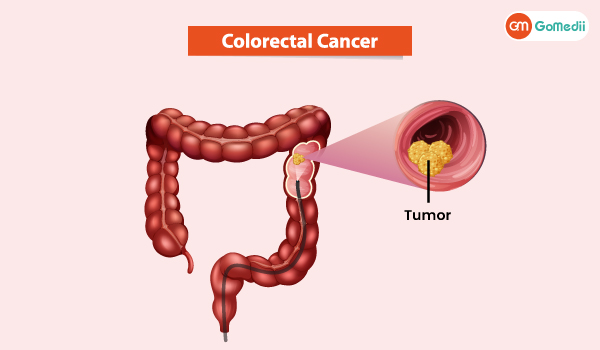
Cancer of the large intestine is also called colon or colorectal cancer. This cancer occurs in the large intestine (colon) or rectum (the last part of the gastro intestinal tract). This cancer is spreading rapidly throughout the world. In case of this cancer, there are stomach related problems like irritable bowel syndrome, piles or constipation. Let us tell you what is Colorectal Cancer?, symptoms of Colorectal Cancer and Colorectal Cancer Treatment in India.
What Is Colorectal Cancer?
Colorectal cancer begins in the innermost layer of the wall of the large intestine. Most colorectal cancers begin in small polyps. Polyps are called groups of cells. Gradually these polyps develop into cancer. This cancer spreads first in the wall of the large intestine, then in the surrounding lymph nodes and then throughout the body.
Symptoms of Colorectal Cancer:
- Change in bowel habits; persistent diarrhea
- Constant feeling of weakness or fatigue and loss of appetite
- Weight loss
- Decrease in hemoglobin (anemia)
- Stomach pain or discomfort
- Red or black blood stains in the stool
Causes and Risk Factors of Colorectal Cancer:
Sometimes the DNA of a healthy cell changes during cell division. This leads to uncontrolled growth of the cell which becomes cancer. Colorectal cancer risk factors mean things that increase the risk of getting cancer. This only increases the risk. Let us know some such risk factors.
- Old age
- Western diet (high-fat diet, rich in red meat and processed meat; low-fiber diet)
- History of colorectal polyps (adenomatous polyp, large polyps, and multiple polyps)
- Family history of colorectal cancer (about one-third of colorectal cancer patients have a family member with the disease)
- Previous history of colorectal cancer (if you have previously been treated for colorectal cancer)
- Inflammatory bowel disease of the colon, ulcerative colitis and Crohn's disease (risk of cancer increases with duration and severity)
- Diabetes
- Obesity
- Smoking and alcohol consumption
Genetic Risk Factors (Inherited Syndromes)
A small percentage of patients with colorectal cancer, (about 5%) have a gene change that is heritable and increases the risk.
Hereditary Colon Cancer Syndrome Is:
- Hereditary Nonpolyposis Colorectal Cancer: HNPCC, also called Lynch syndrome, increases the risk of colon cancer and some other cancers. People with HNPCC get colorectal cancer before the age of 50.
- Familial Adenomatous Polyposis: FAP is a rare disease that causes thousands of polyps to form in the large intestine. People with FAP have an increased risk of developing colorectal cancer before the age of 40.
Treatment of Colorectal Cancer:
- Treatment of localized (limited) disease – surgery
Treatment of colon cancer depends on the stage and location of the tumor. In this, the cancerous part of the large intestine is removed along with the surrounding lymph nodes, then the cut parts of the intestine are joined together to re-establish the continuity of the intestine.
Sometimes, when the tissue is not healthy, the anastomosis may not connect. In such cases, the intestine is opened through an opening called an ostomy (ileostomy or colostomy). It is temporary and is discontinued after improvement in the patient's condition and chemotherapy (if necessary).
- Surgery for colon cancer – Colectomy:
The operation for colon cancer is called partial colectomy. This surgical procedure has different names depending on the part of the colon removed such as right hemicolectomy, left hemicolectomy, sigmoidectomy, transverse colectomy, right or left extended hemicolectomy, and anterior resection.
To achieve the best results in advanced rectal tumors, chemotherapy, radiotherapy and surgery are combined, which is called multimodal treatment. Currently, in the treatment of rectal cancer, chemotherapy or chemoradiotherapy is given first, which is called neoadjuvant treatment, followed by surgery.
In rectal cancer surgery, the cancerous part of the rectum is surgically removed along with surrounding lymph nodes to healthy tissue. The surgical procedure is recognized with different names depending on the part of the rectum that is removed; Anterior resection, low anterior resection, ultra-low anterior resection or abdominoperineal resection.
The cut sections of the intestine are either joined together to re-establish continuity of the intestine (anastomosis) or the intestine is opened above the abdomen, which is called a colostomy.
Important information needed before surgery is how close the tumor is to the anus. The decision whether or not to perform a colostomy depends on the distance and extent of the anus from the tumor.
Sometimes, the entire colon is removed. It is performed in patients whose remaining part of the colon is affected by polyps, inflammatory bowel disease or intestinal obstruction.
Methods of operation for Colorectal Cancer:
- Open Surgery: In open surgery, a long incision is made in the abdomen.
- Laparoscopic surgery: This is a special technique of performing the operation, which is also known as key-hole surgery, minimally invasive surgery or minimal access surgery. In this, instead of a large incision, the operation is performed by inserting special instruments and a camera through small holes in your abdomen. These instruments are made thin and long with special construction.
The camera projects high-resolution images of the inside of your abdomen on a large screen, which the surgeon sees while performing abdominal operations. This technology is one of the most important inventions in the surgical field in the last few decades which has revolutionized the field of abdominal surgery. This surgical technique is now available and accepted for most abdominal operations. The use of this technique is also beneficial in the operation of stomach cancer.
Benefits of laparoscopic surgery:
Open abdominal surgery involves a large incision and hence recovery time is taken and a long stay in the hospital is required. Minimally invasive surgery means “less pain”, “minimal scarring” and “faster recovery”. There is less stay in ICU and hospital. Due to the larger view of the inside of the abdomen on a larger monitor, there is less blood loss during surgery. You can quickly start walking and eating by mouth. The risk of infection and hernia is also less compared to open surgery.
Cancer can sometimes block the colon. In such cases, a stent is placed to remove the blockage, improve the patient's condition and then surgery is performed. If a stent cannot be placed or is not available, surgery is performed directly. In such cases, usually, the ends of the intestine are not reattached but are brought out through an ostomy. When the patient's health improves, the ends of the intestine are later reattached in a second operation. And, robotic surgery in India for this surgery is available in international hospitals.