Are you confused between an apostille and an attestation? If so, then you are not the only one. Since both an apostille and an attestation are used indiscriminately, people are often confused between the two. They both serve different functions and are applicable in different contexts.
It is necessary to understand the attestation and apostille processes while preparing documents for international use. These processes validate your documents to make sure they are legally recognised in foreign countries.
Read the blog below to learn more about attestation and apostille, key differences, the process and what's necessary for you.
What is Attestation?
It is the process of verifying the authenticity of a formal document, statement or certificate. In this process, you will receive an attestation stamp from the relevant officials.
- In many cases, an attestation is used to assure individuals about the reliability of the documents.
- It can reduce the chances of risk, improve transparency and provide proof of due diligence.
- Many individuals visit the country for various reasons, including work, leisure or business. To avoid getting rejected, you must have your documents attested before applying for a visa.
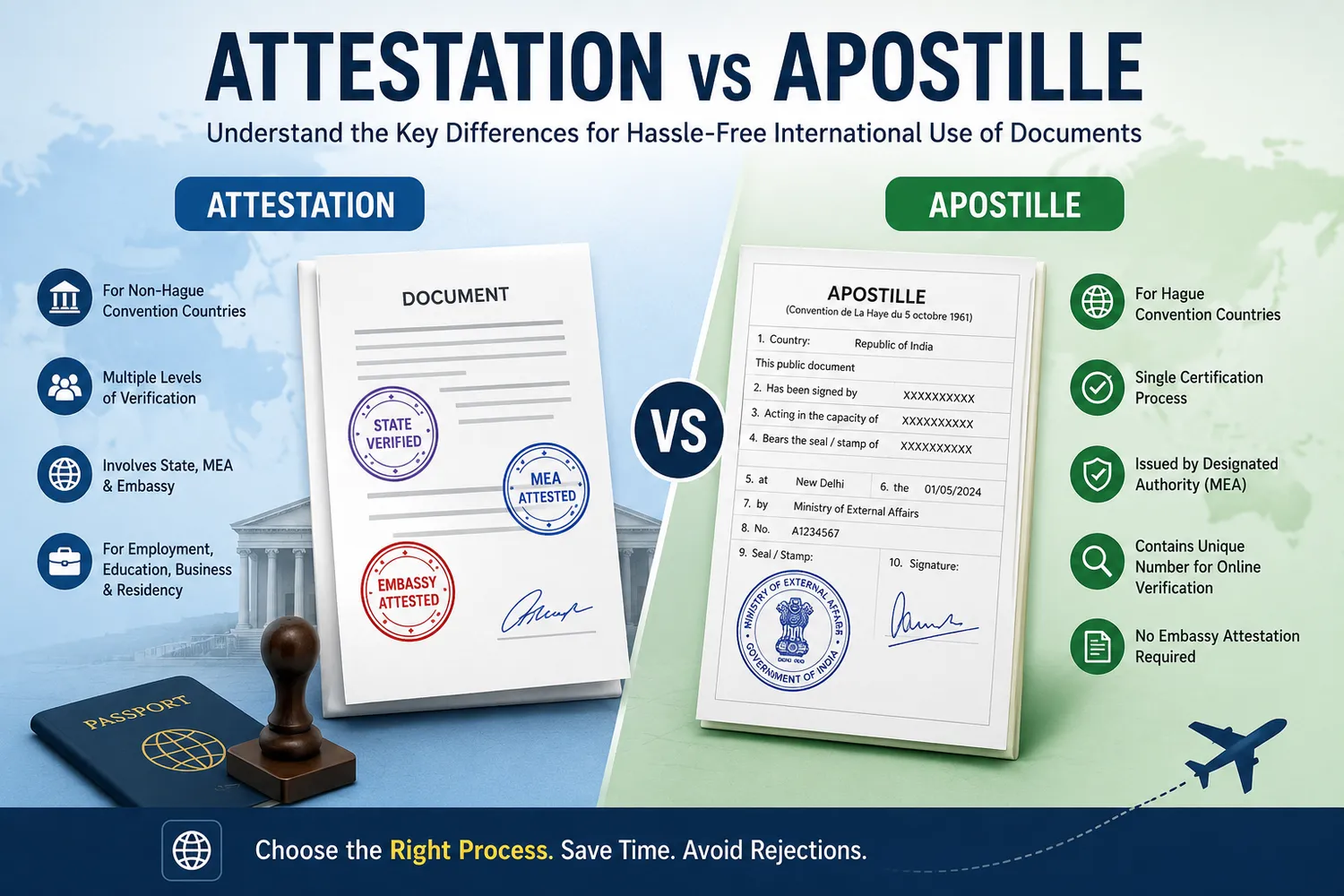
What is an Apostille?
It is a type of attestation where reports are approved under a specific arrangement. It is valid in countries that have signed the Hague Apostille Convention, which is a worldwide verification and is recognised by 92 countries.
- The Apostille Stamp is a square sticker applied to the back of the report.
- It was made by the Ministry of External Affairs (MEA) of the Government of India.
- The stamp contains a unique number that allows any member of the Hague Convention to check its authenticity online.
- The government office is not required to verify a report after it is apostilled.
What are the different types of Attestation?
There are 3 types of attestation, namely:
1. Attestation by the State
- A state-specific verification is mandatory before a validation from the Ministry of External Affairs.
- For instance, if you request educational records, the Department of Education must authenticate those documents.
- The Ministry of External Affairs will only validate individual archives if they are authenticated by the Home Department, the General Administration Department or the relevant state.
2. MEA (Ministry of External Affairs) Attestation
- An attestation is important for school, work or business overseas.
- This validation is carried out similarly to HRDs and SDMs.
3. Attestation from an Embassy
- This allows foreign embassies or high commissioners to attest the documents issued by the home country.
- The documents can then be used to get a residence, study, work or business visa abroad after the MEA attestation.
What is the process of getting an attestation?
It is as follows:
- Document verification includes attestation. Its main purpose is to verify the credibility of the documents.
- The signatory plans to make a will.
- Wills and trusts are created voluntarily by those who plan to use them.
- A person can sign an attestation if he/she has seen the will signed by the testator.
- In state probate laws, attestation provisions vary but serve the same function.
What is the difference between Attestation and Apostille?
The Points below outlines the basic difference between attestation and apostille.
Attestation
- Required for use in non-Hague Convention countries.
- Verifies the authenticity of documents for foreign use.
- Involves verification by the Ministry of External Affairs (MEA) along with the embassy and consulate.
- Commonly required for employment, visa applications, and education abroad.
Apostille
- Required for use in Hague Convention countries.
- Certifies the origin and authenticity of documents for international use.
- Issued through certification by a designated authority, such as the Ministry of External Affairs (MEA).
- Commonly used for legal and personal documents in Hague Convention member countries.
Conclusion
Understanding the difference between attestation and apostille is important when preparing documents for international use. While attestation involves multiple levels of verification for countries that are not a part of the Hague Convention, an apostille provides a simplified authentication process for its member countries. Choosing the correct procedure helps in avoiding delays, rejections and unnecessary costs. Before submitting your documents abroad, verify the destination country's requirements to ensure a smooth legalisation process.