What is Vanilla?
There are nearly 110 varieties of vanilla spread throughout the tropical areas of the world: South America, Africa and Asia. Vanilla is a spice formed by the fruit of an orchid, native to Central America, of the genus Vanilla.
Of the 110 species of vanilla varieties, 3 have a fragrance developed enough to be marketed. Vanilla planifolia, the main species sold in the world (95%), vanilla tahitensis, very rare and expensive, and vanilla pompona, also known as banana vanilla or vanillon. These three species of vanilla have aromatic and agronomic qualities that give rise to a genuine craze for vanilla.
The genesis of vanilla
The name "vanilla" comes from the Spanish "vainilla", short for vaina (bean). However, vanilla is known by different names depending on the culture. The Aztecs called it Tlilxochitl, the Totonacs called it Xahnat and the Mayans called it Cizbiques.
The Aztec word for vanilla "tliltxochitl" is a cross between the words tlilli (black) and xochitl (flower). Literally meaning "black flower". This term is still used in Nahuatl. Vanilla originated in the depths of Latin America. For a long time associated with the cocoa bean, this spice crossed the ocean to spread to Africa where the land is suitable for its cultivation.
Distribution and climate
Vanilla grows only in humid and tropical areas in latitudes between 25°N and 25°S, with rainfall of about 2,000 mm per year. Temperatures must be between 20 and 30°C in order for the vanilla tree to develop properly. In terms of altitude, vanilla can grow up to 1000 meters.
Vanilla originated in Mexico, then it would have spread to neighboring countries such as Guatemala, Belize and Honduras. Then, vanilla would have become rare in the wild.
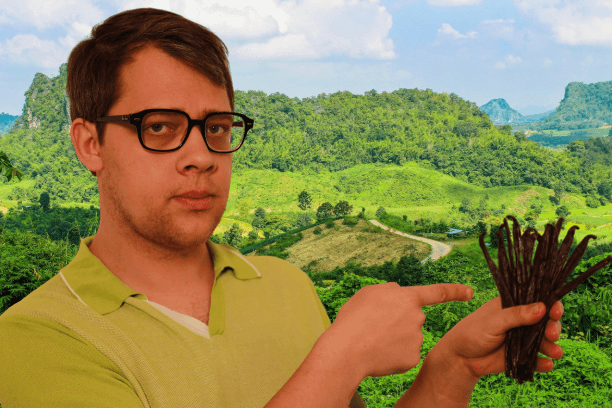
Today, we find it in all the tropical and humid forests of the world. We find various varieties of vanilla in the world: Vanilla planifolia is mainly located in the Indian Ocean where it has also obtained the right to use the name "vanilla bourbon". For example, the vanilla of Madagascar is a bourbon vanilla because it is located in the Indian Ocean and the variety of vanilla is vanilla planifolia. Moreover, the Bourbon Island (Reunion Island) and the Red Island (Madagascar Island) are the biggest vanilla producers in the world.
The island of Tahiti, Papua New Guinea, Indonesia, the Cook Islands and Niue Island are home to vanilla tahitensis, also called Tahitian vanilla. It is a very rare variety.
Then, the Vanilla Pompona takes place in the West Indies and Central America.
Despite strong competition from countries with tropical rainforests such as Indonesia, Madagascar retains its title as the world's leading producer and exporter of vanilla. The Red Island produces nearly 80% of the world's vanilla.
Botany
The plants used for the cultivation of vanilla are called "vanilla tree" or simply "vanilla". They are the only orchids cultivated for the human food industry.
The vanilla tree, which can reach up to 15 meters in length, is a liana with green, often fleshy, cylindrical and twiggy stems. These vines cling to trees with their aerial roots. The fact that they cling in this way makes them a plant that lives as an epiphyte.
Orchids give flowers. These vanilla flowers will produce fruits that will in turn produce vanilla pods of about 20 cm. Often called pods, the botanical term is "capsules".
A vanilla flower varies between green, yellow and white. They are very beautiful flowers.
The natural fertilization of the vanilla is only possible by the intervention of the pollinating insect, the Melipona bee, which is only present in Mexico. Therefore, in countries where vanilla cultivation has spread without the pollinating insect, fertilization is done manually, flower by flower.
Mode of cultivation
To grow, vanilla needs a warm and humid climate, a support (a tree) and some shade:
in undergrowth, using the trunks of trees as supports; it is a very natural technique since the planters are impregnated with the ecological scenery to make vanilla grow in environmentally friendly conditions.
in semi-intensive culture, i.e. by intercalating vanilla between sugar canes for example,
intensive cultivation, i.e. reproducing the ideal cultivation conditions in an artificial way so that the vanilla can grow. This makes it possible to meet, in a precise way, the requirements of the vanilla plant.
A long process
A long process and precise care are necessary on the part of the planters to ensure a vanilla rich in flavors. This preparation, requiring precision in the cultivation and processing of vanilla, makes vanilla one of the most expensive food products in the world, after saffron.
Scalding consists in putting the green pods (freshly harvested) in wicker baskets. The baskets are immersed for 3 minutes in water heated to 63°C.
Steaming consists of placing woolen blankets in boxes and then placing the pods in them for about 12 hours. The pods are kept in a good heat, they dehydrate and develop their black color.
The role of drying is to dry the vanilla beans. They are therefore placed on racks for an hour in the sun and then an hour in the shade per day. This long process lasts four months minimum.
The refining consists in putting the vanilla pods in wooden trunks lined with paraffin paper. This long stage lasts 8 months. The trunks must be regularly checked to remove any pods showing signs of mold.
The calibration of the pods allows to sort them according to their size, the longest ones will obviously be the best valued (sign of quality).
The packaging is used to prepare the vanilla beans for sale.
Vanilla in all its forms!
Vanilla takes on different forms, whatever its variety and origin.
A raw form
The vanilla bean is undeniably the most raw form of this spice. In this form, the vanilla bean reveals captivating and bewitching aromas. The vanilla pods, shiny and fleshy, which exceed 20 cm are real quality pods since the vanillin content is obviously higher than in a smaller vanilla pod.
In powder form
Once used, scraped and split, the vanilla bean is ground into powder. Powdered sugar can be added to add a sweet taste.
Liquid
Vanilla can also be used as a liquid. Vanilla extract is made of sugar syrup, alcohol and vanilla beans. Easy to use, this product brings real flavor to a dish.