
What is it?
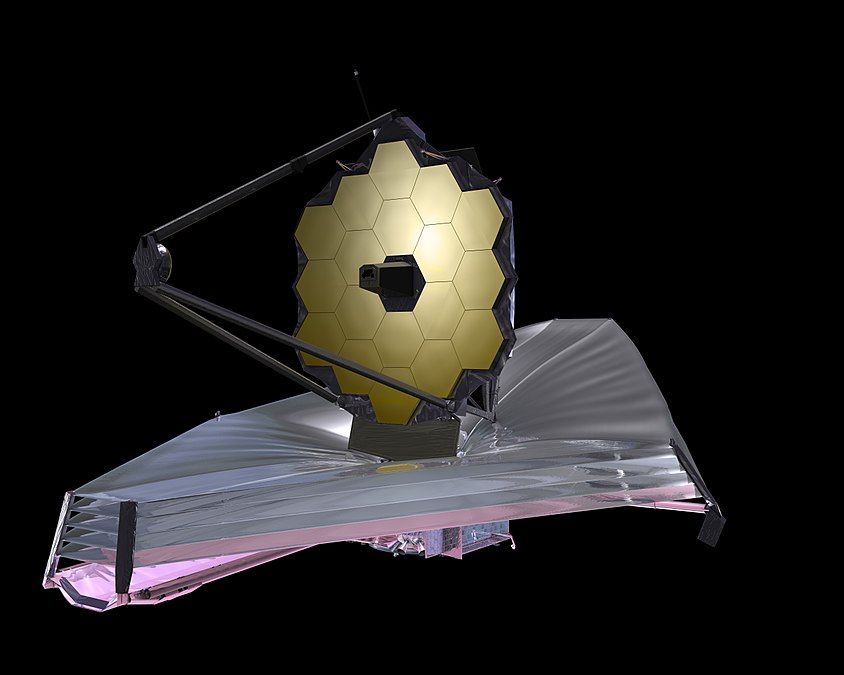
The James Webb Space Telescope (sometimes called JWST or Webb) is an orbiting infrared observatory that will complement and extend the discoveries of the Hubble Space Telescope, with longer wavelength coverage and greatly improved sensitivity. The longer wavelengths enable Webb to look much closer to the beginning of time and to hunt for the unobserved formation of the first galaxies, as well as to look inside dust clouds where stars and planetary systems are forming today.
The JWST is being developed by NASA , with significant contributions from the European Space Agency and the Canadian Space Agency is named for James E. Webb, who was the administrator of NASA from 1961 to 1968 and played an integral role in the Apollo program. The prime contractor is Northrop Grumman.
What are its missions?
The JWST has four key goals:
- To search for light from the first stars and galaxies that formed in the Universe just after the Big Bang.
- To study the formation and evolution of galaxies and clusters.
- To understand the formation of stars and planetary systems.
- To analyze planetary systems and search for the origins of life .
These goals can be accomplished more effectively by observation in near-infrared light rather than light in the visible part of the spectrum. For this reason the JWST's instruments will not measure visible or ultraviolet light like the Hubble Telescope, but will have a much greater capacity to perform infrared astronomy. The JWST will be sensitive to a range of wavelengths from 0.6 (orange light) to 28 micrometers.
When is it launching?
On 31 October 2021 as of July 2020, on Ariane 5 rocket from the French Guiana.
That's cool. Tell me more
The telescope is not serviceable once launched and astronauts would not be able to perform tasks such as swapping instruments, as with the Hubble Telescope. Its nominal mission time is five years, with a goal of ten years. JWST needs to use propellant to maintain its halo orbit around L2 (Lagrange 2), which provides an upper limit to its designed lifetime, and it is being designed to carry enough for ten years. The planned five year science mission begins after a 6-month commissioning phase. An L2 orbit is only meta-stable so it requires orbital station-keeping or an object will drift away from this orbital configuration.