Stablecoins are one of the pillars of the crypto industry for many activities ranging from DeFi to being an asset to hedge against market volatility. In fact, three stablecoins made it into the top 10 largest assets in the crypto market.
This shows the importance of stablecoins in the crypto industry. However, concerns about stablecoins have started to emerge in recent years. From investigations into Tether and Binance to the risk of centralization in stablecoins like USDC.
On March 11 , 2023 this risk materialized and USDC depegged . Similarly in the past , another Stablecoin Called UST was deppeged on 9 may 2022 .
So, what is crypto depeg and how did these depeg Impacted Markets & Uniswap ? What is the impact of these depeg on Uniswap Pools & Volume ? Let’s Examine .
Table of contents :
USDC , USDT & Other Stablecoins : DominanceStablecoins Depeg event impact on the MarketStablecoins Depeg event impact on UniswapOpportunities garnered During DepegPast Depegs : UST & its Impact on UniswapConclusion
1. Exploring the Dominance of Stablecoins
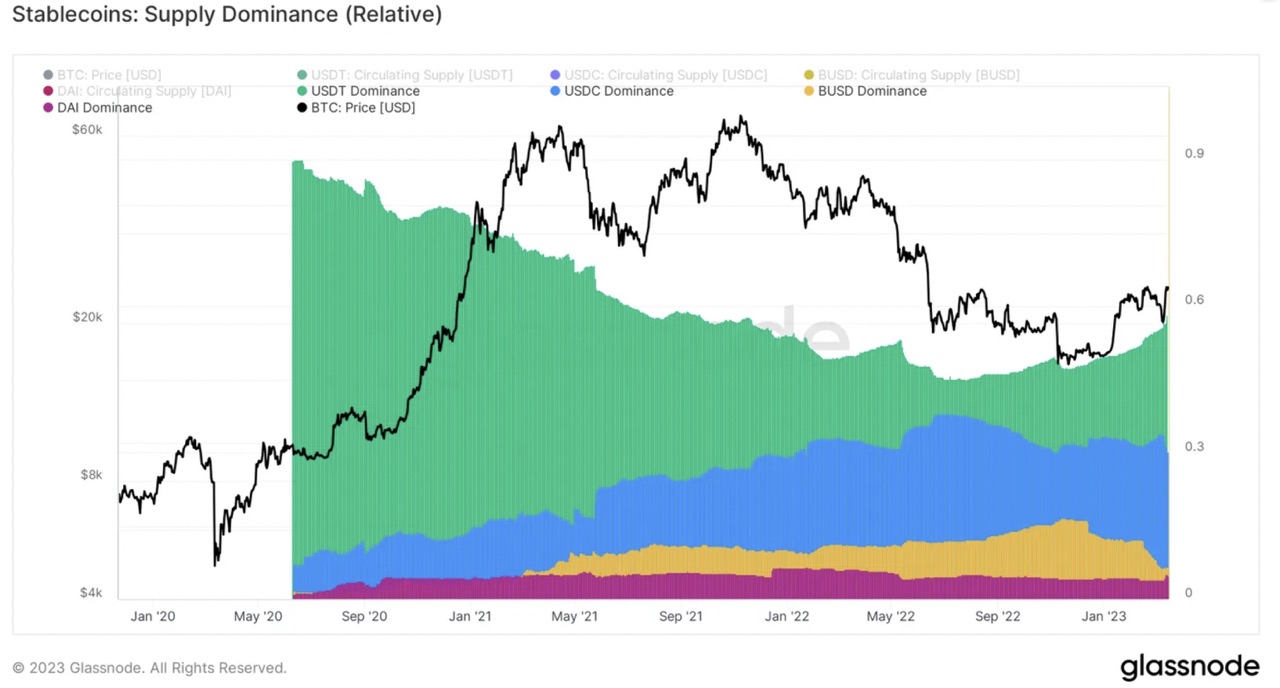
Stablecoin dominance (green for USDT , Blue for USDC ). Source: Glassnode.
The USDC depeg also affected the stablecoin market. The market capitalization of USDT (Tether) increased by about $5 billion on 11-19 March 2023. The dominance of USDT also increased to 58.1% while USDC dropped to 30%. This depeg brought USDC dominance back to the pre-UST crash in May 2022.
In addition, DeFi which relies on USDC collateral is also affected. According to DeFiLlama, DAI and FRAX also experienced a dip to $0.96-0.97 during the incident. The majority of DAI and FRAX was printed using USDC collateral. On the other hand, some stablecoins benefit from the USDC depeg. TrueUSD (TUSD) and Liquity USD (LUSD) saw their supply expand by 22.9% and 10.3% respectively in the last seven days.
2. Stablecoin Depeg event impact on Market
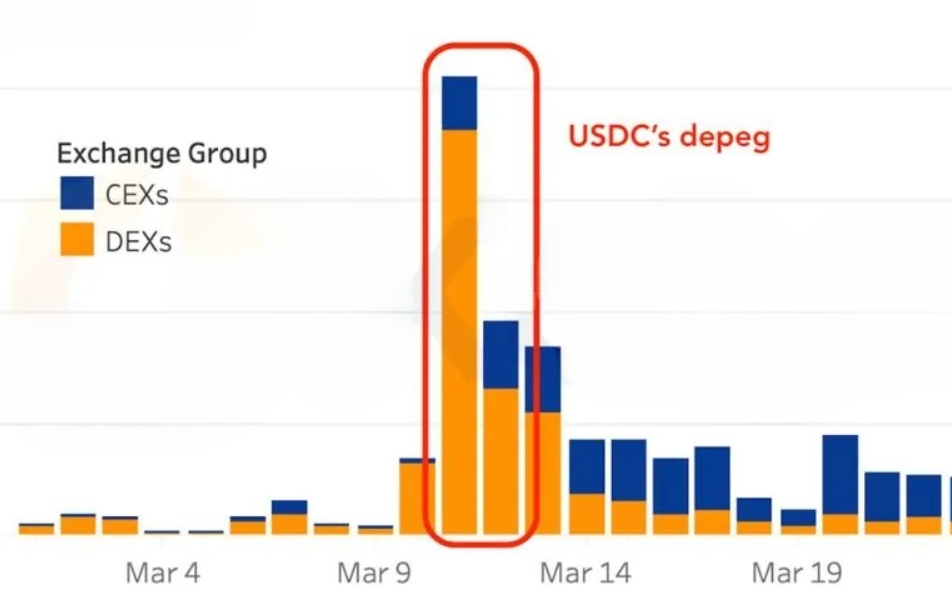
A depeg is a situation where the value of a stablecoin is not equivalent to its pegged asset. A stablecoin pegged to the US dollar depegs when the price of $1 offered is not equivalent to 1 US dollar. In this case, on March 11-13, the price of $1 USDC was not equivalent to $1 US dollar. USDC even fell to $0.87 on March 11.
Circle is the issuer of the USDC stablecoin and explains that the assets that collateralize USDC are USD treasury bills and assets held in banks.
USDC depeg started with news of a bank in the US called Silvergate experiencing a bank run where it could not fulfill its customers’ asset withdrawal requests. Silvergate had liquidity issues as a number of its assets were locked up in long-term assets and so it is unable to meet the short-term needs of its customers.
However, a big problem suddenly arose when Silicon Valley Bank (SVB), a bank with $209 billion in assets, was shut down by the government on Friday, March 10 due to the same thing as Silvergate. Unfortunately, Circle was one of SVB’s clients. Circle explained that it kept about $3.3 billion or 8% of its reserves in SVB (out of USDC’s total $40 billion market cap). Hearing the news about Circle and SVB, many crypto investors rushed to sell their USDC for other stablecoins like USDT or fiat.The Impacts of USDC Depeg
It should be noted that the SVB incident is the largest bank failure in the US since the global financial crisis in 2008. It spread quickly on social media and caused panic in the traditional financial market as well as crypto. In crypto, USDC has considerable dominance in major DeFi protocols including Frax Finance and Curve. The incident caused a significant fall in the liquidity of some protocols. In addition, the stablecoin landscape has also shifted.
3. Stablecoin Depeg event impact on Uniswap
When users flee crypto assets to safer assets, it also means that on-chain activity is at its busiest, contributing to the peak of transaction volume on many DeFi platforms. On March 11, 2023, the current market leading DEX, Uniswap, recorded the highest daily trading volume in history, at $11.84 billion. This number is even nearly twice as high as the recently broken record of 6.67 billion USD.
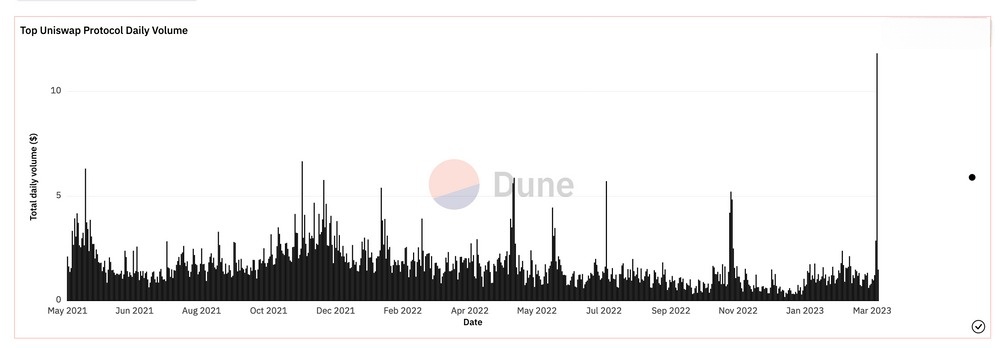
Let’s analyse the effects on Uniswap LP & Volume it gained over the course of the depeg event
On UniSwap The USDC-USDT and DAI-USDC liquidity pools saw $6 billion and $1.4 billion dollars in volume.
USDT assets were also depleted as everyone wanted to exchange their USDC for other stablecoins. LPs on Uniswap also earned sizable transaction fees of $2.4 million on the USDC-USDT pool and $4.7 million on the WETH-USDC pool.
Several assets saw large spikes in acquisition, but none more than, once again, USDC. Outside of stablecoins, wETH also saw a spike in acquisition volume.
Similarly , Curve had an eventful day as it score its highest transaction volume in history, $6.03 billion on March 11. Furthermore, the majority of this transaction volume occurred in just one liquidity pool, the 3pool. The 3pool liquidity pool contains USDC, USDT, and MakerDAO’s DAI. USDT in 3pool was depleted to less than 1% as everyone converted their USDC to USDT. Users who were liquidity providers (LPs) on this pool managed to earn $4.9 million dollars in transaction fees on the week of the USDC event.
Fun Fact: Justin Sun earned $3.3 million dollars in profits from a series of trades he made while USDC depegs. Justin Sun bought USDC using USDT at a price below $1, and he profits when the price returned to normal.4. Navigating Opportunities During Depeg Event
According to on Chain Data , $70M in Fresh On-Chain USDC Positions were at Risk of Liquidation if Stablecoin Depeged by 10% .
Traders were actually betting on a USDC revival were in healthy profit but downside risk remained in the event of another depeg. Traders using decentralized finance (DeFi) protocols like Aave , Compound etcc to bet on a USDC revival over the weekend are at risk of eight-figure liquidations if the stablecoin loses its $1 peg again this week.
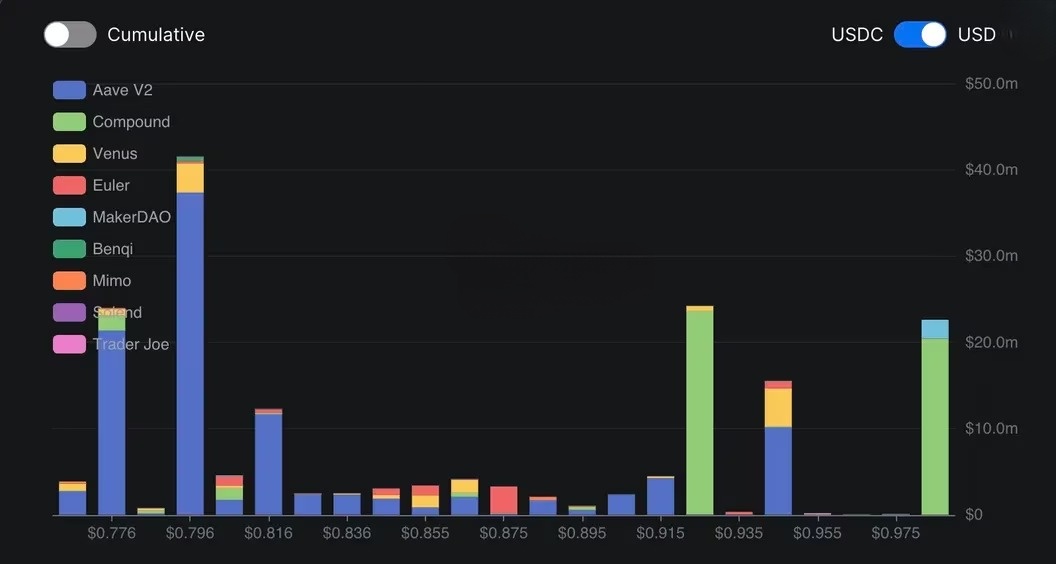
According to data from DeFiLlama, there were $70.8 million in positions that can be liquidated between $1.00 and 90 cents, with two filled positions on interest protocol Compound being worth $20.7 million and $15.4 million, respectively.
Moreover , Big Trading Firms were utilizing high freq trading to maximise the profits .
5. Past Depegs : UST & It’s Impact on Uniswap
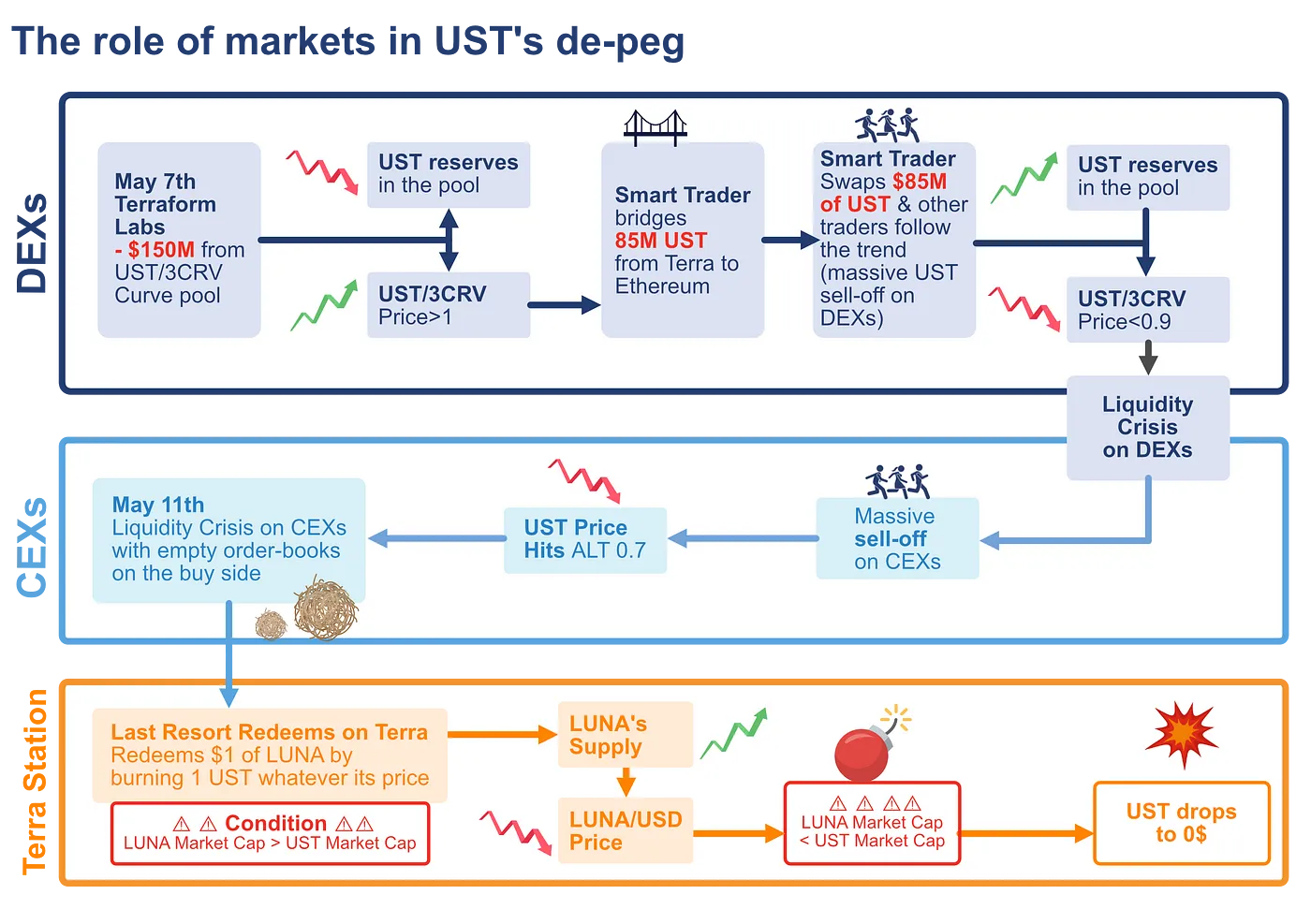
We can chart the individual swaps for UST on the DEXs Curve and Uniswap V3 to see how a large number of sell orders quickly unbalanced liquidity pools.
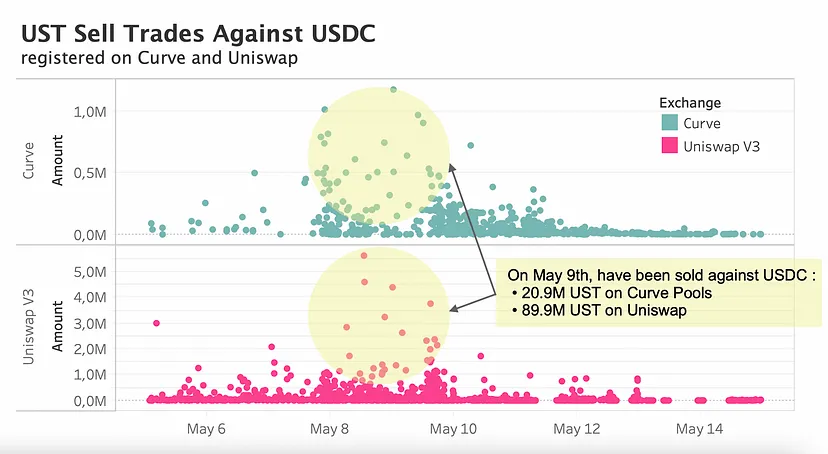
At this point, UST had not yet completely unravelled, showing how DEX liquidity pool and swaps data could have predicted what was to come.
Across all UST markets on both DEXs and CEXs, prices were aligned, despite a lot happening under the hood of these liquidity pools.
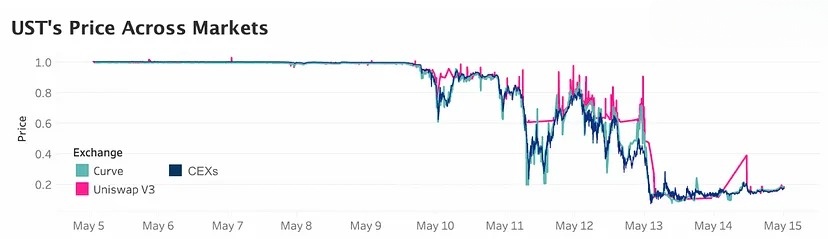
In Above Chart we can see UST’s price across Uniswap V3 and CEXs shows that prices were aligned despite unbalanced pools.
The market had a different reaction to both CEXs and DEXs, which we can observe by looking at trade volumes across the two types of exchanges. While on DEXs we observe an all-time high in the traded volume on May 9th, just before the price dropped below 0.9, on CEXs there is a 1–2 day lag on trading volume, which peaked on May 10th and 11th, too late for UST holders to escape from UST’s price de-peg.
Down below we can see UST trade volume peaked on DEXs like UNISWAP 2 days before they peaked on CEXs.
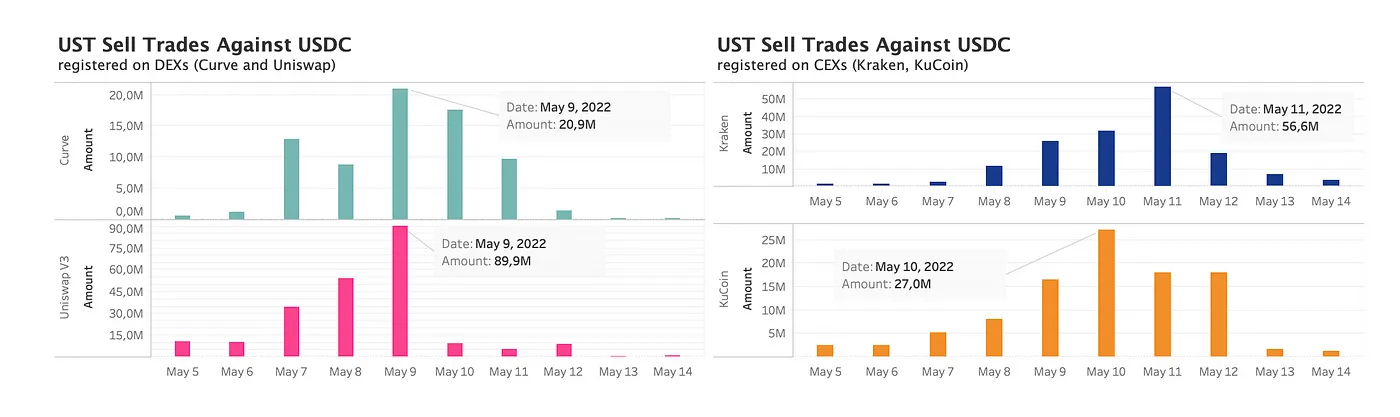
Information asymmetry between CEXs and DEXs led to massive losses for the latecomers. UST holders that traded on CEXs seemed to have reacted 1–2 days after UST holders that traded on DEXs when prices had already dropped to 0.8.
Conclusions -
UST Chapter -
Access to DEX data eases part of information asymmetry and avoids taking unconsidered risks. Altogether, DEX data provided clear warning signals that could have led UST holders to act earlier.
To summarise, the signals identified and described in this article are the following:
- The UST sell-off on Curve on May 7th-8th
- The Curve pools very early imbalance since May 7th
- The 2 day lag between traders' reactions to UST decentralized and centralized markets
USDC Chapter -
- 📉 USDC hit a low of $0.87 on March 11 and managed to return to $0.99 on March 13, 2023. The recovery happens when the US government anounce a bailout for the banks so Circle assets are safe.
- 🏦 The USDC crash was triggered by Sillicon Valey Bank (SVB) experiencing liquidity issues due to a bank run. The bank run was triggered by the news that SVB kept its assets in long-term US bond. SVB’s long-term bonds lost more than $1 billion dollars and this cause panic in SVB’s customers.
- 🧠 The USDC incident impacts the DeFi market, causing some USDC liquidity pools to drain as users trade their USDC for other stablecoin such as USDT.
- 💭 USDC price has now returned to normal but the incident has reignited many concerns about stablecoins. Discussions about stablecoins pegged to other currencies and the need for decentralized stablecoins has resurfaced.