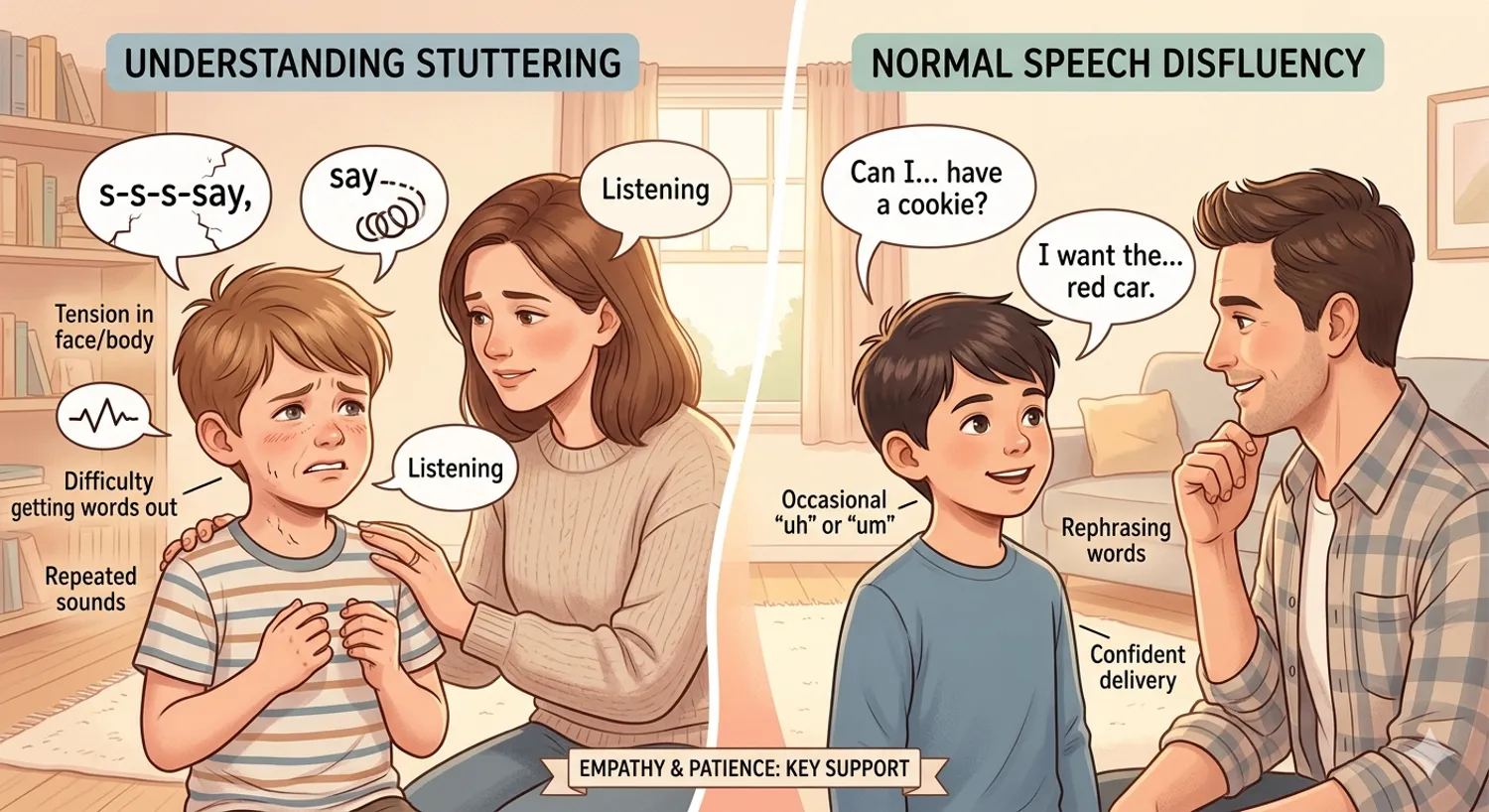
Your child repeats the word "but… but… but I want it!" for the third time before finishing the sentence — and your stomach does a little flip. Is this normal? Should you be worried? As parents, we're wired to notice these things, sometimes a little too intensely.
Here's the truth: almost every child stumbles over words at some point. The tricky part is knowing when that stumbling is just part of growing up, and when it's something worth looking into. At our speech and hearing clinic in Bhopal, this is one of the most common questions we hear from parents — and it deserves a clear, honest answer.
What is "normal" disfluency, anyway?
Between the ages of 2 and 5, children's brains are developing at a breathtaking pace. They're absorbing vocabulary, grammar, and ideas faster than their mouths can keep up. The result? They repeat syllables, stretch out sounds, or pause mid-sentence — not because something is wrong, but because their communication system is simply still under construction.
This is called normal disfluency, and it looks like: repeating whole words ("and and and then"), revising sentences halfway through ("I want — can we go?"), or adding filler words like "um" and "uh." These patterns tend to come and go, often getting worse during periods of excitement, illness, or big life changes like starting school.
Quick tip for parentsIf your child's disfluency seems to increase around age 3, don't panic. This is peak language-explosion territory. The stumbles are often a sign of a busy, growing brain — not a problem.
When does it cross into stuttering?
Stuttering is different — both in how it sounds and in what's happening underneath. Unlike normal disfluency, stuttering involves part-word repetitions ("c-c-c-can I?"), prolonged sounds ("mmmmilk"), or complete blocks where the word seems to get stuck entirely. You might also notice your child blinking rapidly, tensing their jaw, or showing visible frustration when it happens.
Another telling sign is awareness. Children with stuttering often know something is different about how they speak, and that self-consciousness can sometimes lead to avoidance — dropping certain words, going quiet in groups, or refusing to speak in situations they previously enjoyed.
So, what should you actually do?
First — don't finish their sentences or tell them to "slow down." It's well-meaning, but it can quietly signal that something is wrong with how they speak. Instead, give them your full, unhurried attention. Model slow, calm speech yourself. Create a home environment where there's no rush to get words out.
Second, pay attention to the pattern. Is it happening every day? Is it getting worse over weeks? Is your child visibly distressed by it? If you're answering yes to any of these, it's worth getting a professional opinion sooner rather than later. Early intervention makes a significant difference.
At our speech and hearing clinic in Bhopal, we offer evaluations that go beyond just listening to how a child speaks. We look at the full picture — language development, social comfort, family patterns — because stuttering is rarely just about the mouth.
A word on the waiting game
Many children who stutter between ages 2 and 4 recover naturally — research suggests around 75–80% do, often without therapy. But the remaining group benefits enormously from early support. The challenge is that it's nearly impossible for a parent to know which category their child falls into just by watching and hoping. That's exactly what specialists are here to figure out with you.
If your gut is telling you to look into it, trust that instinct. Reach out to a qualified speech-language pathologist. A single consultation can give you clarity, tools, and — more than anything — peace of mind.
Because the earlier you understand what's happening, the better equipped you are to help.
Have questions about your child's speech development? Our team at the speech and hearing clinic in Bhopal is here to help — no question is too small.