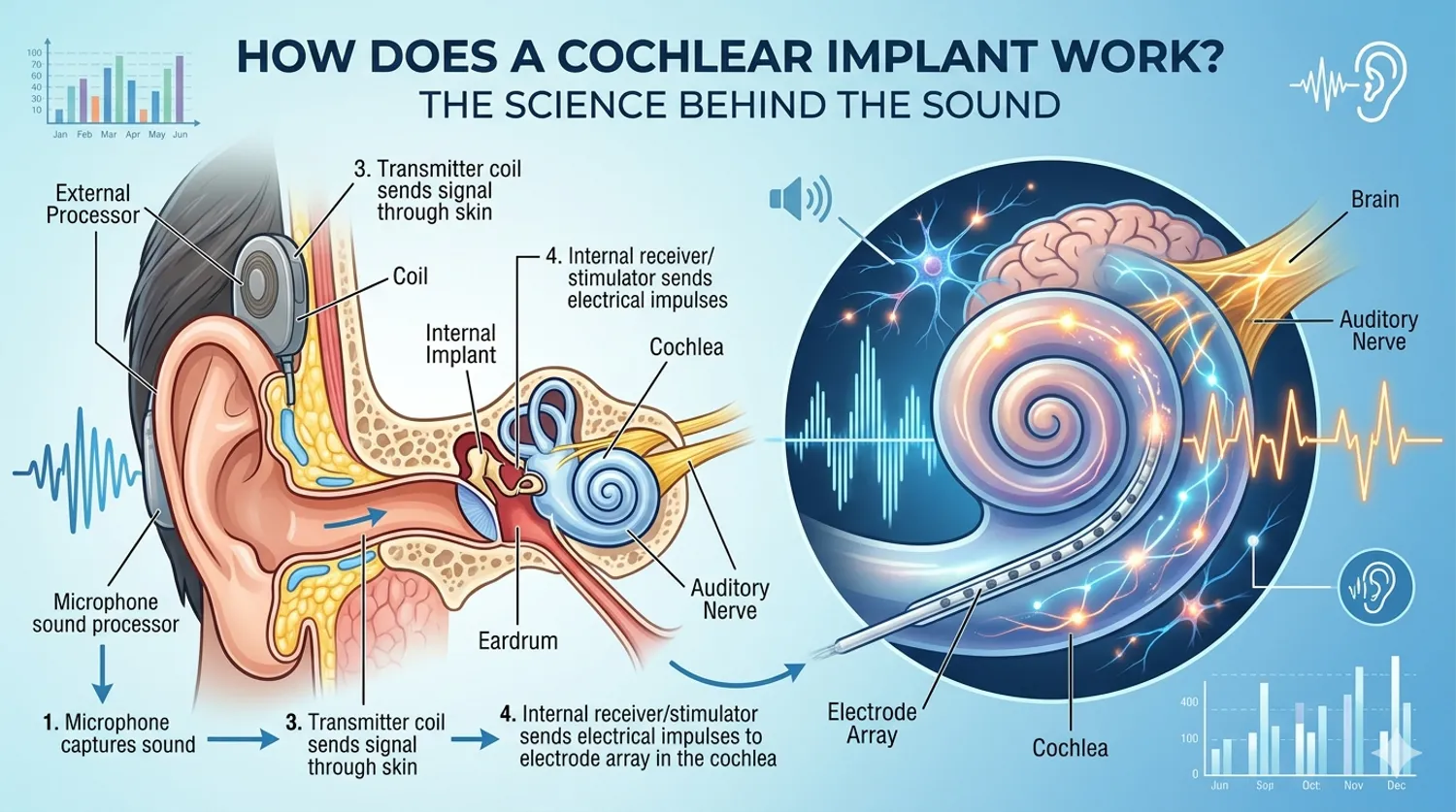
Sound is something most of us take for granted — the laugh of a child, rain tapping on a window, someone calling your name from across the room. But for millions of people living with severe to profound hearing loss, these everyday moments exist only in memory or imagination. Cochlear implants have changed that reality for hundreds of thousands of people worldwide. And if you've ever wondered what actually happens when someone "gets their hearing back," the answer is equal parts biology, engineering, and — honestly — a little bit of wonder.
It's Not a Hearing Aid
Let's clear this up first. A cochlear implant is not a hearing aid machine. A hearing aid amplifies sound — it takes what's already there and turns up the volume. That works well when the ear can still process sound, just not loudly enough.
A cochlear implant does something fundamentally different. It bypasses the damaged parts of the ear entirely and speaks directly to the auditory nerve. Think of it as rewiring the connection between the outside world and the brain.
The Two-Part System
A cochlear implant has two main components — one external, one internal.
The external processor sits behind the ear, much like a hearing aid. It picks up sound through a microphone, converts it into digital signals, and sends that data wirelessly to the internal component through the skin.
The internal implant — surgically placed under the skin behind the ear — receives those signals and passes them to an electrode array threaded into the cochlea (the snail-shaped structure in your inner ear). These electrodes stimulate the auditory nerve at different points, each corresponding to different sound frequencies. The brain then interprets these electrical signals as sound.
It's not "natural" hearing — not exactly. But the brain is remarkably adaptable. Over time, many recipients learn to understand speech, enjoy music, and reconnect with the sounds that make life rich.
Who Can Benefit?
Cochlear implants are typically recommended for people with severe to profound sensorineural hearing loss — damage to the hair cells inside the cochlea — when hearing aids no longer provide meaningful benefit. They're used in both children (sometimes as young as 12 months) and adults.
If you or someone you love is exploring this option, consulting a specialist early makes a real difference. Those searching for a cochlear implant in Bhopalnow have access to experienced ENT and audiology teams locally, without needing to travel to larger metros.
Finding the Right Support
Whether you're just starting to research options or are ready to move forward, choosing the right cochlear implant clinic in Bhopal is crucial. Look for a team that offers comprehensive evaluation, surgical expertise, and long-term rehabilitation support — because the implant is only the beginning. Auditory therapy after activation is what truly brings sound to life.
And if a full implant isn't the right fit yet, a modern hearing aid machine in Bhopalfrom a qualified audiologist can still dramatically improve quality of life while you weigh your options.
The Bottom Line
The science behind cochlear implants is sophisticated — but the outcome is beautifully simple: people get to hear again. If you or a loved one is navigating hearing loss, know that the technology available today is more advanced, more accessible, and more life-changing than ever before.