If you've recently been told you have hearing loss, one of the first things your audiologist will discuss with you is the type of hearing aid that suits your specific condition. And honestly? It can feel a little overwhelming at first. There are so many styles, acronyms, and brand names thrown around that most people leave their first consultation more confused than when they walked in.
Let's change that.
In this post, we're breaking down three of the most commonly recommended hearing aid styles — BTE (Behind-the-Ear), RIC (Receiver-in-Canal), and Custom hearing aids — in plain, simple language. No jargon overload. Just what you actually need to know to make a confident decision.
First, a Quick Word on How Hearing Aids Work
All hearing aids, regardless of style, do the same basic job: they pick up sound, amplify it, and deliver it into your ear. The differences lie in where each component sits — on your ear, in your ear canal, or some combination of both — and how that affects comfort, sound quality, and day-to-day usability.
Your audiologist at a trusted hearing aid doctor in Bhopal will typically recommend a style based on the degree of your hearing loss, the anatomy of your ear canal, your lifestyle, and yes, your budget too.
BTE (Behind-the-Ear) Hearing Aids
BTE aids are exactly what they sound like. The main body of the device sits behind your ear and connects to a custom earmold that fits inside your ear canal via a small tube.
They're one of the oldest hearing aid styles, but don't let that fool you — modern BTEs are sleek, powerful, and feature-packed. They come in both standard and mini versions, and many now support Bluetooth connectivity.
Who is BTE ideal for?
• People with severe to profound hearing loss — BTEs can accommodate more amplification than smaller devices
• Children, since the BTE body can be replaced easily as they grow while keeping the same earmold
• People with narrow ear canals or frequent ear drainage issues
• Those who prefer easier handling — the larger size makes battery changes and adjustments simpler, especially for seniors
What to keep in mind:
BTEs are more visible than other styles. For someone conscious about how the device looks, this can be a dealbreaker. They can also pick up more wind noise compared to in-ear devices, which matters if you spend a lot of time outdoors.
RIC (Receiver-in-Canal) Hearing Aids
RIC aids are often the audiologist's first recommendation for mild to moderate hearing loss — and for good reason. The device sits behind the ear just like a BTE, but here's the difference: the speaker (or 'receiver') is placed inside the ear canal itself, connected by a thin wire rather than a tube.
This might sound like a small change, but the effect on sound quality is significant. Because the speaker is closer to the eardrum, sound feels more natural and less like it's being 'pushed' into your ear.
Who should consider RIC?
• People with mild to moderate hearing loss who want a natural listening experience
• Active individuals — RICs are lighter, more discreet, and less likely to interfere with glasses or masks
• Those who find traditional BTEs too bulky or visible
• People who want advanced features like Bluetooth streaming, app control, or rechargeable batteries
A few things to know:
The receiver wire can occasionally need replacement if damaged — but this is a quick and inexpensive fix at any good hearing aid doctor in Bhopal. Also, RICs may not suit people with profound hearing loss, as the speaker size has limits on how much amplification it can deliver.
Custom Hearing Aids (ITE, ITC, CIC, IIC)
Custom hearing aids are made entirely to fit inside your ear or ear canal. There are a few subtypes — ITE (In-the-Ear), ITC (In-the-Canal), CIC (Completely-in-Canal), and IIC (Invisible-in-Canal) — and they differ mainly in how deep they sit in the ear.
These are made from an impression of your ear canal, which means no two are identical. If discretion is your top priority, custom aids — especially CIC and IIC — are essentially invisible to others.
Who are custom aids a good fit for?
• People who want maximum cosmetic discretion
• Those with mild to moderate hearing loss (certain custom styles can handle moderately severe loss too)
• People who wear glasses or headsets frequently, since there's nothing sitting behind the ear
• Users who value a natural, in-ear sound feel
The honest tradeoffs:
Custom aids are smaller, which means smaller batteries and shorter battery life. Some styles like CIC and IIC don't have room for advanced features such as directional microphones or Bluetooth. They also require more precise ear hygiene since they sit deep in the canal. And because they're custom-made, they tend to cost a bit more.
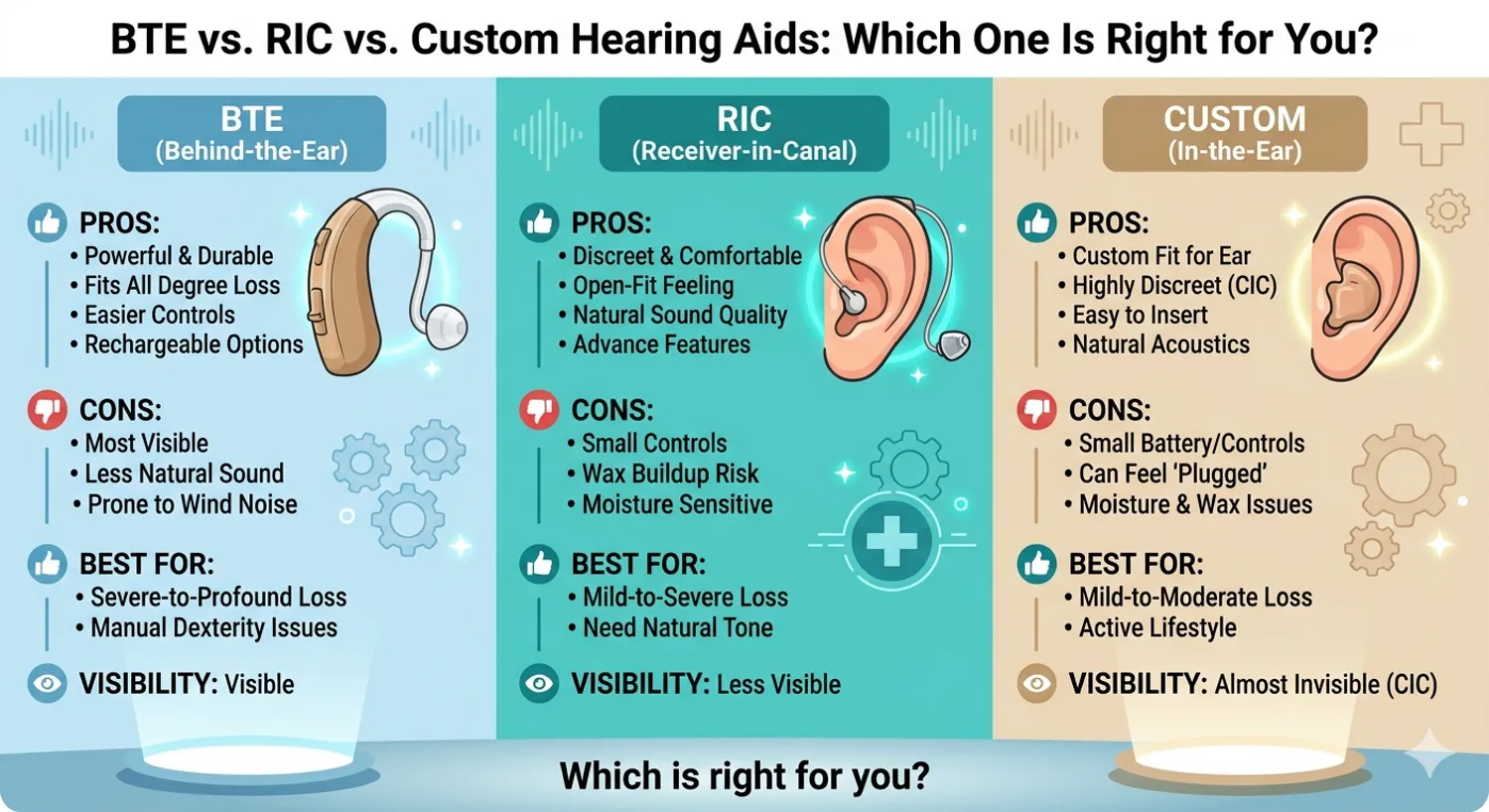
A Side-by-Side Snapshot
Here's a quick way to think about all three:
BTE: Best for severe/profound hearing loss, children, users needing durability and easier handling. Most visible, but most powerful.
RIC: Best for mild to moderate loss, active lifestyles, and natural sound quality. Slim, discreet, feature-rich. Most widely recommended today.
Custom (CIC/IIC): Best for cosmetic preference and mild-moderate loss. Near-invisible but limited in features and battery life.
So, How Do You Actually Decide?
Honestly, the best answer isn't something you can figure out from a blog post alone — and we're not just saying that. Hearing aid selection is genuinely personal. Two people with the same audiogram can end up with very different devices based on their lifestyle, ear anatomy, and what matters to them day-to-day.
That said, here are a few questions to think about before you walk in:
• How active is your daily routine? (Work, travel, sports, social settings)
• Do you care about visibility, or is performance your priority?
• Are you comfortable handling small devices, or do you prefer something easier to manage?
• Is Bluetooth streaming or app-based control something you'd actually use?
• Do you have any other ear conditions — like drainage, narrow canals, or previous surgeries?
Bring these thoughts to your consultation. A good hearing aid doctor in Bhopalwon't push you toward a particular device based on stock availability — they'll take the time to understand your hearing profile, run the right tests, and walk you through options that genuinely make sense for you.
What We Do Differently at Umang Speech & Hearing Clinic
At Umang, we've been helping people across Bhopal hear better since 2009. Over those years, we've seen firsthand how much a well-fitted hearing aid can change someone's life — and equally, how much frustration a poorly chosen one can cause.
As one of the top hearing aid clinics in Bhopal, we work with all major hearing aid brands — Oticon, Resound, and Signia among others — and our approach has always been the same: test thoroughly, recommend honestly, fit carefully, and follow up consistently.
We also offer home visits for patients who find it difficult to come in, because good hearing care shouldn't be limited by mobility or distance. Whether you're in Bhopal, Mandideep, Raisen, or Sehore, our team is reachable.
Final Thoughts
BTE, RIC, or Custom — none of these is universally "the best." The best hearing aid is the one that fits your ears, your life, and your hearing profile. And arriving at that answer takes a proper evaluation, not a guess.
If you or someone in your family is dealing with hearing difficulties and you're not sure where to start, reach out to us. We'll start with a hearing test and go from there — no pressure, no jargon.
Because at the end of the day, what we really care about is making sure you can hear the things that matter.
Umang Speech & Hearing Clinic | S/7 Metro Plaza, Arera Colony, Bhopal | Call: +91 9770057312 | Mon–Sat: 10:30 AM – 7:30 PM