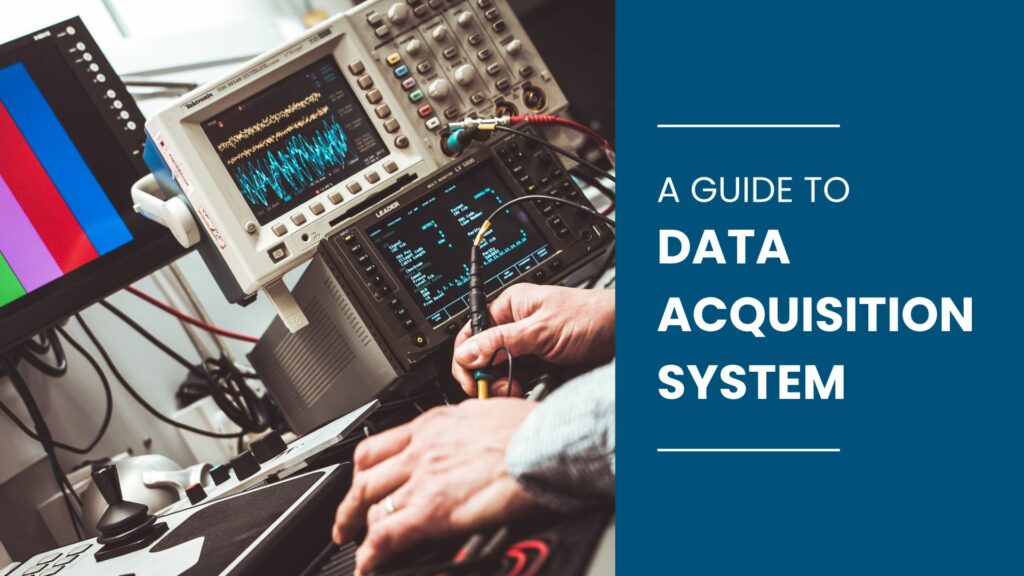
A system that comprises of a computer, measuring tools, and sensors is known as a data acquisition system. A data acquisition system is needed to process collected data since it collects the knowledge required to understand electrical and physical processes.
Data acquisition systems can gather data about a real-world system and store it in a comprehensible, retrievable format for engineering or scientific research objectives.
The following are the vital parts of a data acquisition system:
A. Sensors:
Sensors and transducer’s main purpose is to interact with the object being measured. They transform natural occurrences like light, heat, pressure, location, sound, etc. into quantifiable signals like voltage & current.
B. Signal conditioners:
In order to use the electrical signals that the sensors have acquired, they must be processed to remove any noise or interference that may have corrupted them. The data collecting system cannot always pick up the signals because they are too faint. As a consequence, signal optimization is achieved by using additional circuitry. Technically speaking, this extra gear is referred as a signal conditioner. Making the signals as error-free as feasible is hence the task of signal conditioning.
C. Analog-to-Digital Converters:
This DAQ module converts analogue inputs to digital data. This chip's job is to interpret information from the environment around it into discrete levels that a computer can comprehend.
D. Software Application (LabVIEW):
NI LabVIEW has a lot of hardware support and is ideally suited for developing DAQ applications. For automated product testing in a production setting, LabVIEW is widely utilized and is quickly becoming as the industry standard. Possible Engineers, designers, and research scientists favor LabVIEW as a software development platform because of its integration with many hardware platforms.
Parameters Measured on DAQ:
Many different parameters can be measured using a data acquisition system,including the following:
– Current
– Voltage
– Strain
– Frequency or time interval
– Pressure
– Temperature
– Distance
– Vibration
– Angles
– Digital signals
– Weight
Benefits of DAQ System:
– Accurate
– Flexible
– Scalable
– Programmable
DAQ Applications:
A. Automotive:
Data gathering software and equipment are utilized to guarantee that the manufactured car components are of the greatest quality.
B. NI Instruments:
National Instruments data acquisition (DAQ) devices are categorized into separate classes to make choosing quick and easy. These systems are quantified using common form factors or system types like temperature and strain.
C. Aerospace Defense:
Almost every aircraft sector and the flight-testing facility uses data acquisition products. These solutions can work in a number of settings and circumstances. To ensure that it functions as it should, every DAQ system is put to the test in the lab, the telemetry control room, the engine Test Bench stand, and the flight line.
These systems can be used for a wide range of purposes, such as monitoring direct analog inputs or digitized parameters that are telemetered from an aircraft to a ground monitoring station, flight testing, missile testing, range safety, maintenance, and troubleshooting on (or next to) an aircraft, electromechanical testing in an aircraft hangar, component EOL testing & validation, structural testing on military vehicles, and more.
D. Electronics:
Data acquisition systems are used in the electronics industry. They are employed to measure electrical design parameters such as heat output, resistance, conductivity, magnetics, etc.