Responsible innovation matters for India's digital future because technological progress must address genuine human needs without exposing individuals and institutions to avoidable harm. Digital financial services, educational platforms, healthcare applications and government portals can improve access to essential services. However, their effectiveness depends on privacy protection, security, accessibility and accountable decision-making. By incorporating these considerations into technology development, India can pursue economic opportunities while protecting individual rights and addressing inequalities that might otherwise limit participation in the digital economy.
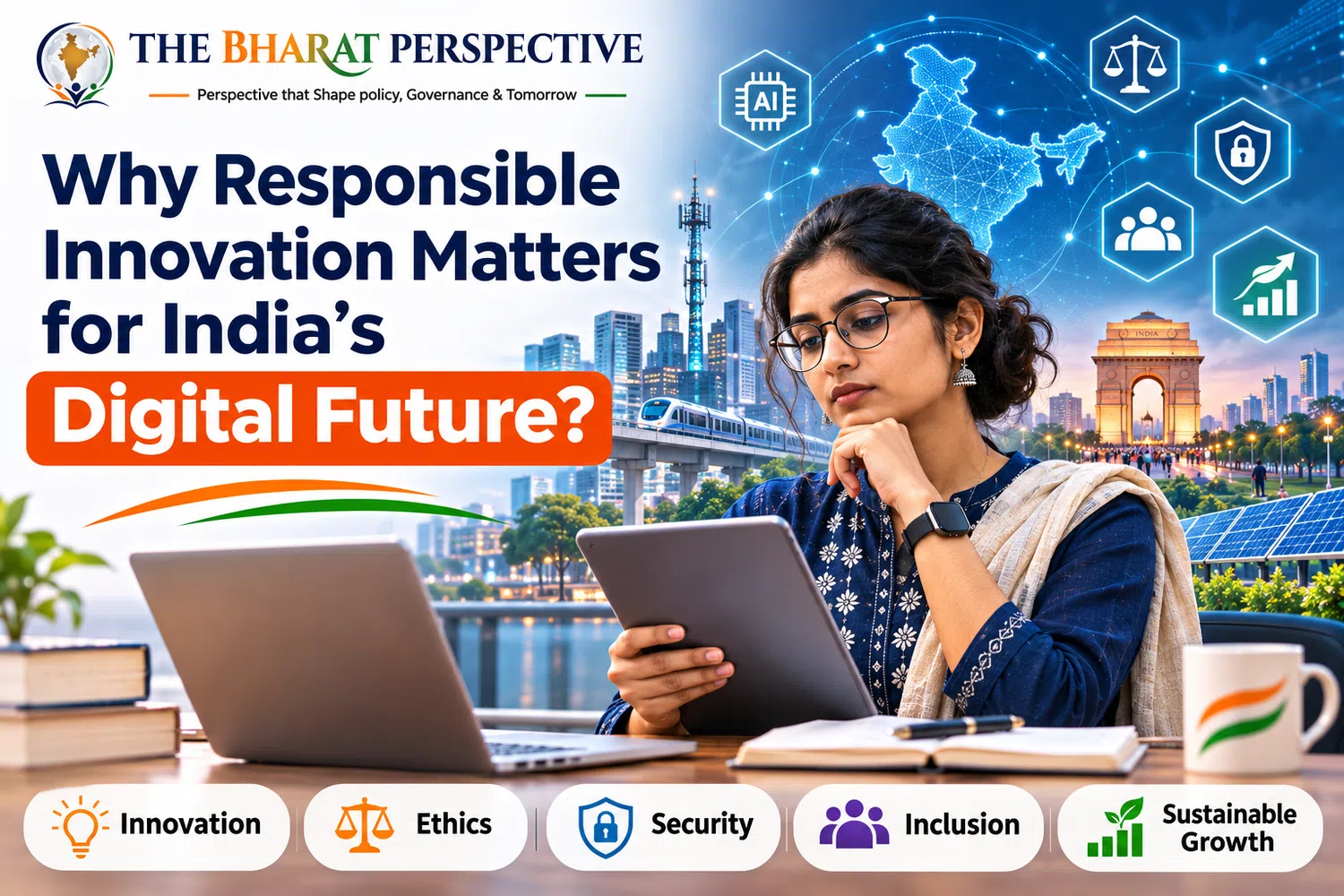
What Responsible Innovation Means for India's Digital Future?
Responsible innovation involves designing, developing and operating technologies with careful consideration of their social, economic, ethical and environmental consequences. Rather than assessing success solely through functionality, profitability or adoption rates, innovators also examine how their decisions affect users and communities.
For example, developers creating a public service application should consider whether individuals with limited connectivity can complete essential tasks. Similarly, organisations introducing automation should examine how inaccurate outputs could affect employees or customers.
Key Principles of Responsible Innovation
Anticipation: Identify foreseeable risks and potential consequences before introducing technologies.
Participation: Involve relevant stakeholders, including individuals whose circumstances may differ from those of developers.
Accountability: Establish clear responsibilities for technological decisions and their consequences.
Continuous evaluation: Monitor performance and improve systems when evidence identifies shortcomings.
These principles need not discourage experimentation. Instead, proportionate safeguards allow researchers and businesses to investigate new opportunities while addressing risks according to their severity and likelihood.
Protecting Data Privacy and Strengthening Digital Trust
Digital services frequently process personal information to authenticate users, deliver services or manage transactions. However, excessive collection, unclear explanations and inappropriate retention practices can create privacy risks that extend beyond the original purpose of a service.
Privacy-Conscious Technology Development
Organisations can incorporate several principles into their product design and information management practices:
Data minimisation: Collect only the information necessary for specified, legitimate purposes.
Purpose limitation: Establish clear reasons for processing personal information and assess proposed additional uses.
Transparency: Explain information handling practices in accessible language without concealing significant conditions.
Access management: Restrict access to sensitive records according to legitimate operational responsibilities.
Data retention: Review how long operational and legal requirements justify retaining information.
For example, a healthcare application could distinguish information necessary for clinical services from optional information for personalisation. Developers should also examine applicable Indian data protection requirements when designing such systems. Although privacy and cybersecurity overlap, privacy concerns appropriate information use, whereas security addresses protection against threats such as unauthorised access. Responsible innovation requires attention to both.
Ensuring Ethical Artificial Intelligence and Algorithmic Accountability
Artificial intelligence can support activities ranging from medical assessment and educational assistance to recruitment and financial decision-making. Nevertheless, its outputs can contain errors or reflect limitations in training data, system design and deployment conditions.
Addressing Algorithmic Bias
Unrepresentative datasets and historically biased records can contribute to unfair algorithmic outcomes. For instance, a hypothetical recruitment system might favour particular applicant profiles because its training information reflects narrow historical hiring patterns.
Developers should therefore evaluate dataset suitability and test system performance across relevant user groups. Moreover, organisations should monitor outcomes after deployment because changes in operating conditions can introduce problems that initial testing fails to identify.
Maintaining Human Oversight
When automated systems influence significant decisions, organisations should consider meaningful human review, appropriate explanations and accessible correction mechanisms. Reviewers need sufficient authority and relevant information to question algorithmic recommendations rather than merely approve them.
AI systems do not possess independent moral judgement. Consequently, the institutions deploying them must retain responsibility for their use and establish safeguards proportionate to the potential consequences of errors.
Strengthening Cybersecurity Across India's Digital Ecosystem
Dependence on digital infrastructure can increase exposure to financial fraud, information theft, service disruption and unauthorised access. Therefore, cybersecurity should form part of technology development from the initial design stage through routine maintenance.
Practical Cybersecurity Priorities
Secure development: Incorporate security requirements into software design, testing and deployment.
Access controls: Limit system privileges and use appropriate authentication measures.
Vulnerability management: Identify, assess and address security weaknesses through responsible procedures.
Software maintenance: Apply relevant security updates and review unsupported components.
Incident preparedness: Establish procedures for identifying incidents, limiting damage and restoring services.
User awareness: Communicate common security risks and appropriate protective practices.
For example, a digital payment provider could test application security before introducing new transaction features. However, technical safeguards alone cannot eliminate every threat. Organisations also need trained personnel, clear reporting responsibilities and reliable recovery arrangements. Security requirements should account for usability, since unnecessarily complicated processes may encourage users to adopt unsafe shortcuts or abandon essential services.
Making Digital Innovation Inclusive and Accessible
India's digital development must account for differences in language, disability, income, education, geographical location and connectivity. A technically functional application may still exclude users who cannot navigate its interface or maintain a stable internet connection.
Designing Technology for Diverse Users
Developers and service providers can address accessibility through practical design choices:
Multilingual interfaces: Provide relevant language options and clear instructions.
Accessible design: Support assistive technologies, readable text and suitable navigation methods.
Connectivity considerations: Optimise essential functions for limited bandwidth and intermittent connections.
Authentication alternatives: Provide appropriate accessible verification methods where circumstances permit.
Assisted services: Maintain suitable offline or supported access for individuals who cannot complete digital procedures independently.
For instance, an educational platform could provide downloadable materials and accessible video captions alongside interactive lessons. Furthermore, inclusive testing should involve people with different abilities and device configurations. Expanding internet connectivity helps address infrastructure barriers, but digital inclusion also requires affordable access, relevant skills and services that accommodate diverse user requirements.
Supporting Economic Growth and Responsible Business Innovation
Responsible innovation can help Indian businesses develop products that address genuine market requirements while managing operational, consumer protection and regulatory risks. Entrepreneurs can incorporate these considerations early, when changing a product's design may involve fewer complications than correcting problems after deployment.
Consider a small enterprise introducing an automated customer support system. Before deployment, the business could examine response accuracy, privacy implications and procedures for escalating unresolved complaints to human staff. Consequently, it can identify situations where automation offers practical value and others where conventional support remains appropriate.
Organisations should also establish transparent pricing, accessible complaint mechanisms and clear information about product limitations. Such practices can support consumer confidence and help businesses identify recurring problems through customer feedback.
However, responsible development requires investment in testing, technical expertise, staff training and ongoing monitoring. Businesses should prioritise these resources according to the significance of potential harm, applicable obligations and the complexity of their technologies. For smaller enterprises, shared testing facilities and specialist training can make these safeguards more attainable without requiring each business to maintain internal technical teams.
Addressing the Environmental Impact of Digital Technologies
Digital services require physical infrastructure, electricity, electronic equipment and other resources. Although technology can support environmental monitoring and resource management, its development and operation can also create environmental pressures.
Data centre operators can assess electricity consumption, cooling requirements and hardware utilisation when evaluating infrastructure efficiency. Similarly, software developers can reduce unnecessary processing and optimise applications for their intended functions.
Hardware design also influences environmental outcomes. Durable devices, repair options and continued software support can extend useful product lifespans under suitable conditions. Businesses should consider responsible electronic waste handling when equipment reaches the end of its usable life.
Nevertheless, environmental assessments must account for trade-offs. Replacing functional equipment with more efficient alternatives may reduce operational energy consumption, but manufacturing new devices also requires resources. Likewise, efficiency improvements may not reduce overall consumption if demand expands substantially. Lifecycle assessments can help organisations compare these considerations rather than focus exclusively on immediate operational savings.
Building India's Digital Future Through Shared Responsibility
Government institutions, businesses, researchers, educational establishments and users all contribute to responsible digital development. Public authorities can establish clear governance arrangements, while developers and businesses can incorporate appropriate safeguards into their operational practices.
Readers following The Bharat Perspective technology coverage can assess technological developments by examining their implications for accessibility, privacy, public welfare and economic participation alongside technical capabilities.
Educational institutions can strengthen professional preparation by incorporating technology ethics, security awareness and risk assessment into relevant programmes. Meanwhile, users can improve digital safety through informed choices and responsible information handling.
Regulatory compliance and voluntary ethical practices serve related but distinct purposes. Organisations must identify applicable legal obligations, while additional responsible practices can address foreseeable risks beyond minimum requirements. Furthermore, public consultation and independent evaluation can help institutions identify concerns that technical teams might overlook. Effective coordination requires clear responsibilities, adequate expertise and mechanisms for addressing problems throughout the technology lifecycle.
Conclusion
India's digital progress requires careful attention to the consequences of technological decisions. Responsible innovation offers a practical framework for pursuing useful advances while addressing foreseeable risks to individuals, institutions and the environment. However, its effectiveness depends on meaningful safeguards, proportionate governance and continuous evaluation rather than ethical commitments alone. By considering human needs alongside technical capabilities, innovators can contribute to a digital economy that values both technological achievement and the welfare of the people who depend on it.