Introduction :
Shipping embryos is not the same as shipping an ordinary medical package. When a clinic, lab, or patient needs to ship embryo specimens, the equipment must protect something deeply valuable, biologically sensitive, and often irreplaceable.
That is why embryo transport depends on more than a courier label and a cold container. It requires the right cryogenic logistics equipment, properly validated shipping equipment, trained handling, monitoring visibility, and clear procedures from pickup to delivery.
For IVF clinics and fertility labs, equipment standards are not just a technical detail. They directly affect specimen safety, chain of custody, compliance readiness, patient confidence, and the clinic’s reputation.
Below, we’ll break down the most important embryo shipping equipment standards to look for before selecting a cryogenic shipping partner or upgrading your IVF lab’s transport process.
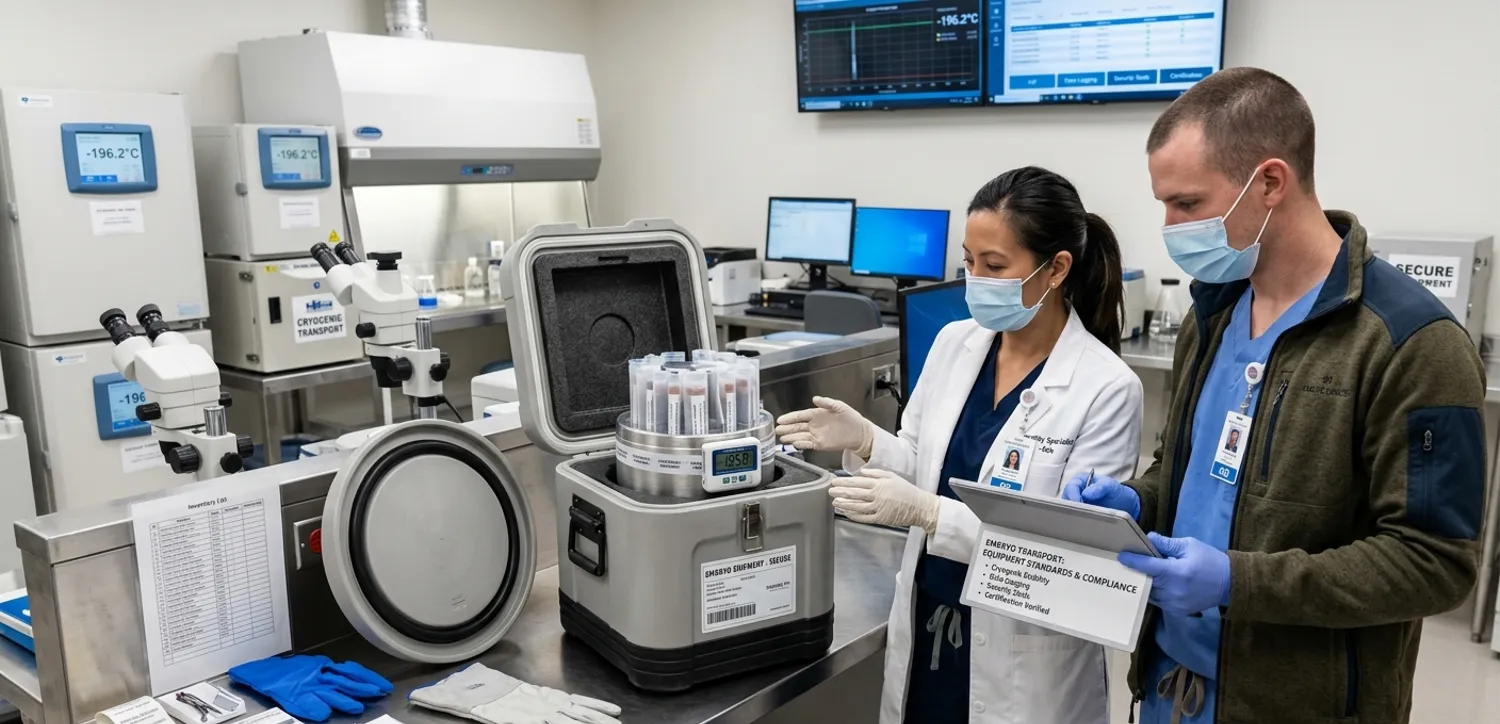
Which Equipment Standards Matter Most in Embryo Shipping?
The most important equipment standards in embryo shipping are:
- A validated liquid nitrogen dry shipper or vapor-phase cryogenic shipper
- Proven temperature-hold performance for the full transport window
- Continuous temperature monitoring during transit
- Secure specimen containment and stable internal storage
- Documented chain of custody from release to receipt
- Equipment inspection, cleaning, and maintenance records
- Trained medical couriers or trained reproductive tissue logistics staff
- Backup plans for route delays, weather disruption, and receiving issues
- Clear validation records, SOPs, and acceptance criteria
In simple terms, the best embryo shipping equipment must prove that it can keep embryos at safe cryogenic conditions, protect them from handling risk, and provide documentation that the shipment remained controlled throughout the journey.
Why Equipment Standards Matter When You Ship Embryo Specimens
Embryos are usually cryopreserved using advanced freezing methods and stored in liquid nitrogen environments. During transport, the goal is to keep the embryo below critical warming thresholds while preventing spills, vibration risk, labeling errors, route delays, or handling gaps.
A weak shipping process can create risk in several ways:
- The shipper may not hold temperature long enough.
- The container may not be fully validated for the route duration.
- The shipment may lack real-time temperature visibility.
- The courier may not understand reproductive tissue handling.
- Chain-of-custody documentation may be incomplete.
- Receiving coordination may fail at the destination clinic.
For intended parents, this can feel overwhelming. For IVF clinics, it creates operational and liability concerns. That is why validated cryogenic logistics equipment is the foundation of safe embryo shipping.
Standard 1: Use a Validated Cryogenic Dry Shipper
The most essential piece of embryo shipping equipment is the cryogenic dry shipper. This is a specially designed container used to transport embryos, eggs, sperm, and other biological specimens at extremely low temperatures.
A dry shipper is typically charged with liquid nitrogen before shipment. The liquid nitrogen is absorbed into the shipper’s internal material, creating a vapor-phase environment that can maintain cryogenic temperatures without loose liquid nitrogen moving inside the container.
What to Look For in a Dry Shipper
A high-quality embryo shipping dry shipper should have:
- Verified cryogenic temperature performance
- Strong insulation and vacuum integrity
- No free liquid nitrogen after charging
- Secure internal canister or goblet positioning
- Suitable capacity for the number of embryo devices
- Proper labeling and documentation compatibility
- A protective outer shipping case
- Evidence of cleaning, maintenance, and inspection
The key point is validation. A shipper should not simply “seem cold enough.” It should have documented performance data showing that it can maintain required cryogenic conditions for the expected transport time, including a safety buffer.
Standard 2: Confirm Temperature-Hold Time With a Safety Buffer
One of the biggest mistakes in embryo shipping is choosing equipment based only on ideal conditions. Real shipments can face weather delays, airport delays, clinic scheduling issues, traffic, missed receiving windows, or courier handoff complications.
That is why validated shipping equipment should have a hold time longer than the planned shipping duration.
Example
If a shipment is expected to take 24 hours, the equipment should be validated for more than 24 hours. The extra margin helps protect the shipment if the route changes or delivery is delayed.
A good embryo shipping process should define:
- Expected transit time
- Maximum validated hold time
- Minimum acceptable temperature range
- Monitoring method
- Delay response plan
- Receiving deadline
- Corrective action procedure
This is especially important in 2026, as clinics and patients expect more visibility, stronger documentation, and better risk planning in reproductive tissue logistics.
Standard 3: Continuous Temperature Monitoring
When clinics ship embryo specimens, temperature monitoring is one of the strongest signs of a professional cryogenic logistics program.
Temperature monitoring helps answer a critical question: did the embryo remain protected throughout the journey?
Modern embryo shipping equipment may include internal temperature sensors, shipment monitoring devices, data loggers, GPS tracking, and environmental monitoring. Depending on the system, these tools may record:
- Internal shipper temperature
- Ambient temperature
- Location updates
- Humidity
- Atmospheric pressure
- Time-stamped route activity
For fertility clinics, this information supports quality control. For patients, it gives peace of mind. For receiving clinics, it helps confirm that the shipment arrived under controlled conditions.
Standard 4: Chain-of-Custody Documentation
Equipment standards are not only about the tank. They also include the documentation system connected to the equipment.
A strong embryo shipping process should document every major step:
- Specimen release from the sending clinic
- Embryo identification and labeling verification
- Shipper preparation and charging
- Pickup time and courier identity
- Transit monitoring
- Delivery time
- Receiving clinic confirmation
- Final inspection and acceptance
For embryo shipping, chain of custody should be clear, time-stamped, and easy to review. This protects the patient, the sending clinic, the receiving clinic, and the logistics provider.
Standard 5: Secure Internal Specimen Positioning
A dry shipper may maintain temperature, but the embryos also need to be physically secured inside the container.
Embryo shipping equipment should be designed to keep cryo devices stable during movement. This helps reduce the risk of dislodging, tipping, or unnecessary handling during transit.
Important equipment considerations include:
- Proper canister fit
- Stable goblet or cane placement
- Compatibility with embryo straws, vials, or vitrification devices
- Clear inventory matching
- Minimal need to open the container during transport
- Secure outer casing
The safest approach is simple: once the embryo is loaded and verified, the shipment should remain closed and controlled until it reaches the receiving clinic.
Standard 6: Equipment Cleaning, Inspection, and Maintenance
Even the best cryogenic logistics equipment can become risky if it is not inspected and maintained.
Before using embryo shipping equipment, the provider should confirm that the shipper is clean, functional, charged correctly, and suitable for use. Maintenance standards should include:
- Visual inspection of the shipper body
- Inspection for dents, cracks, frost patterns, or vacuum issues
- Verification of cap, neck tube, canister, and outer case condition
- Cleaning and decontamination procedures
- Maintenance records
- Retirement criteria for worn equipment
- Routine performance checks
For IVF clinics, this is especially important when choosing between a general courier and a reproductive tissue logistics specialist. Embryo shipping requires equipment quality control, not just transportation.
Standard 7: Validated Shipping Equipment With SOPs
Validated shipping equipment should be supported by written procedures. A shipping system is only reliable if staff know exactly how to prepare, load, monitor, transport, and receive the shipment.
A good embryo shipping SOP should include:
- Shipper selection criteria
- LN2 charging procedure
- Temperature verification steps
- Specimen loading procedure
- Witnessing and labeling requirements
- Courier handoff instructions
- Emergency response steps
- Receiving clinic instructions
- Documentation checklist
- Acceptance and rejection criteria
This is where professional embryo shipping providers stand apart. They are not improvising each shipment. They follow a defined process designed to protect reproductive tissue.
Standard 8: Trained Medical Courier Handling
Embryo shipping equipment matters, but the person handling it matters too.
Cryogenic shippers must be kept upright, protected from unnecessary impact, and handled according to biological transport requirements. A dedicated medical courier or trained reproductive tissue courier understands that the shipment is not just cold cargo.
A trained courier should understand:
- The importance of upright handling
- Why the shipper should not be opened casually
- How to protect the container during transit
- How to communicate delays
- How to coordinate with both clinics
- How to preserve chain-of-custody records
For intended parents, this is one of the most important questions to ask: “Who will physically handle my embryos during transport?”
Standard 9: Monitoring and Alert Systems
A professional cryogenic shipping process should include monitoring and alerts where possible.
Modern monitoring tools can help logistics teams identify route delays, temperature concerns, or environmental changes. This gives the provider time to act before a delay becomes a serious risk.
Monitoring may include:
- Internal shipper temperature
- GPS location tracking
- Real-time status updates
- Ambient temperature
- Humidity
- Pressure conditions
- Delivery confirmation
This type of visibility is becoming increasingly important for embryo shipping in 2026 because clinics and patients expect transparency. They want to know where the shipment is, how it is being handled, and whether it arrived safely.
Standard 10: Compatibility With IVF Lab Workflow
Not every cryogenic solution is ideal for every clinic. A small IVF lab, a growing fertility network, and a high-volume storage facility may all need different equipment setups.
The right embryo shipping equipment should fit the clinic’s workflow, storage model, staffing, and transfer volume.
Questions to ask include:
- How many embryo shipments does the clinic handle each month?
- Does the lab need short-distance, long-distance, or interstate transport?
- Are shipments patient-directed, clinic-to-clinic, or network-based?
- Does the clinic need storage, distribution, or full logistics management?
- Does the team need equipment only, shipping support, or both?
- Does the equipment integrate with current monitoring systems?
IVFCRYO’s equipment services are positioned for labs with different needs, from smaller facilities to expanding fertility networks. Their equipment page highlights cryogenic product distribution, monitoring systems, routine maintenance, and multiple equipment options such as IVFCRYO-One, IC-Bio, and MVE products.
How IVFCRYO Supports Embryo Shipping Equipment Standards
IVFCRYO focuses on cryogenic equipment, reproductive tissue logistics, and IVF lab support. For clinics evaluating cryogenic logistics equipment, the IVFCRYO Equipment page is especially relevant because it connects equipment selection with real IVF lab needs.
IVFCRYO offers access to cryogenic equipment options, including IVFCRYO-One, IC-Bio, and MVE products. The IVFCRYO-One is designed for IVF storage workflows, with features such as high capacity, auto-fill functionality, LN2 level tracking, evaporation-rate monitoring, temperature tracking, alert notifications, and redundant monitoring support.
For embryo shipping and reproductive tissue transport, IVFCRYO also highlights dedicated medical couriers, shipment visibility, real-time updates, and environmental monitoring through IVFCRYO-Sense.
That combination matters because embryo shipping is not one piece of equipment. It is a connected system of equipment, validation, monitoring, documentation, trained handling, and clinic coordination.
For clinics that need help with embryo shipping, storage, monitoring, or cryogenic equipment selection, IVFCRYO provides specialized support for reproductive tissue logistics.
Checklist: Questions to Ask Before You Ship Embryo Specimens
Before you choose a shipping provider or equipment partner, ask these questions:
Equipment Validation
- Is the dry shipper validated for embryo transport?
- What is the validated hold time?
- Is there a safety buffer for delays?
- How is the shipper charged and verified before pickup?
Temperature Control
- Is internal temperature monitored?
- Is temperature data recorded?
- Can the clinic or patient receive updates?
- What happens if a temperature alert occurs?
Chain of Custody
- Who confirms specimen identity?
- Who signs at pickup and delivery?
- Is every handoff documented?
- Are records available after delivery?
Courier Handling
- Is the courier trained in reproductive tissue shipments?
- Is the shipment handled directly or mixed with common freight?
- Is the shipper kept upright and protected?
- Is there a delay response plan?
Equipment Maintenance
- Is the shipper inspected before each use?
- Are cleaning and maintenance records kept?
- Are damaged or aging shippers removed from service?
- Are monitoring devices calibrated or verified?
Clinic Coordination
- Will the provider coordinate with both IVF clinics?
- Are sending and receiving windows confirmed?
- Is delivery confirmed by the receiving lab?
- Is there support if paperwork is missing?
Common Equipment Mistakes to Avoid
When planning embryo shipping, avoid these common mistakes:
Choosing a Provider Based Only on Price
Low-cost shipping may not include validated equipment, dedicated handling, real-time monitoring, or strong chain-of-custody documentation.
Ignoring Hold-Time Margin
A shipper that is barely suitable for the planned route may not be safe if delays happen.
Using General Shipping Instead of Specialized Medical Logistics
Embryos require careful cryogenic handling. General parcel movement may not provide the control or accountability needed.
Not Asking About Monitoring
If there is no temperature or route visibility, it becomes harder to confirm shipment conditions.
Treating Equipment and Logistics Separately
Good embryo shipping requires both: validated equipment and a trained logistics process.
Conclusion: The Right Equipment Standard Protects More Than the Shipment
When you ship embryo specimens, the goal is not simply to move a container from one clinic to another. The goal is to protect reproductive tissue, preserve patient trust, support clinic quality systems, and reduce avoidable risk.
The most important standards are validated cryogenic shipping equipment, proven temperature-hold time, continuous monitoring, secure internal storage, trained handling, documented chain of custody, and clear SOPs.
For IVF clinics and fertility networks, choosing the right cryogenic logistics equipment can make embryo shipping safer, clearer, and more reliable. IVFCRYO’s equipment and shipping services are designed around the needs of reproductive tissue storage, transport, monitoring, and lab support.
If your clinic needs help selecting embryo shipping equipment, cryogenic storage products, monitoring systems, or a safer reproductive tissue logistics process, contact IVFCRYO to discuss the best fit for your facility.