Search is no longer just about ranking pages. It’s about being the source of the answer.
In 2026, people aren’t only typing keywords into Google and clicking ten blue links. They’re asking full questions, expecting instant clarity, and trusting AI-powered answer engines and generative search engines to guide decisions—from research to purchase.
For marketers, this shift is massive. It changes how content is discovered, consumed, and credited. And if your strategy hasn’t adapted yet, you’re already falling behind.
Let’s break down what answer and generative engines really are, why they matter, and what marketers must do now to stay visible and drive traffic.

What are answer engines and generative engines?
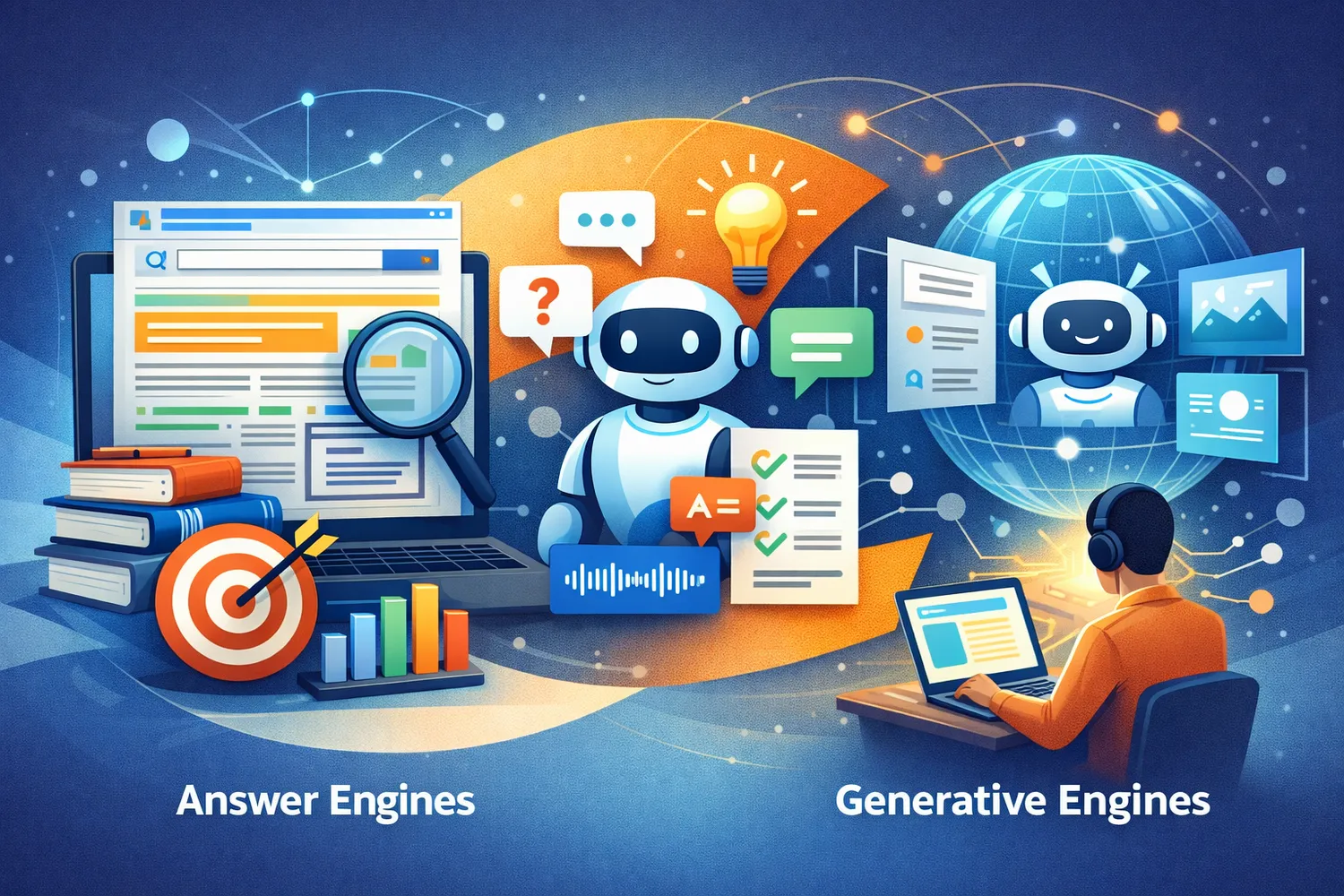
Answer engines are platforms designed to give users a direct, concise answer to a question, often with cited sources. Instead of asking users to click multiple links, they surface the most relevant explanation immediately.
Generative engines, on the other hand, go a step further. They don’t just answer a single question—they generate summaries, comparisons, recommendations, and explanations by combining information from multiple trusted sources.
Together, these systems power:
- AI-driven search results
- Conversational search experiences
- Zero-click answers
- AI summaries and overviews
For marketers, this means your content can influence users even before they visit your website.
Why traditional SEO alone is no longer enough
Search Engine Optimization is still critical. Keyword research, technical SEO, backlinks, internal linking, and content quality remain foundational.
But here’s the reality: ranking does not guarantee traffic anymore.
When AI-generated answers appear at the top of search results, many users get what they need without clicking. That doesn’t mean SEO is dead—it means SEO must evolve.
Modern SEO now supports:
- Content discoverability
- Authority and trust signals
- AI retrieval and summarization
This evolution has given rise to two new disciplines marketers must understand: Answer Engine Optimization (AEO) and Generative Engine Optimization (GEO).
AEO: Optimizing content to be the answer
Answer Engine Optimization focuses on structuring and writing content so it can be easily understood, extracted, and reused by answer engines and AI systems.
AEO is about clarity, not complexity.
Strong AEO content:
- Uses question-based headings (What is, How does, Why does)
- Delivers a clear answer within the first 50–80 words
- Matches real user search intent
- Includes FAQ sections based on actual queries
- Uses simple, human language
When done right, AEO helps your content appear in:
- Featured snippets
- Voice search results
- AI-generated answers
- “People also ask” sections
In short, AEO helps your brand become the trusted answer.
GEO: Being visible inside AI-generated responses
Generative Engine Optimization (GEO) focuses on ensuring your brand and content are mentioned, referenced, or cited inside generative AI outputs.
Generative engines don’t rank pages the way Google traditionally does. Instead, they synthesize responses using sources they consider:
- Clear
- Consistent
- Credible
- Authoritative
GEO relies heavily on:
- Strong topical authority
- Consistent brand messaging
- Well-defined service and solution pages
- Expert-driven content
- Structured and factual information
If AEO helps you answer questions, GEO helps AI recognize your brand as a reliable source worth mentioning.
Why marketers must care (and how traffic still happens)
A common concern is: “If AI answers everything, how do we get website traffic?”
The answer lies in intent.
AI handles surface-level questions well. But users still click when they need:
- Deeper explanations
- Step-by-step guidance
- Comparisons and evaluations
- Tools, templates, or examples
- Proof, expertise, and trust
That’s where smart content strategy wins.
Brands that combine SEO, AEO, and GEO don’t lose traffic—they attract higher-quality, higher-intent visitors.
Content types that drive traffic in an AI-first world
If you want consistent traffic in 2026, focus on content AI can summarize—but not replace.
High-performing formats include:
- In-depth guides and tutorials
- Comparison articles (X vs Y vs Z)
- Industry-specific use cases
- Original research and insights
- Playbooks, checklists, and frameworks
- Thought leadership with a strong point of view
AI may introduce your content, but humans still click for depth and confidence.
A practical framework marketers can follow
To future-proof your content strategy:
- Start with SEO fundamentals
Build strong keyword clusters and internal linking. - Layer in AEO
Answer questions clearly and early in your content. - Strengthen GEO signals
Publish authoritative, consistent, expert-backed content. - Optimize for humans first
Write naturally, clearly, and with empathy. - Measure beyond rankings
Track branded search growth, conversions, and engagement quality.
Final thoughts
Answer engines and generative engines are not replacing search—they are redefining it.
Marketers who adapt will gain:
- More visibility
- Greater trust
- Better-qualified traffic
- Stronger brand authority
Those who don’t will compete for shrinking clicks.
The future belongs to brands that rank well, answer clearly, and get referenced confidently. If your content strategy aligns with SEO, AEO, and GEO today, you won’t just survive the shift—you’ll lead it.