
Simply put, equity represents a startup or company’s ownership, typically expressed in stock percentage. Four main groups of actors can get startup equity – co-founders, investors, advisors or mentors, and employees. On the other hand, equity valuation is a blanket term and refers to tools and techniques that investors use to determine the actual value of a company’s equity. Nevertheless, it is one of the most crucial elements of successful investment decisions, and startup resources and tools can be of profound help.
WHAT IS EQUITY VALUE
Equity value is the total value of a company attributable to equity investors and is calculated by multiplying a company’s share price by its number of shares outstanding. The formula for equity value is –
Equity value = share price x number of shares outstanding
OR
Equity value = Enterprise value – debt and debt equivalents – non-controlling interests – preferred stock + cash and cash equivalents
Now that we know the basics of equity valuation and value, let us analyze how you can determine your equity value within a startup.
STARTUP EQUITY DISTRIBUTION: A SIMPLE SUMMARY
Factors like time dictate startup equity, degree of contribution, level of commitment, and the company’s valuation at the time of equity distribution. Needless to say, founders generally and unsurprisingly receive the most initial equity. If you are a technical co-founder of a company, then your equity value in the company will be equal or almost equal to the founder. However, factors such as ideation, startup stage, seed capital, etc., also come into consideration.
In addition, the earliest investors of a company also receive more equity than those who get on board later. Likewise, you can expect a larger equity share if you are among the early employees who helped get things off the ground. Again, financial tools, such as a startup equity calculator, can be of tremendous help during such situations.
Although there is no one-size-fits-all regarding the startup equity distribution, you can expect the process to progress in the following trajectory as the company scales and moves through the funding stages.
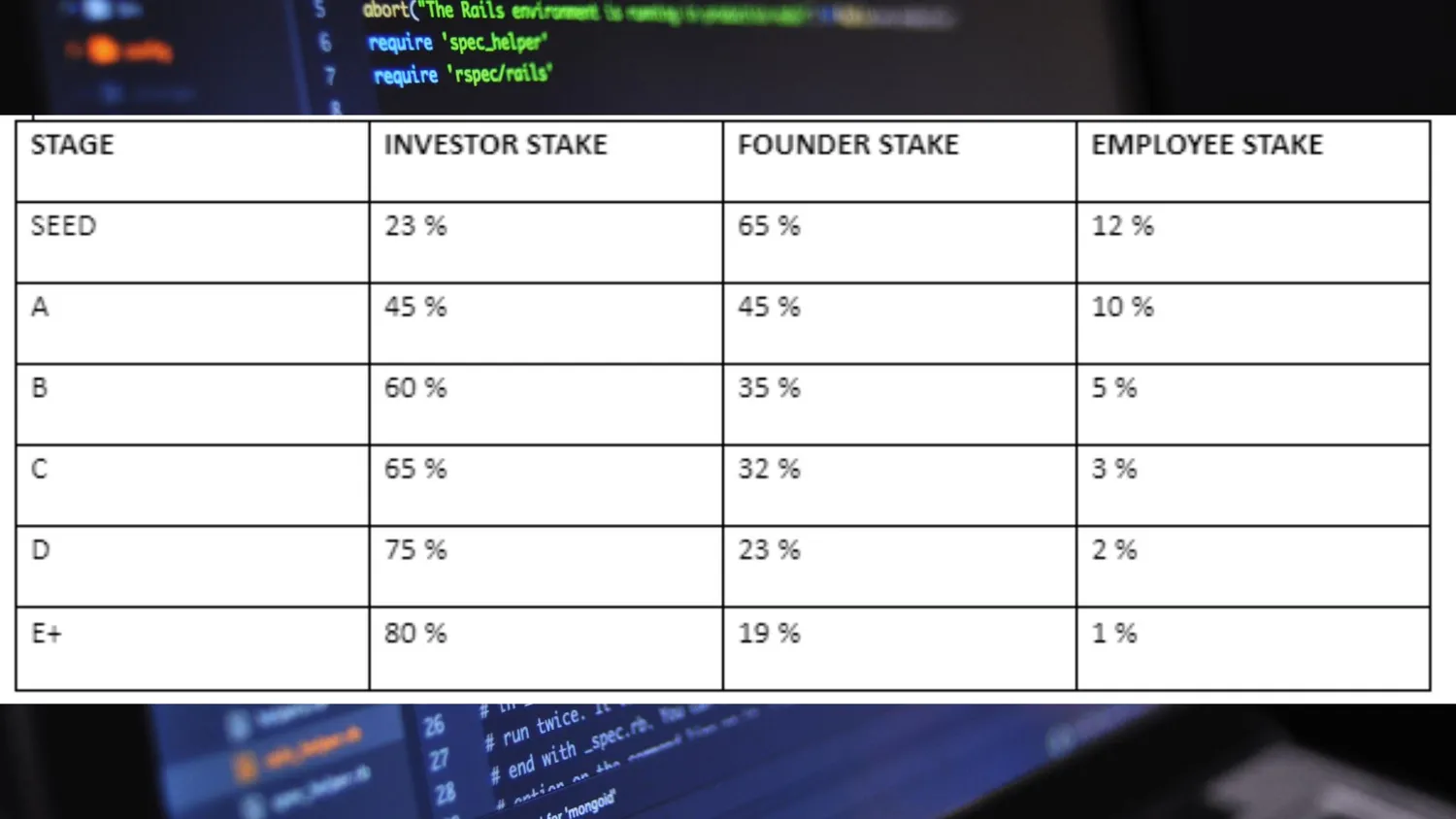
Thus, the crux remains that equity value in a company is a fluid phenomenon, and it is feasible to witness a radical shift as the company scales. If you are involved with a growing startup in any capacity, knowing the value of your present equity is the key. And how can you calculate the value? Let us find out!
HOW TO VALUE EQUITY IN A STARTUP
You can determine your equity value in a company by gauging the following startup resources –
- Last Preferred Price – It is what investors paid for a single startup share during the company's most recent funding round. You can use it as a reference point to determine the company's potential success.
- Post-money Valuation – It depicts the broader value of a company after one round of funding. It is calculated by adding the pre-money valuation (a company's total value prior to a round of investment) and the amount f new equity.
- Number of Options in Your Grant – As the name suggests, it refers to the number of options in your grant.
- Hypothetical Exit Value – It is the ostensible value at which a company would exit it. In other words, the hypothetical exit value refers to the value that a company would generate had it been sold off immediately. It is noteworthy to remember that young companies do not readily offer this information. However, if you want to find a somewhat comparable figure, then researching the hypothetical value of similar companies can help. You can also use a startup equity calculator for such tasks.
- Strike Price – It is the price per share you would incur to exercise your option.
After you have the aforementioned startup resources, it becomes easy to determine your equity value in a company.
EQUITY DISTRIBUTION: A CRISP GUIDE FOR BEGINNERS
Who deserves what share of equity in a startup or company depends on how the business is structured. But, the typical distribution has a specific layout, which we have described below -
- Co-founders – To begin with, equity division among co-founders is reasonably straightforward as long as everyone follows specific basic rules. Firstly, it is vital to make the equity split equal and fair. The presence of multiple co-founders can unnecessarily complicate the process. However, it is crucial to note that not all equity division among co-founders is equal, as factors such as innovation, ideation, risk, seed capital, etc., play a prominent part. For instance, among the two co-founders of Instagram, one received an equity of 40 percent, as his technological maneuvering made it a reality. On the other hand, the second co-founder who came on board later got a 10 percent share.
- Investors – The most challenging aspect of equity division is among investors, but a simple formula might come in handy. For instance, if a company plans to raise USD 3 million, the investors feel the company's worth is USD 10 million. The founders have to give them 30 percent of the organization in exchange for the money.
- Board of Directors and Advisors – In most situations, the equity offered to the board of directors ranges from around 05 percent to 2 percent. On the other hand, the equity distribution for advisors is approximately at around 1/10 o 0.5 percent.
- Employees – It is common for early employees to receive an equity share as an incentive in exchange for the faith, blood, and sweat they have placed in an embryonic organization. Such a strategy will motivate them to improve and grow your company in the long haul. Several startups follow the thumb rule of keeping equity points aside from 1 to 10 percent for early hires. The co-option of tools such as a startup equity calculator becomes crucial during such a situation.
So, there we have it, a crisp overview of what your equity value can be in a company