Today I’m going to comment on this kid:
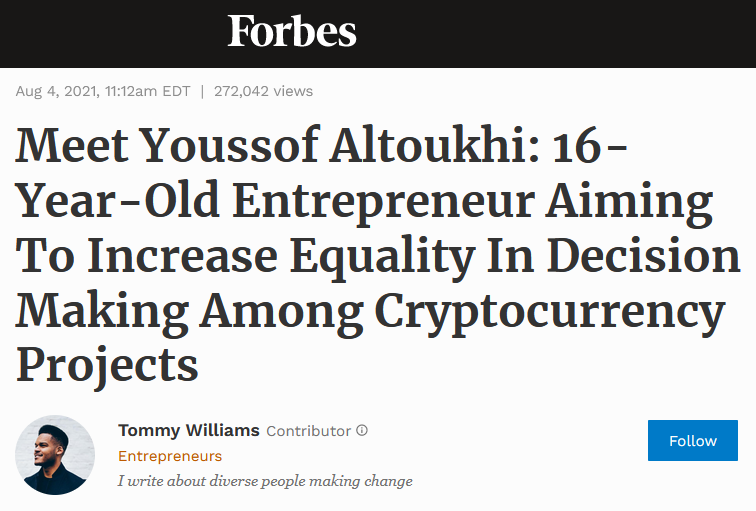
That said, this kid is ultimately just one example of a truly annoying phenomenon, so I guess what I’m more commenting on is Forbes’ presentation of the phenomenon, but we’ll come to that.
The first comment on Altoukhi is that he’s obviously got rich parents. There are many clues to this, like the fact that all the “entrepreneurial” ideas he had at bizarrely tender ages require seed capital a poor kid couldn’t get by curing cancer (”he received a 3D printer as a gift when he was in primary school”; “his next business idea... was reselling sneakers and limited edition clothing”; “he started investing some money in the stock market when he was 10 years of age”; “in 2018 bought multiple ASIC miners to mine Bitcoin and various cryptocurrencies“), and that he clearly received this investment in spite of actually failing in business repeatedly (”there were not many orders but it proved to be a valuable experience”; “demand was limited and there was a significant amount of fraud in the space”; “tying up money on inventory and the risks associated with that was something Youssof learned”; “logistics, warehousing, and physical side of the business alongside school and other commitments was too much”; ”at the cryptocurrency all-time high of 2017, he came across ‘alt’ coins... he invested in some of these coins in 2017”).
All of that of course being true, the main way I know he has rich parents is that he chose to tell me:
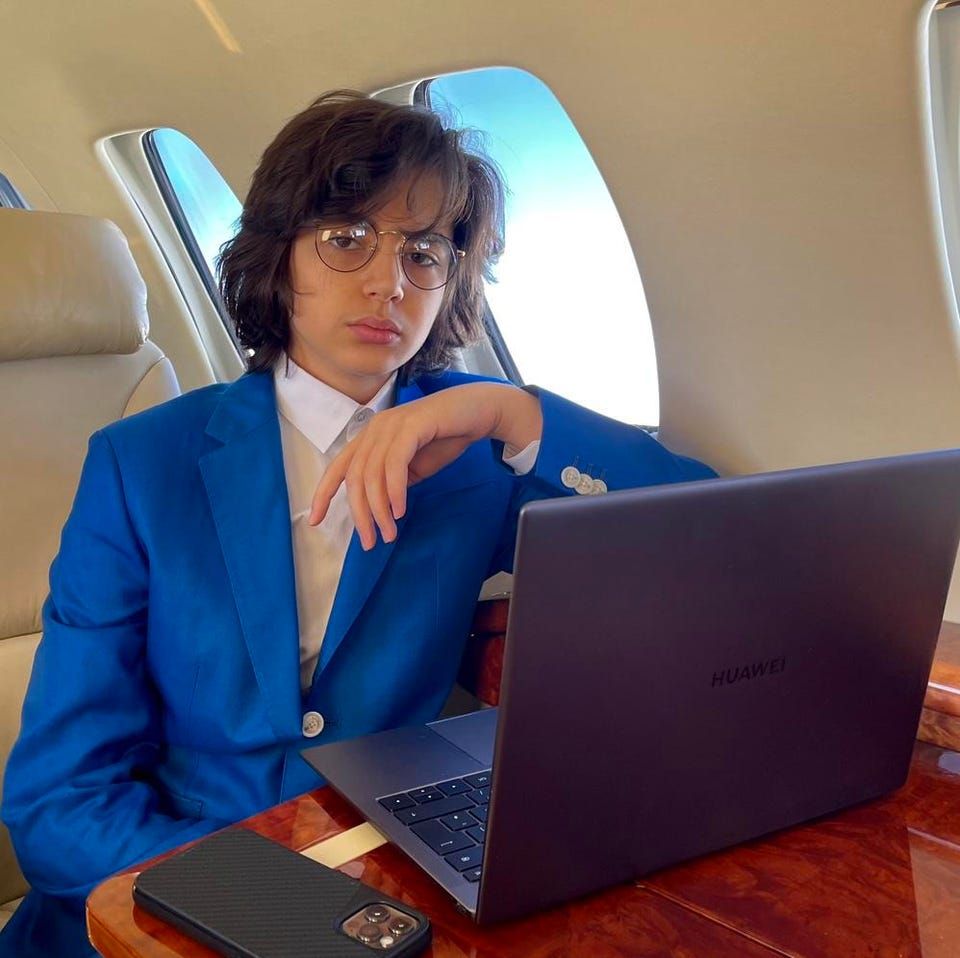

Regardless of whether his parents are actually Richie Rich billionaires, it is evident that they had enough spare capital to allocate that they felt happy repeatedly choosing to allocate it to his endeavours despite, by the sounds of it, often making notable losses. This isn’t some generic “kid has rich parents so nothing he does counts and he’s terrible” discourse; obviously he has done a bunch of stuff very few 16 year olds have done.
The point is more about the presentation of this child as an entrepreneur. If you subscribe to the worldview this Forbes columnist obviously does, entrepreneurs are meant to be archetypal capitalists, seeing unsupplied demand, cleverly innovating to respond to it, and generating a win-win-win solution that provides a valuable new product for consumers, good jobs for workers, and deserved profit for the risk-taking entrepreneur. There is no evidence presented in this article that Altoukhi has yet created any type of business that could sustainably do any of the three things above.
A more accurate, still extremely charitable description of what he is is a motivated, presumably precocious young man who has been given the fortunate opportunity to lose a fair bit of his parents’ money learning about business and finance at an unusually young age, where if he did the same in a real market environment he would not have been able to. That’s great! There’s nothing wrong with parents supporting their kids in experimenting and learning, and it may well have set Altoukhi up such that he will one day be a successful entrepreneur, although whether this crypto thing actually creates any value is a separate question and leaves open to discussion whether they could have found him a less destructive hobby.
However, I don’t really subscribe to the cult of the entrepreneur, so there are two things to highlight here. The first is that if you are of the belief people should get off their asses and start a side hustle, start a business, make their own job if they don’t like their boss, or otherwise see entrepreneurship as either a responsibility or a meaningful opportunity for people to find social mobility, he has precisely no relationship to that narrative because he is not a successful entrepreneur.
The second point, given that observation, is that the only way this story meaningfully reflects on entrepreneurship is that the columnist, whose area of expertise is entrepreneurs, either can’t identify that this kid is not one, or finds it so difficult to find real examples that he has to write about what could at best be described as a “potential future entrepreneur”. Then, for whatever reason, he opts to include exactly no critical analysis of this kid’s claim to success as an entrepreneur or context as to what enabled it. If it really didn’t matter that he has rich parents, given how hard it is for entrepreneurs to find investors, you would think it would be natural to explain where Altoukhi got his capital.
Anyway, this kid’s parents aren’t actually the point here. The point is an analysis of his observation regarding the problem with democracy in cryptocurrency, and his proposed solution. He certainly accurately notes a problem with cryptocurrency. Cryptocurrency decentralises record-keeping and in so doing purports to remove the need for a central authority dictating which transactions and which tokens are legitimate and which are counterfeit. The problem with relying on a community for this role is that many people can’t be trusted, particularly when it comes to money. How do you identify attempted fraud? Crypto has two models:
- Proof-of-work: to verify a transaction, miners must solve complex maths equations; the fact that there are a large number of dispersed miners, that they get paid to verify and thus have an economic incentive to maintain the integrity of the currency, and that there is an upfront investment to be made in being able to mine all make it difficult for anyone to obtain the immense computing power required to overwhelm the network.
- Proof-of-stake: people can verify transactions based on the quantity of currency they hold; this makes sense given people with the most currency have the most incentive to maintain its value, but also means they can make the most income from verifying.
Proof-of-work has two problems: firstly, it uses as much electricity as a country, and a bunch of very expensive hardware, to do essentially pointless calculations. I am personally confused as to why we couldn’t just use that computing power to do useful calculations while still verifying transactions, but apparently no entrepreneur has worked that out yet. Secondly, there is a compelling argument that a non-economic actor with deep pockets (e.g. a nation-state) could take the network down. The counterargument to this was:
Pomp said his reasoning was flawed because he failed to take into account the fact that bitcoin is “the strongest computing network in the world […] by every measure.“
Unfortunately this counterargument suffers from the issue of not being a counterargument, which is troubling coming from someone who wants to replace the entire global monetary system.
Proof-of-stake has a different problem, one which I find quite amazing. Despite the hyper-capitalistic culture surrounding crypto, the infatuation with billionaires and tech bros and the total disregard for the government, people don’t like that proof-of-stake rewards capital with more capital. Completely enamoured with the idea that crypto democratises the monetary system, they are troubled by the realisation that a system which rewards capital with more capital and then attributes decision-making power to capital is undemocratic. Apparently this leads to exactly zero realisations about our capitalist system outside of cryptocurrency, and no self-reflection on their view that government essentially shouldn’t exist.
So, realising rentier capitalism is incompatible with democracy, they immediately stand up from their computer, go out into the real world and engage in grass-roots activism to restore the civil, political and economic rights of the oppressed. I kid, of course, they try and work out how to solve this problem, which apparently is purely a computer science problem, reflective of no real world situation, and in need solely of a clever “entrepreneur” with a keyboard and some of his parents’ money to add another coin to the 10,000 that already exist.
Suffice it to say I don’t think Altoukhi’s project, Y Coin, will deliver “absoulute democracy”.
There is a simple reason for this. Democracy arose out of people’s desire for real rights; rights and guarantees to have their needs met, that they would have sufficient food, be able to raise families, and not have their labour exploited. The power of the nation-state is fundamentally located in the real world, and all its digital activities (predominantly surveillance) still serve to support its real world power. This is one of the reasons crypto has so staggeringly failed to become a replacement for currency without the state embracing it: at the end of the day, taxes are paid and tenders accepted in local currency; if you want to participate in the legitimate monetary system at any time, you will need to convert back to it. Otherwise, you will go to jail, i.e. the state will use physical violence to enforce its monetary sovereignty.
Since democratic rights are rooted in bodily autonomy, and people vote in person, voter fraud is rare simply because it is logistically difficult and cost-inefficient (compared to, say, donating to a senator). This is not the case in a computer network. Cryptocurrencies, much as they claim and wish to replace the state, make absolutely no claim to actually replace any of its functions in guaranteeing people’s rights. It has no responsibility to individuals, so there is no concept of citizenship. “One person, one vote” can’t apply to a digital environment because a digital account, which you can create any number of, has no link to your personhood. Crypto doesn’t require a concept of personhood because its core unit is property, not people. Democracy isn’t like that.
You might think I’m overblowing this: we can just ask people for their ID, or put some hurdles in the way of making an account. That is a technologically trivial thing to do; except, unfortunately, it catastrophically damages the promise of crypto. The reason for that is that, as long as the governance of the network is expected to actually matter to anyone, it will be threatened by extremely sophisticated hackers. Given that, essentially the only way to really confirm someone’s identity is to ask someone to provide a state-issued ID or whatever other type of evidence of personhood ultimately backed by the state (for instance, an address is a claim to property enforced by the state). The state identifies people because personhood is, for better or worse, relevant and necessary to its functions. We have no other infrastructure to prove your unique personhood (coming up with a robust one would be genuinely impressive and I see absolutely no indication that he has).
This exposes the contradiction between democracy and crypto: citizenship in a democracy is personhood defined in relation to the state. Crypto’s vision of decentralised anarcho-capitalism with an absolute right to privacy has neither personhood nor the state, and obviously it can’t. If you need to verify your personhood via your identity, you have been intimately stripped of what they see as privacy (let‘s be honest, a vision of privacy born of the desire to commit crimes). The question of how to verify identity in a purely decentralised way, of course, is another version of the exact problem we started with, which makes it a bad solution. However, it’s actually a much harder problem, because again, it requires translating physical personhood into a purely digital community without in any way using a central power or compromising people’s privacy at all. How does this “young genius” (his own words) purport in his whitepaper to solve this?
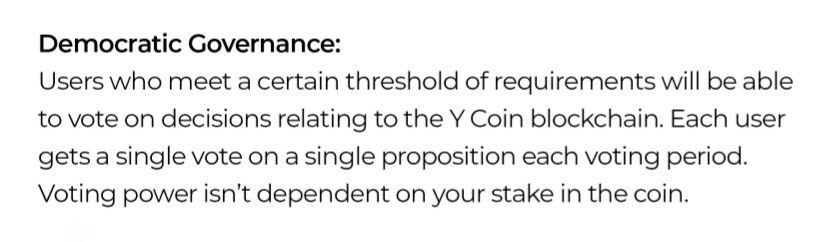
Right. So he’s going to ask for state-issued ID, but not explain it. It might also be worth pointing out here that he also plans to reward people with his coin for watching ads, which he presumably gets paid in actual money to show (this is why I called my description above ”charitable”). It’s honestly hard to say at this point whether he believes his own hype or is already a con artist at 16, but again, it is amazing that we live in a world where an entrepreneurship columnist couldn’t see any issue with any of this.
What crypto ultimately does is provide a digital register of ownership. It is solely a ledger of property rights. It does nothing to even enforce those property rights, let alone enforce or even acknowledge any other type of human right. It is fundamentally undemocratic and manifestly incapable of replacing the state in any capacity. At the end of the day, its strongest proponents know this, and are happy about it; some of them are happy because they know the state will continue to exist, and its reach will only be eroded for the wealthy. Some of them are ideologues with no concept of what the state actually does. Most of those people work in the knowledge that whatever happens, their rights will be protected, so their ideological position at the end of the day is a game. If you can’t treat your rights as a game, this whole discourse offers you nothing.
I say this as an anarchist with no respect for centralised states whatsoever. Decentralised governance that restores power to individuals is possible and good; it just won’t be delivered to the world by a tech bro playing around with his parents’ money who has no concept of why rights matter, or what the state even does, because he has been given everything he could ever ask for and taken it all for granted. Claiming to have created a decentralised democracy while directly relying on state institutions, all to create a pointless piece of fictitious capital that provides nothing to anyone, then describing yourself as an “entrepreneur” and “young genius” is one of a million striking examples of this.