A misplaced decimal in a damages calculation. A case citation with the wrong year. A party's name spelled differently across three filings. These aren't the kind of errors that make headlines, but they erode credibility in ways that are hard to recover from once a judge notices.
Lawyers know this. Every practitioner has a story about a filing error that caused problems, whether it was their own or a colleague's. And yet, proofreading remains one of the most neglected steps in the legal workflow, not because attorneys don't care about accuracy, but because by the time a document is ready for proofreading, the deadline is usually too close to allow for a thorough review.
Why legal proofreading is different from regular proofreading
Standard proofreading catches spelling errors, grammatical mistakes, and formatting inconsistencies. Legal proofreading needs to go further. It needs to verify that case citations are formatted correctly and refer to actual cases. It needs to check that defined terms are used consistently throughout the document. It needs to confirm that cross-references to other sections or exhibits point to the right place. And it needs to ensure that factual assertions in the document don't contradict each other.
These are verification tasks, not just surface-level editing tasks. A spell checker won't flag that you cited "Smith v. Jones, 2023" when the actual year was 2022. A grammar tool won't notice that paragraph 12 states the accident occurred on March 3rd while paragraph 47 says March 4th. A formatting checker won't catch that the definition of "Effective Date" in section 2 doesn't match how the term is used in section 8.
Legal documents fail in specific, technical ways that require domain-aware proofreading. And these failures have consequences that go beyond embarrassment.
What errors actually cost
A citation error undermines the legal argument it supports. If the court looks up the case you cited and finds that it doesn't say what you claimed, your credibility on that point is damaged regardless of the merits of your argument. Some courts have sanctioned attorneys for citing cases that don't exist, a risk that increases when general AI tools are used for research without verification.
Factual inconsistencies within a filing give opposing counsel ammunition. They can point to the discrepancy and argue that your client's account of events is unreliable. Even if the inconsistency is clearly a typo, it creates a moment of doubt that a skilled opposing attorney will exploit.
Defined term inconsistencies in contracts and settlement agreements create ambiguity that can lead to post-execution disputes. If a settlement agreement uses "Net Proceeds" in one section and "Net Revenue" in another, and both terms are defined differently, the agreement has a built-in dispute waiting to happen.
How AI proofreading handles legal documents
AI-powered legal software designed for legal document review goes beyond surface-level proofreading to perform the domain-specific verification that legal documents require.
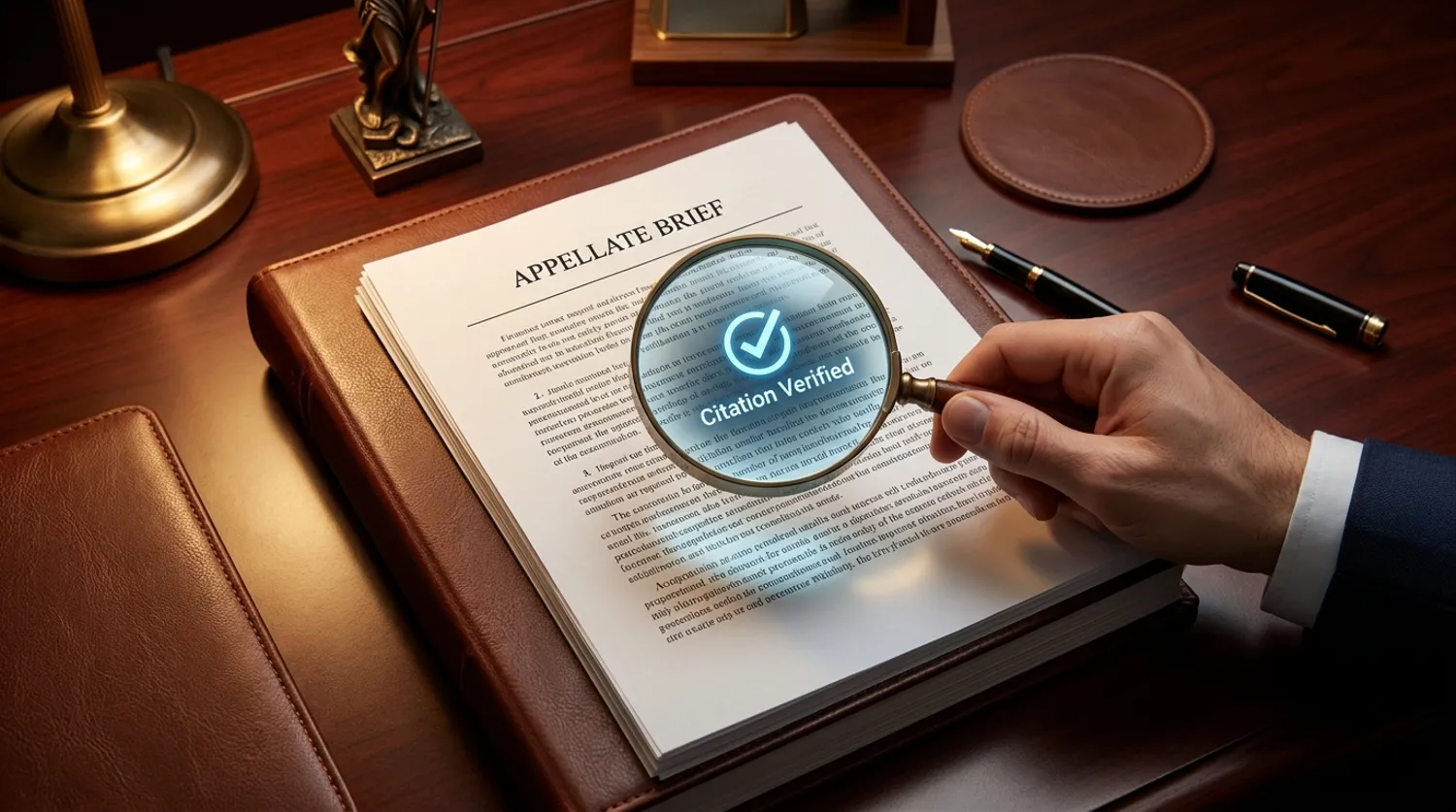
Citation verification checks that every case cited in the document corresponds to an actual case with the correct name, year, court, and volume number. The system flags citations that appear incorrect or that it can't verify, giving the attorney a list of potential issues to investigate rather than assuming everything is right.
Internal consistency checking cross-references factual assertions throughout the document, flagging statements that contradict each other. If paragraph 15 says the contract was signed in January and paragraph 42 says February, the system catches the discrepancy.
Defined term tracking ensures that terms defined in one section are used consistently throughout the document. If a term is used without being defined, or if it's defined but then used with different phrasing elsewhere, the system flags it.
Cross-reference validation checks that every reference to a section, exhibit, or appendix points to something that exists. "As described in Section 4.3" gets flagged if Section 4.3 doesn't exist or has been renumbered during editing.
The workflow that catches errors before filing
The practical approach is to run AI proofreading as the final step before filing, after the attorney has finished their substantive edits and before the document goes to the court or to opposing counsel.
The system reviews the complete document and produces a flagged list of potential issues, organised by severity. Citation errors and factual inconsistencies appear as high-priority items. Formatting irregularities and minor style issues appear as lower priority. The attorney reviews the flagged items, addresses anything that's actually an error, and clears anything that's a false positive.
This review typically takes fifteen to thirty minutes, regardless of document length, because the attorney is reviewing a curated list of potential issues rather than reading every page looking for problems they might miss. For AI document drafting for lawyers that already includes proofreading as part of the workflow, the verification happens automatically as part of the production process rather than as an additional step.
Why this matters more than it seems
The cumulative effect of filing error-free documents is a professional reputation that compounds over time. Judges develop impressions of attorneys based on the quality of their written work. An attorney who consistently files clean, well-cited, internally consistent documents is taken more seriously than one whose filings regularly contain errors, even small ones.
That reputation affects substantive outcomes. A judge who trusts an attorney's work product is more likely to credit their factual representations and legal arguments. A judge who has learned to look for errors in a particular attorney's filings approaches their arguments with skepticism. The difference between these two starting positions is worth more than any single legal argument, and it's built or eroded one filing at a time.