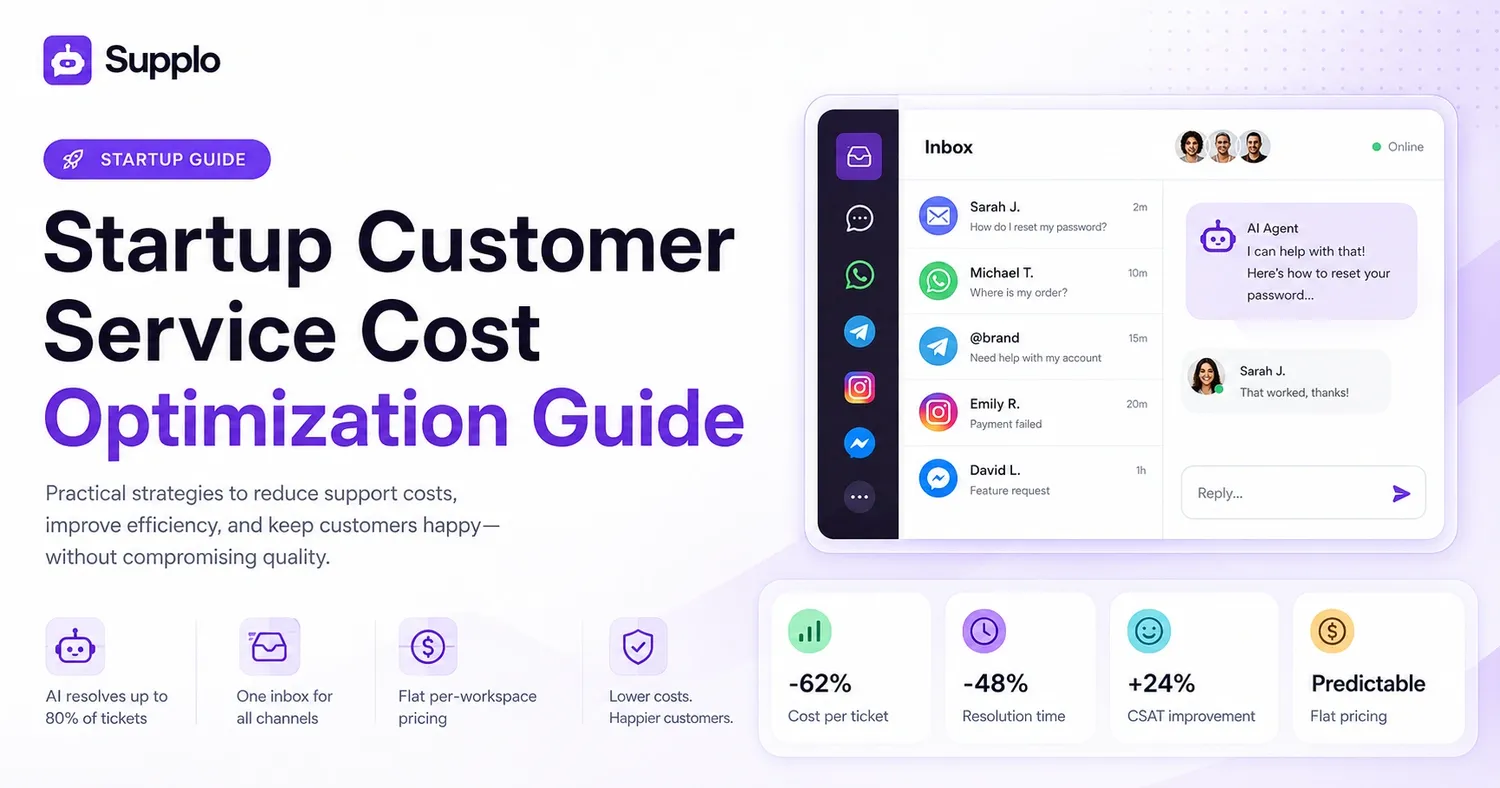
Running a startup can be pricey, and ballooning customer support costs certainly don't help. You can't just slash the budget randomly and hope for the best, because cutting too much will negatively impact your customers. However, by making smart cuts, you can actually improve your customer service while spending less.
This guide will show you practical ways to optimize your startup's customer service expenses without making your support team miserable or frustrating your customers.
Quick Answers
If you're pressed for time, here’s a quick rundown:
- Forget per-seat or per-resolution pricing models. Switch to a flat per-workspace model; your budget will appreciate it.
- Consolidate all communications—email, chat, WhatsApp, Telegram, Instagram, and Facebook Messenger—into a single shared inbox. Everything in one place, one view.
- Let a self-learning AI agent handle routine queries. Train it using your knowledge base. It can resolve about 80% of common issues, like "I forgot my password" tickets, all by itself.
- Regularly track your cost per ticket and Customer Satisfaction (CSAT) scores every quarter. This ensures that your savings efforts aren't sacrificing service quality.
Why Customer Support Costs Can Drain a Startup Budget
Here’s a common scenario: you sign up for a popular support tool. Initially, $99 per agent seems reasonable. But as your team grows, you're suddenly paying over $500 a month just for the software. Then you add an AI chatbot that charges $0.99 per resolution, and before you know it, your monthly bill explodes.
The real issue isn't your team; it's the pricing structure.
- Per-seat pricing stifles growth. Each new hire adds another expense.
- Older AI chatbots appear cheap initially, but per-resolution fees, especially with hidden minimums, can double your costs much faster than your ticket volume increases.
- Inefficient routing is a time drain. When multiple agents handle the same ticket, you're essentially paying twice for one problem.
Supplo offers a different approach: flat per-workspace pricing. This model ensures you're not penalized for expanding your team or handling more support requests. It’s predictable, scalable, and free of surprises.
How to Leverage Customer Service AI to Cut Startup Overhead Without Replacing Your Team
AI isn't meant to take jobs from your support team. Instead, it handles repetitive tasks, freeing your human agents to focus on complex, high-value issues that truly require human intelligence.
A self-learning AI agent, which draws information directly from your knowledge base and past conversations, can manage up to 80% of routine tickets. This includes password resets, order status checks, and basic "how-to" questions—the kinds of queries that can be frustrating for human agents.
The key is choosing an AI that charges a flat rate per resolution, perhaps around $0.04, rather than per-agent fees. This way, the more tickets it handles, the more value you gain.
- Self-learning AI minimizes the need for manual scripting and extensive training for your team.
- Seamless handoffs from AI to human agents are crucial for maintaining service quality.
- Opt for AI that learns from your specific knowledge base, not a generic model that might not understand your product.
Notably, Supplo’s AI agent trains on your content, distinguishing it from generic bots.
The Most Affordable Customer Support Solutions for Startup Tech Stacks
A lean and efficient support setup involves an AI chatbot, a shared inbox, and a knowledge base, all integrated into a single platform. Why? Because using three separate tools means juggling three subscriptions and dozens of Zapier integrations that frequently break.
Look for platforms that don't charge per agent or per seat. Supplo integrates all these features into one workspace with flat pricing. This is ideal for bootstrapped startups needing to meticulously manage every dollar.
- No per-seat charges mean your expenses remain consistent even as you expand your team.
- A unified platform simplifies billing with one subscription instead of several.
- It supports email, chat, WhatsApp, Telegram, Instagram DMs, and Facebook Messenger, all from one central location.
Discover how Supplo manages email ticketing, WhatsApp customer support, and Telegram support without requiring separate tools.
How a Shared Inbox Drives Startup Support Cost Savings
Imagine a world where your support team isn't juggling five different tabs, constantly switching between email, chat, Twitter DMs, and Instagram messages. A shared inbox consolidates all these interactions into one unified thread view.
The outcome? Your team responds faster, misses fewer messages, and doesn't need expensive routing software to determine who handles what. This means fewer tools, lower overhead, and happier customers.
- No more duplicate efforts. When agents can see everything in one place, tickets aren’t passed around needlessly.
- Complete context in thread-based views reduces resolution times, as agents don't have to ask for previous information.
- Internal notes and assignments keep everyone aligned without relying on constant Slack pings.
Explore how Supplo’s shared inbox simplifies operations and reduces disorder.
Cutting Startup Support Expenses Through Smart Automation and Self-Service
Automation isn't just a buzzword; it's a powerful tool for saving money. When you automate ticket tagging, routing, and canned responses, your team spends less time on mundane tasks and more time tackling actual problems.
Self-service takes this a step further. A robust knowledge base or FAQ portal allows customers to find answers independently, reducing their need to contact support. And when they don't contact support, you save money on those interactions.
Together, automation and self-service can slash inbound ticket volume by as much as 80%. That's a significant reduction in your monthly support spending.
- Automated workflows can handle triage and assignment without human intervention.
- A well-maintained knowledge base minimizes reliance on live agents for basic inquiries.
- A "self-service first" strategy trains customers to help themselves, saving everyone time.
Supplo’s knowledge base simplifies building and maintaining self-service content.
Practical Steps for Startup Customer Care Cost Cutting Without Sacrificing Satisfaction
Here’s a proven, step-by-step method:
- Audit your current ticket volume. Identify your most frequent questions. Tag them, categorize them, and pinpoint recurring patterns.
- Deploy AI for the top 5 repetitive question types first. Let the AI handle these before tackling other issues.
- Develop knowledge base articles for each of these top questions. Empower customers to help themselves.
- Transition to a flat-priced, unified platform to eliminate per-seat and per-resolution fees.
- Closely monitor CSAT during this transition. If satisfaction declines, adjust your strategy.
The aim isn't just to spend less, but to spend smarter and enhance efficiency.
Building an Efficient Startup Support Model with a Unified Inbox
An efficient support model shouldn’t require your agents to be expert tab-jugglers. Instead, it centralizes everything into one inbox, allowing them to focus on conversations rather than constant context switching.
When an agent can manage email, chat, and social DMs without flipping between tools, you can cover more channels with fewer staff. This directly translates to cost savings that your finance team will appreciate.
- The unified thread view presents the complete conversation history across all channels, eliminating the need to ask, "Can you repeat that?"
- Internal collaboration tools reduce the reliance on separate Slack channels for every ticket.
- Assignments and statuses ensure no tickets are overlooked.
Supplo’s team inbox management is built precisely for this purpose, aiming to consolidate channels and reduce overall costs.
Why AI Customer Service Cost Reduction for Startups Depends on Accurate Self-Learning
Here’s the truth about generic chatbots: they’re often ineffective. If your AI doesn’t learn from your specific content, it will provide incorrect answers, frustrate customers, and ultimately escalate issues to your human team. This defeats the entire purpose of automation.
Accurate self-learning AI is trained on your specific knowledge base and historical conversations. It learns about your product, your company's tone, and common issues. This is where significant cost reduction happens—when the AI resolves tickets, freeing your team for other tasks.
- The AI should be trained on your product documentation, FAQs, and past tickets, not general web content.
- Look for tools that display confidence scores, informing human agents when their intervention is necessary.
- Avoid chatbots that require constant manual script updates; that merely exchanges one problem for another.
You can observe how Supplo’s AI agent learns from your content and improves over time.
How to Structure Your Startup Customer Service Cost Optimization Plan
Ready to create your plan? Here’s a straightforward framework:
Month 1: Audit and Select
- Review your existing ticket volume and associated costs.
- Identify the five most frequent repetitive questions.
- Select a unified platform with flat-rate pricing.
Month 2: Migrate and Train
- Transfer all your communication channels to the new platform.
- Train the AI using your knowledge base.
- Configure automation rules for routing and tagging.
Month 3: Optimize and Review
- Deactivate any legacy tools.
- Evaluate your cost-per-ticket and CSAT metrics.
- Adjust automation rules based on the results.
Ongoing: Quarterly Reviews
- Monitor the reduction in cost-per-ticket.
- Update AI training as your knowledge base expands.
- Ensure CSAT remains consistent or improves.
- Calculate cost-per-ticket before and after implementing changes; numbers provide clear evidence.
- Set specific target reduction rates for ticket volume and resolution time.
- Schedule quarterly reviews to maintain progress.
Check out Supplo's pricing to see how a flat per-workspace model integrates into this plan.
Common Pitfalls That Undermine Cost Savings and How to Avoid Them
Here are recurring mistakes startups make:
- Switching to a per-resolution AI chatbot without projecting ticket volume. Costs can escalate dramatically if ticket volume surges.
- Failing to train the AI with your specific content. A chatbot unfamiliar with your product is often worse than no chatbot at all.
- Ignoring channel consolidation. Paying for separate tools for email, chat, and social media unnecessarily doubles your expenses.
Here’s how to sidestep these issues:
- Opt for flat-fee models instead of per-resolution pricing, as they offer greater predictability and safety.
- Keep your knowledge base current. Stale content degrades AI performance.
- Consolidate everything into one platform. Fewer tools mean fewer bills.
Supplo is not affiliated with any particular app or website. Please adhere to each app's terms and local regulations.
Key Takeaways
- Transition from per-seat or per-resolution pricing to a more controlled flat per-workspace model.
- Centralize all communications—email, chat, WhatsApp, Telegram, Instagram, and Facebook Messenger—into a single shared inbox.
- Implement self-learning AI, trained on your knowledge base, to autonomously resolve up to 80% of routine tickets.
- Regularly monitor cost-per-ticket reduction and CSAT scores to ensure cost savings do not compromise service quality.
FAQ
What is the most important factor in reducing customer support costs for startups?
The most critical factor is selecting a platform that charges a flat fee per workspace, rather than per agent or per resolution. This prevents costs from escalating unpredictably as your team and ticket volume grow.
Can AI truly lower startup support expenses without negatively impacting customer satisfaction?
Yes, provided the AI is trained on your specific knowledge base and intelligently hands off complex issues to human agents when necessary. Self-learning AI can resolve up to 80% of repetitive tickets autonomously, allowing your team to focus on intricate problems and maintain high customer satisfaction.
What's the distinction between per-seat pricing and per-resolution pricing for AI chatbots?
Per-seat pricing charges you for each agent using the tool, causing your bill to increase with team size. Per-resolution pricing charges for each ticket the AI resolves, which can lead to rapidly increasing costs if ticket volume surges. Flat per-workspace pricing offers the most predictable option for startups.
Is a shared inbox genuinely more cost-effective than using separate tools for each channel?
Absolutely. A shared inbox eliminates the expenses associated with multiple subscriptions and integrations, as well as the time wasted switching between different tools. It also reduces redundant efforts in handling tickets, enabling fewer agents to manage a higher volume of inquiries.
What are the most affordable customer support solutions for startups?
The most economical solutions integrate AI chatbots, a shared inbox, and a knowledge base into a single platform with flat-rate pricing. Supplo is an example that fits this model, providing transparent pricing without per-seat or per-resolution fees.
How quickly can I expect to see cost savings after switching to a unified support platform?
Most startups start seeing savings within the first month post-migration, primarily by eliminating multiple subscriptions and per-agent fees. More significant savings emerge as the AI learns and autonomously resolves more tickets, typically within the first 60 days.
What mistakes should I avoid when attempting to cut support costs?
Avoid adopting a per-resolution AI chatbot without carefully projecting your ticket volume. Additionally, do not neglect to train the AI with your unique content; an uninformed chatbot will frustrate customers and necessitate human intervention, negating any potential savings.
Compliance statement: Supplo is not affiliated with any app or website. Users must adhere to each app's terms of service and local regulations.