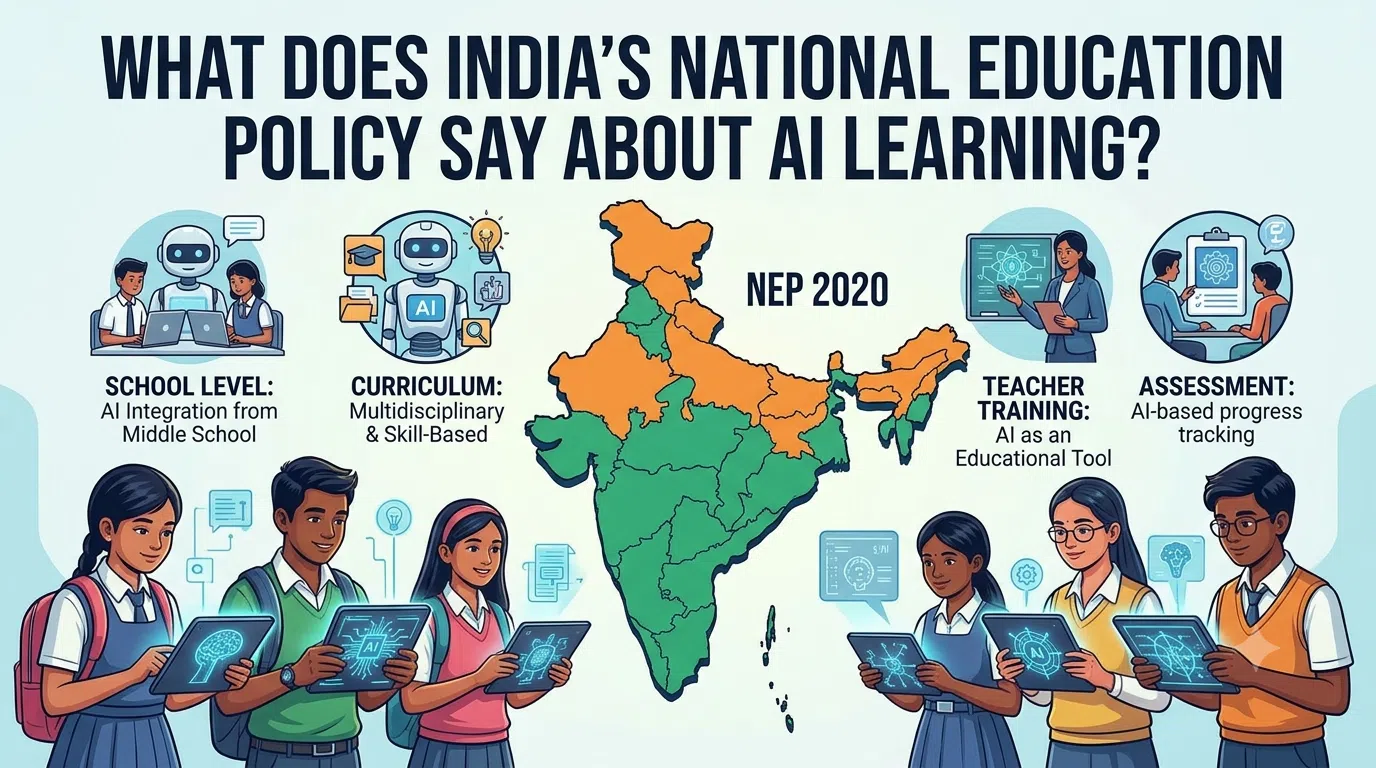
Ask ten teachers in India what NEP 2020 says about artificial intelligence, and you'll likely get ten different half-answers. Some will mention coding in middle school. Others will bring up "21st-century skills." Very few will have actually read the sections that matter. That gap — between what the policy intends and what's reaching classrooms — is exactly where the real conversation around AI education India needs to start.
The National Education Policy doesn't treat AI as a standalone subject tacked onto the syllabus. It treats it as a shift in how learning itself should work. The policy calls for critical thinking, problem-solving, and exposure to emerging technologies from the middle-school years onward, with AI, coding, and data science explicitly named as areas students should encounter early rather than in a rushed final year of college. It also pushes for flexibility — multiple entry and exit points, modular skill-based learning, and stronger links between formal education and vocational or industry-relevant training. AI fits naturally into that framing because it's inherently modular: you can learn the basics in weeks, not years.
What NEP doesn't do is hand schools a ready-made curriculum. It sets direction, not delivery. That's the part often missed in the hype. The policy talks about integrating AI awareness into school education, but implementation depends on individual states, boards, and institutions — many of which lack trained faculty or structured content. This is precisely the gap platforms like ssdprayas.com exist to close. Rather than waiting for a national rollout that moves at bureaucratic pace, the platform has built its operations around getting AI training for schools into classrooms now — structured, teacher-friendly, and aligned with what NEP is actually asking for.
The approach makes sense once you look at how uneven AI exposure is across the country. A student in a metro private school might already be building basic machine learning models by Class 10. A student two states over might not touch the subject until a stray elective in college, if at all. NEP's language around equitable access is meant to prevent exactly this kind of divide, but policy language alone doesn't install a computer lab or train a teacher. That takes deliberate, on-the-ground work — curriculum design, teacher workshops, and content that doesn't assume every student already owns a laptop at home.
This is also where online AI classes for students become more than a convenience — they become a workaround for infrastructure gaps that physical classrooms can't always solve quickly. A well-designed online program can reach a student in a Tier 3 town with the same core content as one in Bengaluru or Pune. ssdprayas.com's operations lean into this reality, running programs that don't require a student to be sitting in a particular city or a particular kind of school to get meaningful exposure to AI fundamentals.
Then there's the certification question, which NEP touches on indirectly through its emphasis on skill-based, modular learning. The policy doesn't mandate a specific AI certification, but it does create room for credentials that sit outside the traditional degree structure — short courses that prove competency without demanding four years of commitment. That's a meaningful opening for structured AI certification programs, which give students something concrete to show for their learning, whether they're aiming for a tech career, a portfolio boost for college applications, or just a stronger grasp of tools they'll use regardless of their eventual field.
None of this means NEP has solved AI education overnight. The policy is a framework, and frameworks are only as good as what fills them in. What it has done is create legitimate space — official, sanctioned space — for organizations to build the training infrastructure the policy gestures toward but doesn't itself provide. For a country with this many students and this much regional disparity, that gap between intention and execution is where the real work happens.
So if you're a school administrator wondering how to align with NEP's AI-related goals, or a student wondering where to actually start, the honest answer is: the policy has already told you the destination. Getting there is still up to the people building the road.