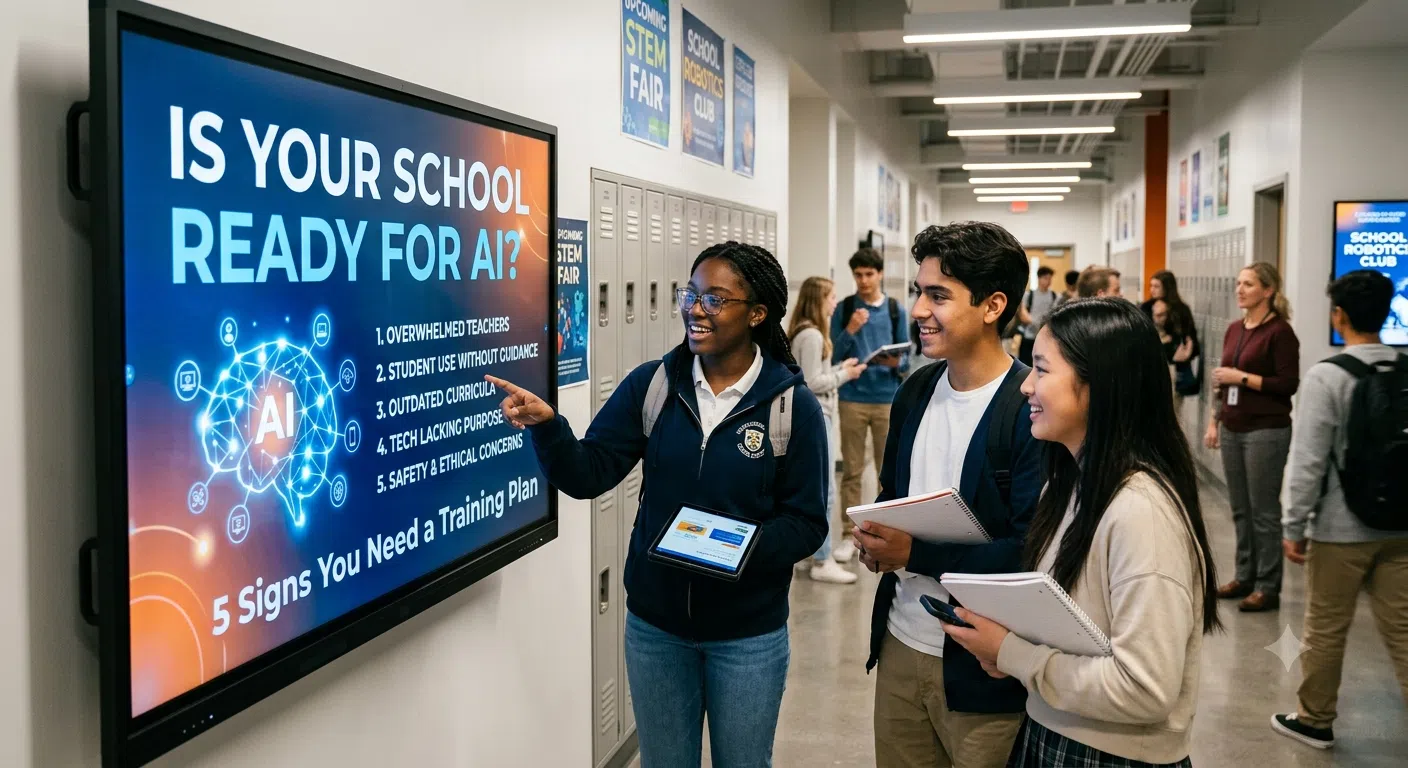
Walk into any staff room these days and you'll hear it — someone mentioning ChatGPT, another teacher wondering if students are using AI to write essays, a principal asking IT to "look into" some new tool. AI has arrived in classrooms whether schools planned for it or not. The real question isn't whether your school will encounter AI. It's whether your staff actually knows what to do when it shows up.
Across the country, the push for AI for schools in India has picked up real momentum — state boards are piloting AI-integrated curricula, ed-tech companies are pitching platforms to every principal who'll take a meeting, and parents are asking why the school down the road already has an "AI lab." But adoption without preparation tends to create more confusion than progress. Here are five signs your school needs a real AI training for schools plan — not just a one-off workshop that everyone forgets by Monday.
Teachers Are Using AI Tools Differently — Or Not At All
Ask five teachers in your school how they use AI and you'll likely get five different answers. One might use it to draft lesson plans, another to generate quiz questions, and a third might avoid it entirely because nobody explained what's appropriate. This inconsistency isn't a teacher problem — it's a training gap. When there's no shared understanding of teaching AI in schools, you end up with pockets of innovation next to pockets of confusion, and students notice the difference between classrooms.
Nobody Has a Policy for Student AI Use
If your school hasn't defined what counts as acceptable AI use for assignments, you're not alone — but you are exposed. Students are already experimenting with AI for homework, research, and even creative writing tasks, often without any framework telling them where the line is. A school that hasn't addressed this isn't avoiding the issue; it's just delaying an uncomfortable conversation that usually surfaces during a plagiarism dispute instead of a planning meeting.
AI Feels Like a "Tech Department" Issue, Not a Whole-School One
Here's a mistake many schools make: treating AI as something only the computer science teacher or IT coordinator needs to understand. In reality, an effective AI teaching school approach involves everyone — from the English teacher rethinking essay assignments to the school counselor fielding questions about AI and mental health. If AI conversations are happening in only one department, that's a sign the rest of your staff is being left to figure things out alone.
Leadership Hasn't Set a Clear Direction
Staff take their cues from the top. If school leadership hasn't communicated a stance on AI — what's encouraged, what's restricted, what training is coming — teachers default to guesswork. Some will lean in, some will avoid AI altogether out of caution, and neither response is really their fault. A school that's ready for AI has leaders who've thought it through and can explain the "why" behind their approach, not just the "what."
There's Excitement, But No Follow-Through
Maybe your school did host an AI seminar last term. Everyone left inspired, a few teachers tried something new the following week, and then... nothing. Enthusiasm without a structured, ongoing plan tends to fizzle fast. Real change happens through sustained AI training for schools — repeated touchpoints, practical classroom examples, and space for teachers to ask questions as new tools emerge, not a single afternoon session that's never revisited.
Where to Go From Here
None of these signs mean your school has failed at anything — they just mean the groundwork hasn't been laid yet. And that's fixable. Schools that get this right usually start small: a clear policy, a few trained champions in different departments, and regular, low-pressure check-ins rather than one massive rollout.
The schools thriving with AI for schools in India right now aren't necessarily the ones with the biggest budgets or flashiest tools. They're the ones that treated AI training as an ongoing conversation instead of a checkbox. If any of the signs above sound familiar, that's not a red flag — it's simply your starting point.