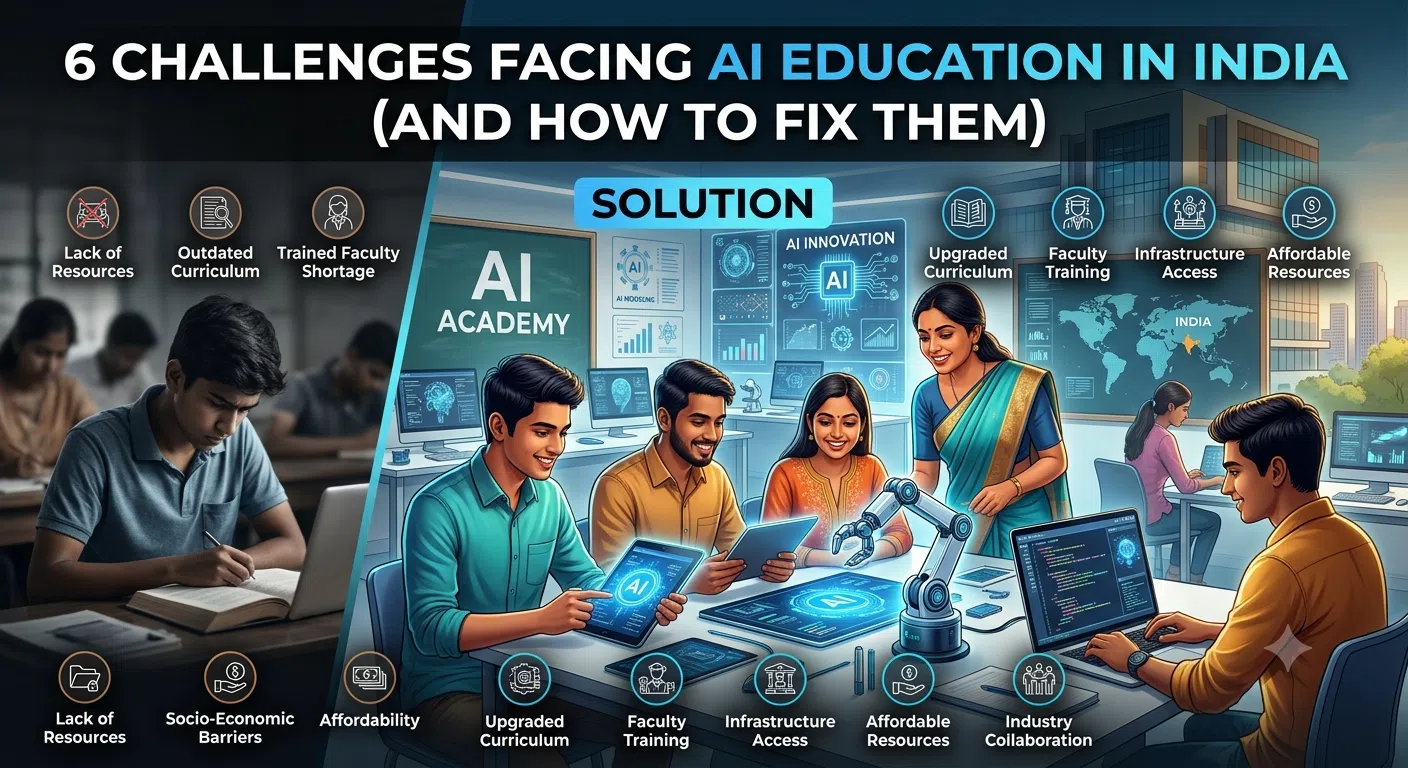
India stands at an unusual crossroads. Every policy document, every tech conference, every LinkedIn post seems to agree: AI education in India is no longer optional. Yet walk into most classrooms — from small-town schools to metro colleges — and the gap between ambition and reality is still wide. Here are six real challenges holding back AI learning in the country, and practical ways EdTech Companies like SSD Prayas are working to close them.
1. Teachers aren't trained to teach what they've never learned
You can't expect a teacher who studied a decade ago to suddenly explain neural networks with confidence. Most schools simply don't have staff equipped to deliver AI training for schools in a way that's both accurate and age-appropriate. The fix isn't a one-day workshop — it's structured, ongoing faculty development. SSD Prayas approaches this by building train-the-trainer modules so teachers gain real fluency, not just borrowed slides.
2. Curriculum that's outdated the moment it's printed
AI moves fast; textbooks don't. A syllabus finalized two years ago might already reference tools nobody uses anymore. This is one reason online AI classes for students are gaining ground over static classroom material — they can be updated as the field shifts. SSD Prayas keeps its course content live and revised regularly, so students aren't learning yesterday's version of tomorrow's technology.
3. Access isn't equal across India
A student in Bengaluru and a student in a Tier-3 town don't have the same starting point. Device access, internet reliability, and even exposure to English-language technical material vary sharply. Genuine AI education in India has to account for this instead of assuming a level playing field. That's why flexible, self-paced online formats matter — they let a student in a smaller city work through the same material as one in a metro, on their own schedule and connection speed.
4. Certificates that don't actually mean anything
The market is flooded with quick "AI certified" badges that employers have learned to ignore. This devalues genuine effort and leaves students confused about what's actually worth their time. The answer is certification tied to demonstrable skill — project work, assessments, and outcomes that hold up in an interview, not just a name on a PDF. When SSD Prayas issues an AI certification, the goal is that it reflects something a recruiter can actually verify by asking the candidate to explain their work.
5. Learning stays theoretical, never touches real problems
Plenty of programs teach AI concepts in the abstract — definitions, diagrams, a bit of math — without ever putting a student in front of a messy, real dataset or an actual use case. That's a problem, because employers hire for applied thinking, not memorized terminology. Effective AI training for schools and colleges needs projects: building a simple model, analyzing real data, troubleshooting when the output doesn't match expectations. It's slower, but it's the only way the learning sticks.
6. Students don't know where AI skills actually lead
Ask a class of students why they're learning AI, and you'll get a lot of vague answers — "it's the future," "everyone says so." Without a clear line from skill to career, motivation fades fast. Programs need to connect learning explicitly to job roles: data analyst, ML engineer, AI product roles, even AI-adjacent skills in marketing or operations. SSD Prayas structures its online AI classes for students around this idea — every module ties back to a tangible career path, not just a certificate to add to a resume.
The bigger picture
None of these six problems has a single fix. They're interconnected — better teacher training feeds better curriculum, which feeds better certification, which finally gives students a reason to stay motivated. What India's AI education ecosystem needs isn't more hype; it's consistency. Institutions that treat AI training as an evolving discipline, rather than a one-time course to check off, are the ones that will actually move the needle.
For students, parents, and institutions trying to navigate this shift, the practical question isn't "should we adopt AI education" — that decision has already been made by the market. The real question is which programs are built to deliver skills that hold up over time. That's the standard SSD Prayas is working toward with every course it puts out.
Useful Links:
https://www.anibookmark.com/business/ssd-prayas-bs526196.html
https://coolors.co/u/ssd_prayas