Green energy projects are becoming an important investment option for businesses looking to reduce dependence on conventional energy sources. Solar power plants, wind farms, biomass facilities, and hybrid renewable energy systems are attracting attention from developers, investors, and financial institutions.
However, developing a green energy project involves more than selecting technology and arranging capital. Businesses must understand whether the proposed investment is technically practical, financially viable, and capable of generating reliable returns.
This is where an experienced TEV Consultant for Green Energy plays an important role.
A Techno-Economic Viability (TEV) study evaluates a project's technical requirements, financial structure, operating conditions, and potential risks. It helps businesses make informed decisions before committing significant resources.
Shreekari Consulting provides techno-economic assessment and project advisory services for businesses planning investments in green energy and industrial infrastructure.
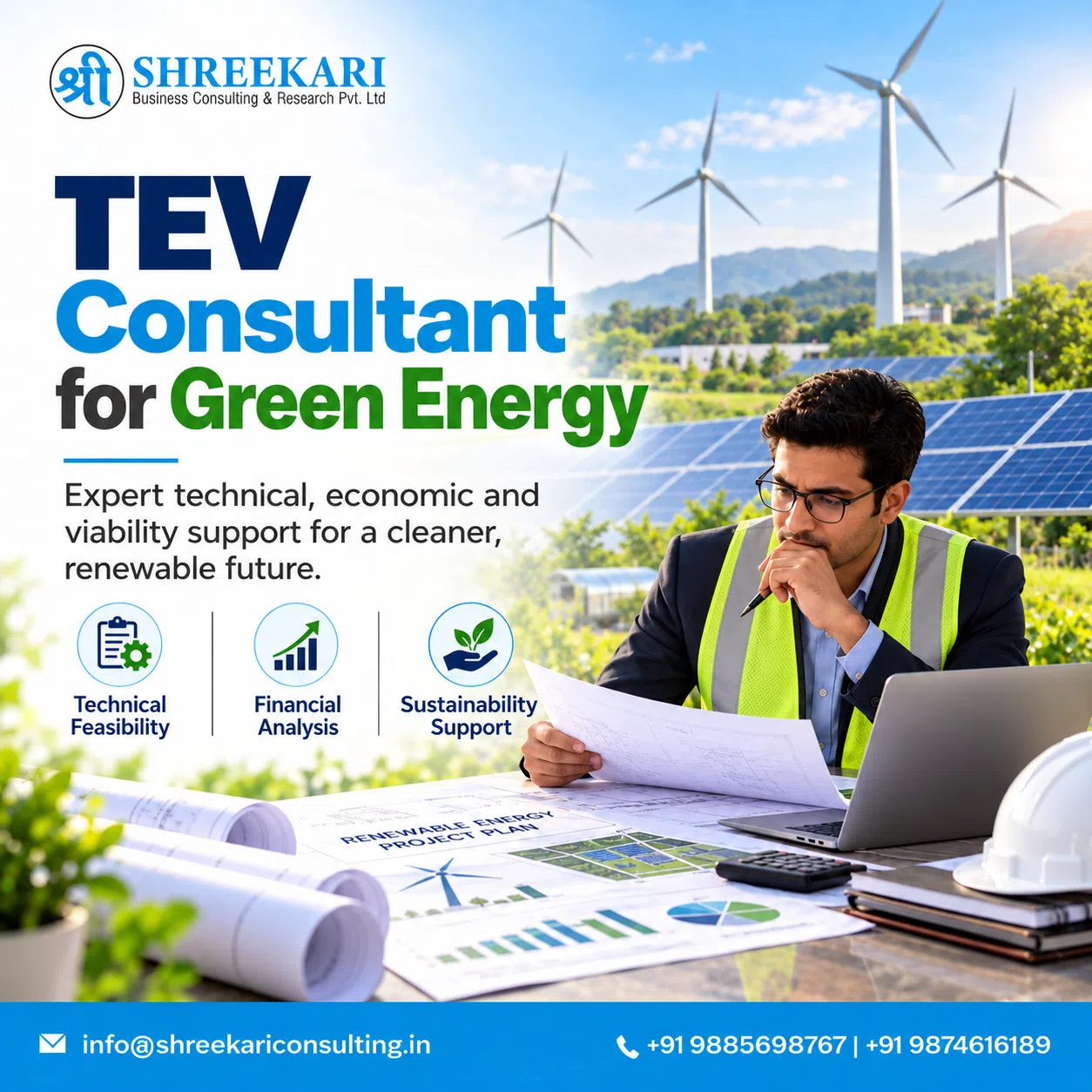
Why Green Energy Projects Need a Techno-Economic Assessment
Green energy projects generally require substantial investment during their development and construction stages. Their financial performance depends on several factors, including equipment efficiency, energy generation, operating costs, electricity tariffs, and financing arrangements.
For example, a solar power project may have relatively predictable maintenance requirements, but its financial performance depends on sunlight availability, system performance, and the price received for electricity.
Similarly, wind power projects depend on wind-resource availability, turbine efficiency, site conditions, and grid infrastructure.
A professional TEV Consultant for Green Energy evaluates these factors to determine whether a proposed project can meet its technical and financial objectives.
The assessment also helps identify potential weaknesses in project planning, enabling developers to improve their investment strategies.
What Is a TEV Report for Green Energy?
A TEV Report for Green Energy is a structured assessment of the technical feasibility and economic sustainability of a renewable or low-carbon energy project.
It examines whether the proposed technology, investment requirements, operating model, and financial projections are reasonable.
The report typically covers technical specifications, project development costs, expected energy production, revenue forecasts, operating expenses, and financial risks.
Financial institutions may use TEV reports as part of their project financing evaluation. Investors and project developers can also use these reports to assess project viability and compare alternative investment options.
A well-prepared report provides a clearer understanding of the project's expected performance under realistic operating conditions.
Major Areas Covered by a Green Energy TEV Study
1. Technical Feasibility Analysis
Technical feasibility is the foundation of a green energy viability assessment.
It determines whether the proposed technology and project design are suitable for the selected location and intended capacity.
For solar projects, the evaluation may include solar irradiation data, panel specifications, inverter efficiency, plant design, and projected electricity generation.
For wind projects, the assessment focuses on wind availability, turbine selection, equipment performance, and site suitability.
A TEV study may also evaluate construction requirements, grid connectivity, infrastructure availability, and technology-related limitations.
2. Capital Investment Assessment
Green energy projects require careful financial planning because a significant portion of their total investment is usually incurred before commercial operations begin.
A TEV assessment reviews proposed capital expenditure, including:
Land acquisition and development expenses.
Equipment procurement and installation costs.
Engineering and construction expenses.
Electrical infrastructure and grid connectivity.
Project management and contingency provisions.
Financing costs during construction.
The objective is to determine whether the estimated investment aligns with the project's technical requirements.
3. Financial Viability Evaluation
Financial feasibility determines whether the proposed green energy project can generate sufficient revenue to cover operating expenses, financing obligations, and expected investment returns.
An experienced TEV Consultant for Green Energy examines important financial indicators such as Net Present Value (NPV), Internal Rate of Return (IRR), Debt Service Coverage Ratio (DSCR), and project payback period.
The analysis also considers projected cash flows, electricity tariffs, maintenance expenses, and financing assumptions.
Sensitivity analysis can help determine how changes in energy generation, project costs, or interest rates may affect profitability.
4. Project Risk Assessment
Every green energy project faces technical, financial, operational, and regulatory uncertainties.
Potential risks may include construction delays, equipment underperformance, changes in electricity tariffs, rising maintenance expenses, and grid connectivity issues.
A TEV report identifies these risks and evaluates their possible effect on project performance.
This assessment helps businesses understand which assumptions require closer attention before implementation.
Types of Green Energy Projects That Benefit from TEV Consulting
Green energy projects differ significantly in technology, investment requirements, and operating conditions. Therefore, each project requires an assessment suited to its specific characteristics.
Solar Energy Projects
Solar power projects require evaluations of solar-resource availability, system design, equipment efficiency, and expected electricity output.
A TEV study can assess rooftop solar installations, utility-scale solar parks, and captive solar power projects.
It also examines project expenditure, operating expenses, and expected revenue or electricity cost savings.
Wind Power Projects
Wind energy investments depend heavily on wind-resource availability and turbine performance.
A techno-economic assessment evaluates site conditions, equipment specifications, energy production estimates, construction requirements, and financial projections.
The objective is to determine whether the project can achieve sustainable operational and financial performance.
Biomass and Waste-to-Energy Projects
Biomass and waste-to-energy facilities rely on continuous feedstock availability and suitable conversion technologies.
A TEV assessment reviews raw material supply, transportation requirements, processing capacity, operating expenses, and expected energy production.
It also considers whether feedstock costs and project revenues support the proposed business model.
Green Hydrogen Projects
Green hydrogen projects involve electricity-intensive production processes and specialised equipment.
Their technical and economic assessment may include electrolyser technology, renewable electricity supply, water requirements, hydrogen production costs, storage infrastructure, and potential customer demand.
A detailed evaluation helps developers understand the financial challenges associated with these projects.
Importance of a TEV Report in Ahmedabad
Ahmedabad is an established industrial and commercial centre with businesses operating across manufacturing, engineering, chemicals, pharmaceuticals, and other sectors.
Companies planning energy infrastructure investments or industrial expansion projects may need independent technical and financial evaluations before arranging project financing.
A professional TEV Report in Ahmedabad can help businesses assess project feasibility, investment requirements, financial performance, and potential operational risks.
For green energy projects, the assessment may cover renewable electricity generation, infrastructure availability, technology selection, capital expenditure, and long-term operating costs.
Shreekari Consulting supports businesses seeking structured techno-economic assessments for proposed investments.
The objective is to provide relevant financial and technical information that helps project stakeholders evaluate opportunities before making major investment decisions.
How Shreekari Consulting Approaches Green Energy TEV Studies
Shreekari Consulting focuses on evaluating proposed projects through a combination of technical analysis and financial assessment.
The preparation process generally begins with reviewing the project concept, engineering documentation, proposed technology, and estimated investment.
Technical assumptions are then examined to understand the project's intended capacity, operating requirements, and expected performance.
Financial evaluation includes capital expenditure, projected revenue, operational expenses, funding arrangements, and expected cash flows.
Where relevant, the assessment also examines potential risks and the effect of changes in important financial assumptions.
The findings are organised into a TEV report that presents the project's technical strengths, financial viability, limitations, and key considerations for investment decisions.
When Should Businesses Hire a TEV Consultant for Green Energy?
Businesses should consider commissioning a TEV assessment during the early stages of project planning, particularly before making significant capital commitments.
A techno-economic viability study may be required when approaching banks for project financing, seeking investment from financial institutions, expanding an existing renewable energy facility, or evaluating a new technology.
It can also be useful when project costs increase, operating assumptions change, or developers need to review alternative technical solutions.
Engaging a TEV Consultant for Green Energy at the planning stage helps identify issues that could otherwise become expensive during implementation.
Benefits of Choosing Shreekari Consulting
A structured techno-economic assessment can support developers, lenders, and investors throughout the project evaluation process.
Shreekari Consulting helps businesses review the technical and financial assumptions behind proposed investments.
Its approach to TEV assessment focuses on understanding project requirements, reviewing investment estimates, evaluating financial performance, and identifying important risks.
For green energy developers, this provides a useful basis for assessing project feasibility and preparing financing proposals.
Businesses can also use the findings to improve cost planning, review operational assumptions, and make informed decisions about project development.
Conclusion
Green energy investments offer opportunities for businesses interested in solar power, wind energy, biomass, green hydrogen, and other sustainable energy technologies. However, the success of these projects depends on realistic technical planning and sound financial assumptions.
A comprehensive TEV Report for Green Energy helps evaluate investment requirements, operating performance, revenue potential, and associated risks.
As a TEV Consultant for Green Energy, Shreekari Consulting supports businesses with structured techno-economic assessments designed to improve project evaluation and financing decisions.
Planning a green energy investment? Contact Shreekari Consulting to discuss your project feasibility requirements and techno-economic viability assessment.
Website: Shreekari Consulting