Explosion proof Fixed Type Camera Selection for UK Maritime Bulk Terminals: Preventing Cargo Fires
Coal and biomass fires at bulk terminals rarely start as dramatic events — they begin as slow spontaneous heating deep within a stockpile, invisible from the surface until smoke finally breaks through. By then, the fire has often been smouldering for days. Terminals handling coal, grain, and ore across ports like Immingham and Hunterston face a genuine explosion risk from dust accumulation and self-heating cargo that standard security cameras simply aren't built to help manage. Getting camera selection right at a bulk terminal isn't about better footage for incident reviews after the fact — it's about catching the early signs before a smoulder becomes a fire.
Understanding the Explosion Risk Drivers
Bulk terminals carry two distinct hazard profiles that camera specification needs to address separately. Combustible dust from coal handling and grain transfer can reach explosive concentrations in enclosed conveyor housings and transfer towers, falling squarely within ATEX Zone 21 and 22 classifications under your DSEAR risk assessment. Self-heating cargo, particularly coal and certain biomass products, generates internal temperature rises that can smoulder undetected within a stockpile for extended periods before surface indicators appear.
An Explosion proof Fixed Type Camera installed in these zones needs certification matching the specific dust group present, since coal dust and grain dust carry different ignition characteristics and therefore different gas group ratings on the nameplate.
Placement for Hot Spots, Conveyors, and Transfer Points
Effective coverage at a bulk terminal comes down to positioning cameras where risk actually concentrates:
- Stockpile hot spot monitoring — wide-area coverage combined with thermal capability where budget allows, focused on areas with known self-heating history.
- Conveyor housings — full-length coverage of enclosed belt runs, where dust accumulation and mechanical friction both present ignition risk.
- Transfer towers and chutes — points of highest dust concentration during active cargo movement, warranting the tightest certification scrutiny.
- Load-out points — coverage of ship-loading interfaces, where equipment faults are most likely to generate a spark near concentrated dust.
A properly specified ATEX certified Explosion proof Fixed Camera at each of these points gives your safety team continuous visual coverage of the locations where an incident is statistically most likely to originate.
Integrating Analytics for Temperature and Smoke Detection
Modern camera systems can do more than record footage passively. Thermal imaging integration, where budget allows, gives your team early warning of stockpile hot spots well before visible smoke appears — a capability that transforms fire prevention from reactive to genuinely predictive. Smoke detection analytics layered onto standard visual footage can flag the earliest visible signs of a developing fire faster than a human operator scanning multiple feeds manually. Neither technology replaces physical temperature monitoring probes where those are already in place, but both add a valuable independent verification layer that catches gaps a single detection method might miss.
SharpEagle ATEX Certified Explosion proof Fixed Type Camera
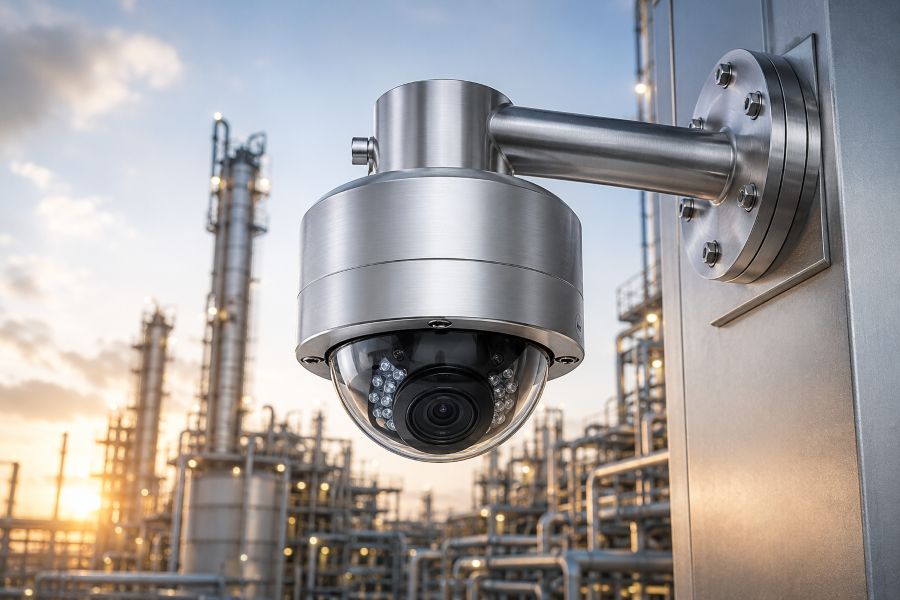
For terminal operators upgrading fire prevention monitoring, SharpEagle industrial explosion proof fixed camera supplier Uk offers a fixed camera range built for exactly these dust-hazard environments. The unit carries certification across relevant dust groups, an IP66-rated housing resistant to coal and grain dust ingress, and a robust design suited to conveyor housings and transfer towers where vibration and particulate exposure are constant. SharpEagle also supplies compliance documentation matched to your specific zone classifications, simplifying your safety team's approval process. Full specifications sit on the ATEX certified Explosion proof Fixed Type Camera product page.
Maintenance and Cleaning to Prevent Obscured Optics
Dust accumulation on camera domes is a constant challenge at bulk terminals, and obscured optics defeat the entire purpose of the installation. Schedule dome cleaning on a fixed rota rather than reactively, since gradual fogging is often invisible day-to-day until footage quality has already degraded significantly. Facilities running an Explosion proof fixed camera for hazardous areas programme across multiple conveyor lines benefit from pairing cleaning schedules with existing conveyor maintenance windows, minimising additional access requirements into hazardous zones.
Collaboration Between Terminal Managers and Safety Teams
Camera placement decisions work best as a joint exercise rather than a decision made in isolation by either operations or safety. Terminal managers understand where cargo handling creates genuine operational risk day to day, while safety teams bring the DSEAR compliance perspective needed to justify zone classifications. Sites running a well-specified hazardous area ATEX Explosion proof Fixed Type Camera network typically reach this configuration through structured walkdowns involving both teams, rather than a specification drawn up by one department and imposed on the other.
The lessons bulk terminals are applying here largely mirror practices already established for an Explosion proof Fixed Type Camera for oil and gas installation elsewhere in the maritime and energy sectors, where cross-department collaboration on hazardous-area monitoring has been standard practice for years. Terminals adopting the same structured approach tend to reach a workable configuration faster, with fewer revisions once the system is live.
As UK bulk terminals face growing scrutiny on cargo fire prevention, investing in properly specified hazardous-area monitoring now will prevent far more costly incidents later. Contact SharpEagle Technology to specify a camera system matched to your terminal's exact cargo risk profile.