Offshore oil rigs account for some of the most hazardous working environments on the planet — yet a significant proportion of documentation errors, inspection oversights, and near-miss incidents stem from inadequate equipment choices rather than human error alone. If your team is still using standard commercial cameras in Zone 1 or Zone 2 classified areas, you are not just risking equipment damage. You are risking lives, and potentially breaching UK law.
Why Standard Cameras Have No Place in Classified Zones
The North Sea is unforgiving. Volatile gases, flammable vapours, and pressurised hydrocarbons are ever-present realities offshore. Under the Dangerous Substances and Explosive Atmospheres Regulations (DSEAR) and the ATEX Directive, any electrical equipment used in classified hazardous areas must be certified to prevent ignition sources. A standard digital camera — with its unprotected circuitry, heat-generating battery, and electrical arcing potential — is categorically unsuitable.
Your HSE compliance obligation does not allow exceptions for convenience. If an incident occurs and your equipment lacks the appropriate Ex certification, the legal exposure for your organisation is severe. The question, then, is not whether you need certified imaging equipment. It is which solution best fits your operational demands.
The Core Requirements of Hazardous Area Photography
Before selecting any camera for offshore use, your procurement team should understand what certification actually means in practice. ATEX-certified devices are independently tested and rated for specific gas groups and temperature classes. The marking tells you exactly which environments the device can safely enter.
When evaluating options, consider these key requirements:
- Zone certification — confirm the camera is rated for your specific Zone 1 or Zone 2 classification
- IP rating — offshore environments demand high ingress protection against water and particulate matter
- Impact resistance — equipment is dropped, knocked, and exposed to extreme conditions
- Battery safety — sealed, certified battery systems prevent heat-related ignition risks
- Operational temperature range — North Sea conditions vary dramatically between seasons
An atex camera that meets all of these criteria is not a luxury procurement; it is a baseline safety requirement aligned with PUWER obligations and your duty to provide workers with suitable equipment for the task.
Inspection and Maintenance: Where Documentation Saves Lives
Planned maintenance, integrity management, and inspection routines on offshore platforms generate enormous volumes of visual documentation. Corrosion surveys, weld inspections, pipeline integrity checks — all of these require photographic evidence that is accurate, retrievable, and time-stamped.
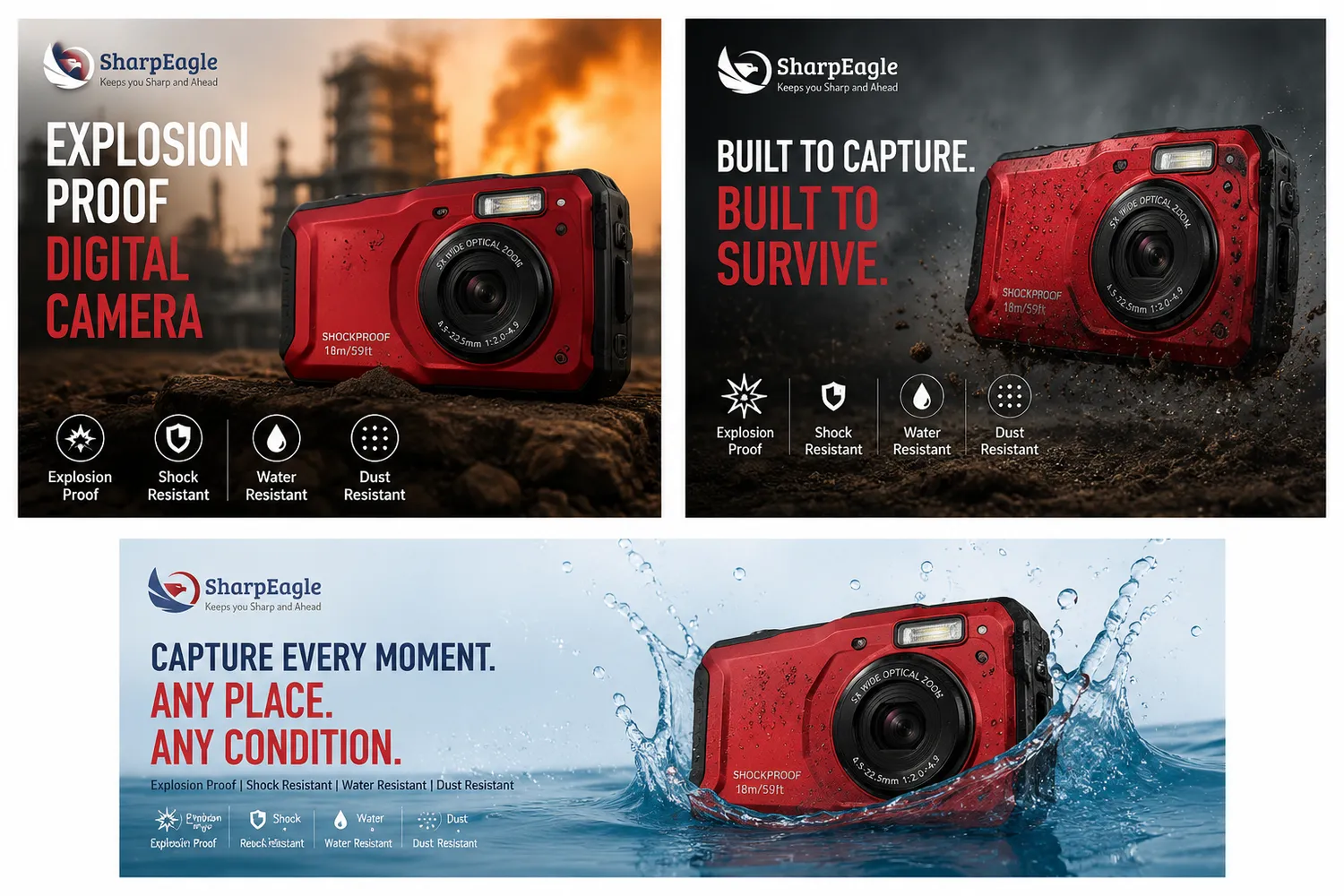
Your maintenance engineers cannot pause their workflow to walk to a safe area every time they need to capture an image. An ex proof digital camera that operates safely in situ removes that friction entirely. It keeps your inspection teams working efficiently without compromising on safety or documentation quality.
This matters beyond operational efficiency. The Health and Safety Executive expects robust evidence trails. When an audit arrives, your ability to demonstrate thorough, site-specific visual records is a direct reflection of your safety culture.
SharpEagle Technology: Purpose-Built for Hazardous Environments
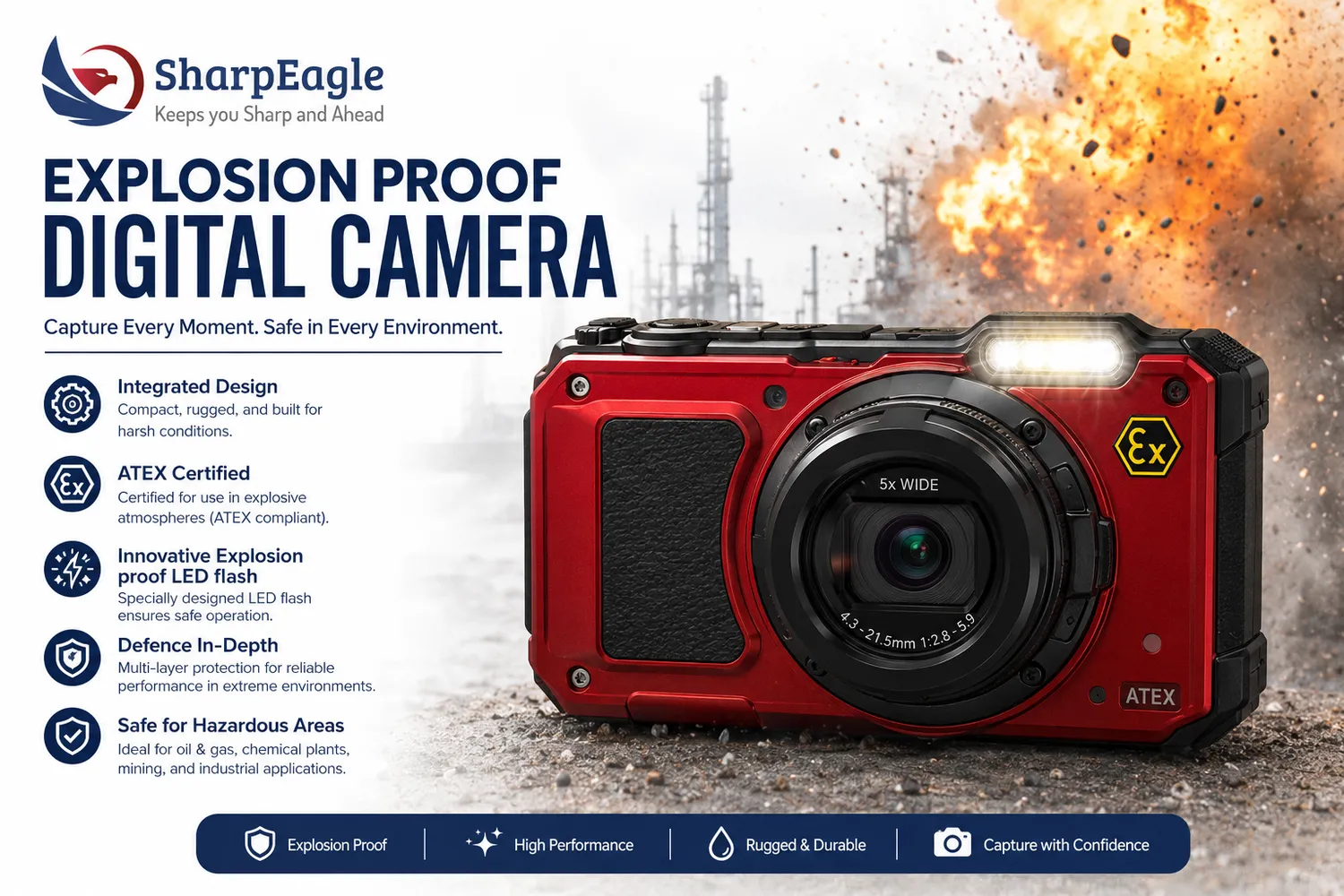
SharpEagle Technology has developed an atex digital camera designed specifically for the demands of offshore and industrial operations. It is not an adapted consumer product — it is engineered from the ground up for environments where standard equipment simply cannot go.
Key features and benefits include:
- Full ATEX Zone 1 and Zone 2 certification, meeting EU and UK post-Brexit compliance requirements
- High-resolution imaging with low-light performance suited to confined spaces and poorly lit installations
- Robust, corrosion-resistant casing built to withstand the physical rigours of offshore work
- Intuitive controls operable with gloved hands — critical when your team is wearing full PPE
- Long battery life to support extended inspection rounds without recharging interruptions
- Lightweight design that reduces fatigue during prolonged field use
What sets SharpEagle apart is the combination of genuine certification rigour and practical usability. Many certified cameras sacrifice image quality or ergonomics in favour of protection ratings. SharpEagle has resolved that trade-off, giving your team a tool that performs as well as it protects.
Emergency Response and Safety Culture
When an incident occurs offshore, speed and accuracy of documentation are critical. Emergency response teams, safety officers, and insurers all require visual records captured immediately after an event. Sending personnel into a compromised area with uncertified equipment compounds an already dangerous situation.
An intrinsically safe camera kept as standard issue within emergency response kits removes this risk entirely. It signals something deeper too — that your organisation takes hazardous area safety seriously at every level, not just in written policy. Safety culture is built through the choices your leadership makes about equipment, training, and accountability. The cameras your team carries are part of that culture.
Conclusion
Offshore oil and gas operations in the UK face a tightening regulatory environment, ageing infrastructure, and growing pressure to demonstrate transparent safety governance. The imaging equipment your teams use is a small but telling indicator of how seriously those obligations are taken. As platforms evolve and inspection demands increase, certified hazardous area cameras will become standard rather than exceptional. For teams ready to make that transition, a useful starting point is the recommended read: 10 Things to Consider When Buying an Explosion-Proof Digital Camera.