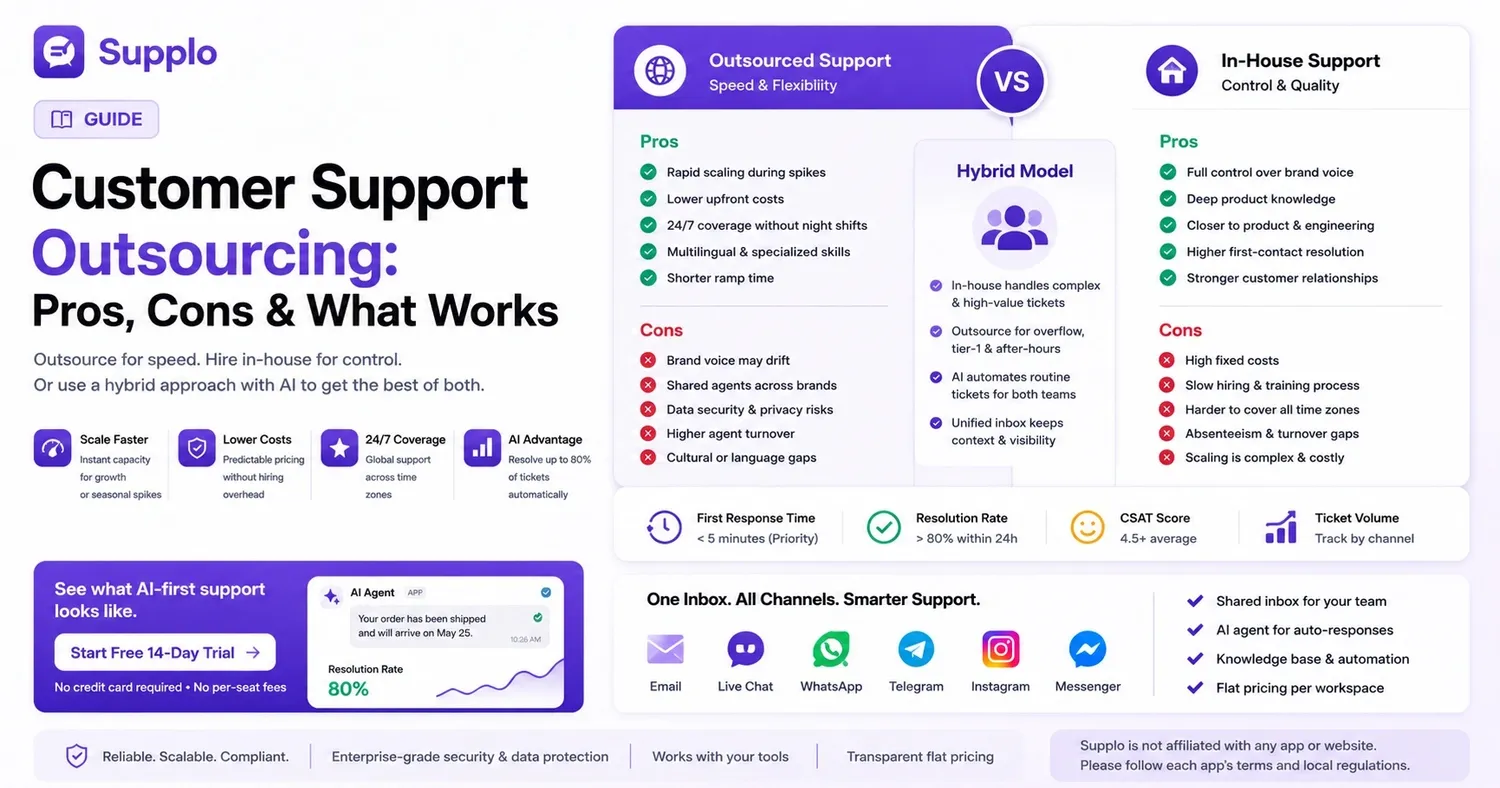
Honestly, deciding between outsourced and in-house customer support can be tough. It's really about balancing flexibility with how much control you want. Outsourcing lets you grow quickly by letting an external team handle customer interactions. On the other hand, an in-house team keeps every conversation tied to your company's culture, which has its own benefits and drawbacks. It's not just about what costs less; it's about how much supervision you're willing to give up for speed.
- Typically, outsourced support teams are third-party agencies that manage tickets for many different brands at once. They're good at what they do, but they're not part of your core staff.
- In-house support means you directly hire, train, and manage agents, paying them yourself and using your own systems. While building this team might take longer, you have complete ownership.
- Both approaches can lead to high customer satisfaction, but the methods to achieve it are quite different.
Advantages of Outsourcing Customer Support: When It's a Smart Move
The biggest perks? You can scale up quickly, save on initial costs, and get 24/7 coverage without needing night shifts. You avoid the expenses of recruiting, training, and setting up infrastructure. This is super helpful during busy seasons or for new startups. Need support in different languages? Many outsourced agencies already offer that, which would take ages to build with an in-house team. This boosts your customer experience without extra hassle.
- Get immediate capacity for product launches or holiday rushes, without lengthy hiring processes.
- Budgeting becomes predictable with fixed per-ticket or per-agent pricing models.
- Agents often come pre-trained on common customer service software, speeding up their productivity.
- Access specialized skills like technical support or billing without developing that expertise in-house.
Disadvantages and Risks of Outsourcing Customer Support
This is where things can get complicated. The downsides of outsourcing often involve losing your brand's unique voice, worrying about data security, and facing inconsistent quality. Agents who work for multiple brands might not have a deep understanding of your products. Plus, high staff turnover in call centers can make your support quality fluctuate week by week. You also face significant risks around data privacy, especially when sensitive customer data crosses international borders. Ensuring data protection is key.
- Your brand's tone can become diluted if agents aren't fully immersed in your product culture.
- Shared agents might prioritize easier tickets from other clients over yours – yes, that can happen!
- Data privacy risks increase if your outsourcing provider lacks strong security certifications.
- Language or cultural differences can lead to misunderstandings, especially in complex customer interactions.
Compliance Line: Supplo is not affiliated with any app or website. Please follow each app's terms and local regulations.
Advantages of In-House Customer Support
Having an in-house support team gives you complete authority over your brand's messaging, how issues are escalated, and product knowledge. Your agents work closely with your engineering and product teams. This means faster bug reports and more effective feedback loops. For high-value clients or complex B2B products, in-house teams often achieve higher first-contact resolution rates and build stronger customer relationships.
- Agents develop in-depth expertise in your specific products as time goes on.
- A direct feedback channel between support and product development teams speeds up issue resolution.
- You maintain full authority over hiring standards, training programs, and quality assurance processes.
- Achieve better alignment with company culture and long-term goals for customer engagement.
Disadvantages of In-House Customer Support: The Scaling Challenge
Expanding an in-house support team isn't easy. Each new hire means more recruiting, training, equipment, software licenses, and management, all of which quickly add up. Covering weekends, holidays, or sudden surges in inquiries often requires multiple shifts or costly overtime. For rapidly growing companies, the delay between hiring new staff and them becoming fully productive can lead to frustrating backlogs in customer service.
- You'll incur high fixed costs, regardless of the ticket volume, meaning you pay even during slow periods.
- Finding specialized support talent is a slower and more expensive process per hire.
- Teams located in a single area struggle to cover global time zones without significant shift differentials.
- Absences or staff turnover create immediate gaps that are challenging to fill quickly.
Key Considerations: Cost, Command, and Consistency
When you're comparing customer support outsourcing versus an in-house setup, three main factors stand out: cost, control, and consistency. Outsourcing often wins on flexible costs and speed, but it can fall short on consistency and how much direct control you have. In-house support excels in quality and brand alignment, though it struggles with predictable costs and scaling quickly. Making the right choice impacts your overall customer satisfaction.
- Cost: Outsourcing means you pay for what you use, while in-house involves paying salaries plus benefits.
- Control: In-house gives you complete authority over processes; outsourced teams follow their own standard procedures.
- Consistency: In-house teams are easier to standardize; outsourced teams rely on the provider's quality assurance.
- Trade-off: There's no perfect model. The best choice depends on your top priority: rapid growth or keeping your brand identity intact.
The Hybrid Approach: Combining In-House & Outsourced Support
Many well-established companies opt for a hybrid strategy. A core in-house team handles complicated or high-value customer interactions. Meanwhile, an outsourced partner manages overflow, initial inquiries, or after-hours requests. This method balances cost management with quality, as long as the transition process is smooth. The main hurdle? Technology. Keeping both teams connected on the same platform with unified visibility is crucial for effective support operations.
- The in-house team focuses on managing complex escalations, gathering product feedback, and assisting VIP accounts.
- An outsourced team handles repetitive inquiries, off-hours volume, and seasonal increases in demand.
- A unified ticketing system is essential; fractured tools lead to isolated work and duplicated efforts.
- Clear Standard Operating Procedures (SOPs) for handoffs reduce customer frustration when switching between teams.
Discover what an AI-first support experience looks like.
Start your free 14-day trial of Supplo and let the AI agent automatically handle up to 80% of your common tickets! There are no per-seat fees, no contracts, and no complicated onboarding process.
Start Free Trial →
How AI Customer Support Transforms the Landscape for Both Models
AI customer support software is completely reshaping the discussion around outsourcing versus in-house teams. A smart AI agent can resolve a significant portion of routine inquiries automatically. This drastically reduces the number of tickets both outsourced and in-house teams need to manage. Plus, it changes the pricing dynamic significantly; AI is much more affordable than human support, especially when billed per resolution instead of per seat. Teams can keep human agents for complex issues while AI handles the repetitive stuff.
- AI helps resolve common questions without needing extra staff or outsourced seats.
- Human agents can focus solely on escalations, making each interaction more impactful.
- Modern AI tools learn from your knowledge base and past conversations, getting better over time.
- AI works 24/7 without needing shift scheduling, removing a key reason companies outsource for broader coverage.
Let your human team concentrate on what truly matters.
Supplo brings together email, live chat, WhatsApp, Telegram, Instagram DMs, and Facebook Messenger into one shared inbox. Your in-house team handles complex issues, and the AI takes care of the rest.
Use Cases: When to Outsource vs. When to Hire
Consider outsourcing your support when you're experiencing rapid growth, seasonal peaks in volume, or need multilingual coverage quickly. Hire in-house when your product is complex, your clients expect specialized expertise, or your brand's unique voice is a competitive advantage. If your ticket volume is stable and your team can train efficiently, an in-house model often works best. However, if volume is erratic, outsourcing offers safer flexibility.
- Outsource: Ideal for e-commerce during Q4 surges, SaaS product launches, or multilingual startups.
- Hire in-house: Best for B2B enterprise support, regulated industries, or luxury concierge services.
- Hybrid: Perfect for fast-growing startups that need immediate coverage but plan to eventually bring more functions in-house.
- Test: Try outsourcing for a specific communication channel or time zone to see how it works before fully committing.
The True Test of Reliability: What Succeeds and What Fails
Reliability in customer support isn't just about system uptime; it's about being consistent across different agents, communication channels, and time zones. Outsourcing can provide reliable coverage if the provider has strong quality assurance and low agent turnover. In-house teams can be very reliable but become vulnerable when key staff are unavailable. The most dependable setup often blends a consistent AI layer with a smaller, highly trained human team, avoiding either a massive outsourced force or an understaffed in-house crew.
- Outsourcing falters when the provider's agent turnover is high and knowledge needs to be rebuilt.
- In-house support struggles when shifts can't be covered or departing staff aren't quickly replaced.
- AI reliability significantly improves with effective knowledge base management and consistent updates to its training data.
- True reliability means getting predictable response times, consistent quality in resolutions, and smooth pathways for issue escalation.
Stop guessing which model will work best. Test both without risk.
Try Supplo for 14 days. Our flat per-workspace pricing includes AI resolution, a multichannel inbox, and a knowledge base, so you can easily compare outsourcing versus in-house without making a long-term commitment.
Key Takeaways
- Outsourcing offers speed and scalability but risks a diluted brand voice, data security concerns, and inconsistent service quality.
- In-house support provides greater control and deeper product knowledge but grapples with predictable costs and quick scaling.
- AI support tools can automatically resolve many routine tickets, reducing the need for human staff in either model.
- The most reliable approach often combines a stable AI layer with a smaller, expert human team for complex issues.
FAQ
Is outsourcing customer support always cheaper than in-house?
It might be cheaper for fluctuating volumes, but fixed per-seat pricing could cost more than AI-automated or expanded in-house teams. Use outsourcing for spikes, but consider AI for consistent automation.
How can I keep my brand's voice consistent with an outsourced team?
Provide thorough brand guidelines, conduct regular quality checks, and limit the number of brands each agent services. Some companies even use recorded practice calls or scripts.
What are the main risks associated with outsourcing customer support?
Data security, losing quality control, and high agent turnover within the outsourcing provider are big risks. Make sure your contracts include service level agreements (SLAs) for training, staff retention, and data protection.
Can AI fully replace outsourced or in-house support?
Not entirely. While AI excels at routine tasks, complex, emotional, or product-specific issues still require human judgment. The best approach combines AI with human intervention for escalation.
How long does it typically take to transition from outsourced to in-house support?
Generally, it takes 3–6 months, encompassing hiring, training, and running both teams concurrently. AI tools can speed up this transition by automating common ticket processing from day one.
What's the best tool for managing a hybrid support team?
Look for shared inboxes that offer multichannel support, internal notes, and role-based permissions. Avoid tools that restrict visibility to only in-house agents.
How do I assess the quality of an outsourced support partner?
Use metrics like CSAT scores, first-response times, resolution rates, and quality assurance audits. Demand monthly performance reports linked to your SLAs.
Compliance line: Supplo is not affiliated with any app or website. Please follow each app's terms and local regulations.