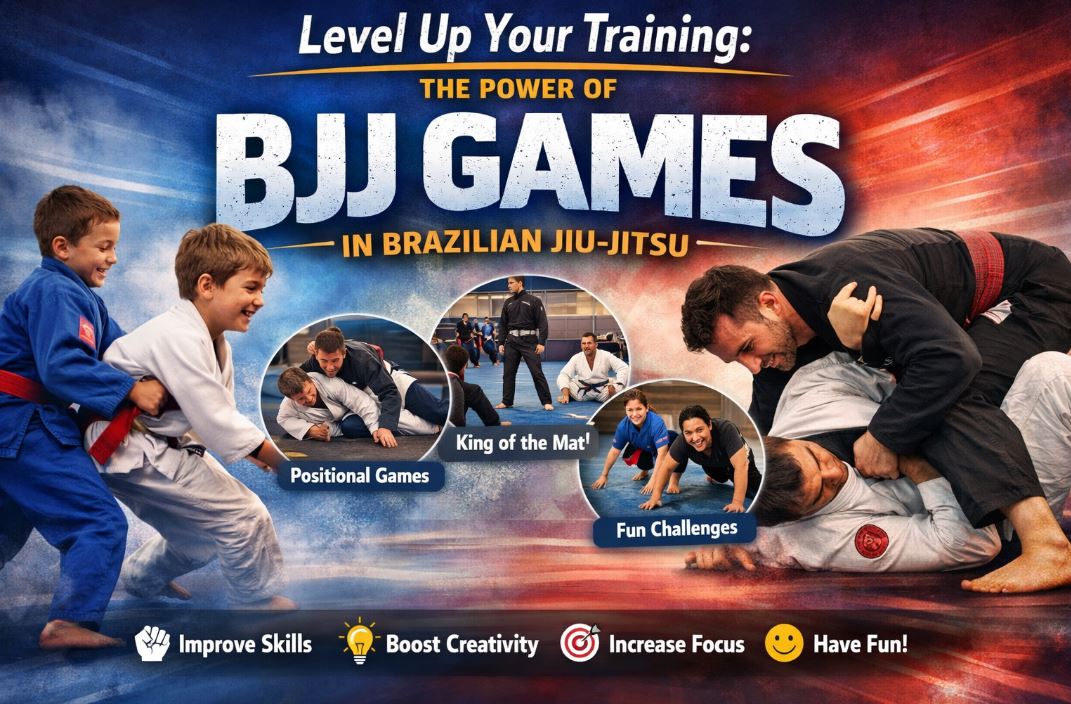
Brazilian Jiu-Jitsu (BJJ) is a martial art rooted in strategy, technique, and real-world problem solving. Yet many practitioners spend years repeating the same static drills only to wonder why progress feels slow or inconsistent. One powerful tool to accelerate skill development and make training more engaging is the use of BJJ games — structured, playful activities that teach real grappling skills. These games aren’t just for kids; they are valuable for athletes of all levels, from white belts to seasoned black belts.
What Are BJJ Games?
At their core, BJJ games are structured drills with specific goals, rules, and constraints that simulate real grappling scenarios. Unlike traditional drilling — where movements are repeated mechanically — games challenge you to solve problems under pressure and adapt in real time. They mimic the unpredictability of live rolling while keeping the environment fun and safe.
Imagine entering a situation where your objective might be “maintain back control for 30 seconds” or “escape from mount without being submitted.” These types of games force you to think one step ahead, make split-second decisions, and master spatial awareness — all in a playful setting.
Why BJJ Games Work So Well
Traditional Brazilian Jiu-Jitsu training often focuses on memorizing techniques and drilling them repeatedly. While repetition has its place, it doesn’t always prepare you for the fluid chaos of live sparring. BJJ games bridge this gap. They help transform isolated techniques into usable skills by situating them inside meaningful problems that require creative solutions.
📷
Here are some benefits of using BJJ games in your training:
- Faster Skill Retention: Games force you to apply techniques in realistic, dynamic contexts instead of memorizing steps that fall apart under pressure.
- Better Decision-Making: You learn to adapt in real time, improving instincts that are essential for live rolling and competition.
- Motivation and Fun: The fun, game-like environment keeps practitioners more engaged and less likely to burn out.
- Inclusive Training: Games can be scaled for all levels, making classes more accessible and enjoyable for beginners and advanced students alike.
How to Incorporate BJJ Games into Training
Whether you’re training solo, with a partner, or coaching a group, there are many ways to add BJJ games to your routine:
1. Positional Games
These are scenarios where both athletes start in a specific position (like guard, mount, or back control) and compete with limited goals. For example:
- Guard Pass Race: One player tries to pass, while the other defends. You score points for completing the pass or successful sweeps.
- Escape Challenges: One athlete begins in mount or side control and must escape within a set time, while the other defends.
Positional games help students focus on core aspects of BJJ — like control, transitions, and escapes — while reducing the cognitive load of full sparring.
2. Rule-Based Games
Adding simple rules can drastically change how players approach training:
- King of the Mat: Players take turns rolling in short rounds. Winners stay on while others rotate in. This game improves endurance and adaptability.
- Point Game: Simulate competition by awarding points for takedowns, sweeps, and dominant positions. This helps players think strategically about every movement.
3. Fun and Creative Games
Games don’t have to be strictly technical to be effective. Creative activities can foster joy and camaraderie while still building BJJ skills:
- Animal Movements: Crawls like bear or crab walks build coordination and mobility — especially popular with kids.
- BJJ Bingo or Challenge Cards: Players complete tasks like securing a specific submission or maintaining guard for a round. These add variety and challenge to your training.
BJJ Games for Kids and Beginners
One of the standout benefits of BJJ games is their adaptability for youth and newcomers. Kids often benefit from playful learning because it keeps them engaged long enough to absorb important fundamentals. Activities like “Dragon Tails,” where players try to capture cloth tails from each other’s belt, teach awareness of body positioning and spatial control in an enjoyable way.
Beginners also thrive in game-based environments because the pressure of sparring is reduced. When training feels like play, learners explore techniques with curiosity rather than fear. This builds confidence and creates positive associations with the art.
Putting It All Together
Incorporating BJJ games into your training plan doesn’t require a complete overhaul of your gym’s curriculum. You can start small:
- Add one positional game to your warm-up.
- Use game challenges during technique blocks.
- End classes with a competitive but light-hearted game.
Over time, students and training partners will notice improvements in timing, adaptability, and problem-solving. The best part? You’ve had fun doing it.
Final Thoughts
BJJ games are more than a novelty — they are powerful educational tools that help students build real grappling skills in a dynamic, engaging way. They break up the monotony of traditional drilling, deepen understanding of positions and transitions, and make training more enjoyable for everyone. Whether you’re a coach seeking new ways to structure classes or a practitioner looking to elevate your game, integrating BJJ games can unlock faster progress and deeper passion for Brazilian Jiu-Jitsu.