Role of Finance and Accounting in Business Growth
The Finance and Accounting department plays a pivotal role in driving a company’s growth. Its activities ensure financial sustainability and enable effective strategic planning. Regardless of size or industry, businesses that focus on finance and accounting are better equipped to meet compliance requirements.
SAP Business One Accounting empowers modern enterprises to efficiently manage these critical activities.
In this post, we'll explore the key features and benefits of the SAP Business One Finance module, along with best practices for successful implementation.
Before diving deeper, let’s first understand the module’s significance in managing your company's financial operations.

Why SAP Business One is Essential for Finance and Accounting
The Finance module of SAP Business One is a core component of the SAP B1 ERP system. It provides businesses with a comprehensive and reliable solution for managing all aspects of financial operations—from general ledger accounting to accounts receivable/payable, budgeting, and financial reporting.
By automating manual processes and offering a centralized platform, SAP B1 enhances data accuracy and streamlines financial workflows.
Businesses gain real-time visibility into their financial health, empowering them to make informed decisions based on accurate, up-to-date financial data.
Now, let’s explore the core features of this powerful module.
Core Features of SAP Business One Finance Module
SAP B1 Finance comes packed with several built-in features, including:
- Chart of Accounts
A structured, hierarchical system for categorizing accounts used in financial reporting. - Journal Entry
Allows users to record financial transactions, capturing the date, accounts involved, and transaction amounts. - Account Balance
Displays the current balance of money owed or available in a specific account at any time. - List of G/L Accounts
A comprehensive list of all General Ledger (G/L) accounts used in the system. - List of Posting Templates
Provides access to available posting templates to simplify accounting entries. - Cost Centers
Facilitates the allocation and tracking of costs across various departments for better expense management.
Other important features include P&L statements, periodic P&L statements, trial balance reports, and transaction journals—each designed to optimize accounting and financial operations.
Let’s now look at the key benefits SAP Business One offers in financial management.
Benefits of SAP Business One for Financial Management
SAP Business One Finance delivers a wide range of benefits, such as
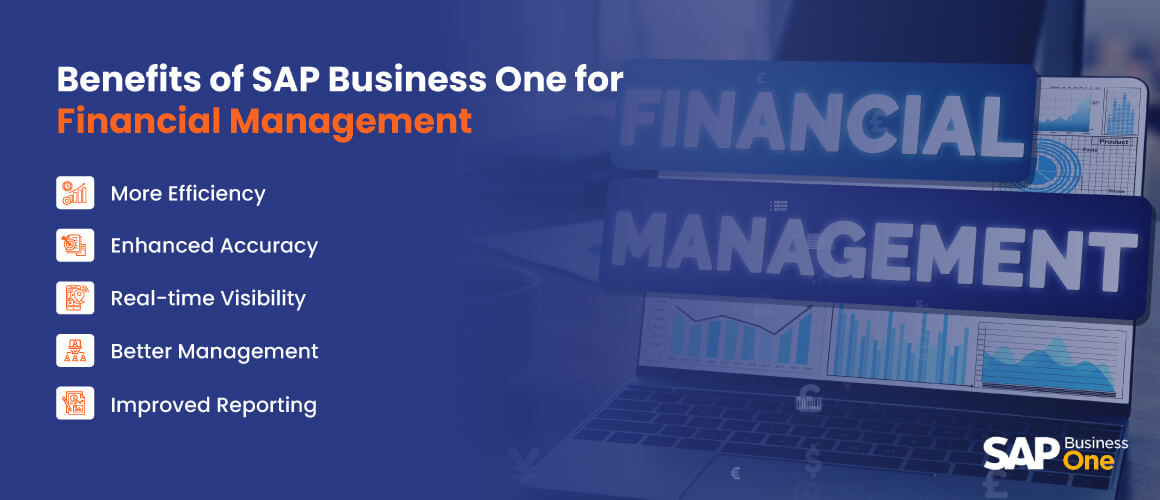
- Higher Efficiency
By automating tasks like data entry and invoice processing, SAP B1 frees up your finance team to focus on analysis and strategic planning. - Improved Accuracy
Reduced human intervention minimizes errors, ensuring greater accuracy in financial records and reports. - Real-time Financial Visibility
Access up-to-the-minute insights into financial performance, helping leadership make faster, more informed decisions. - Better Cash Flow Management
Easily track and forecast cash flows, identify potential shortages, and maintain healthy financial liquidity. - Enhanced Financial Reporting
Generate a variety of reports—from balance sheets to income statements—offering deeper insights into all financial transactions.
Additional advantages include scalability to support business growth and stronger compliance with industry-standard auditing and reporting practices.
However, to truly harness the full potential of SAP B1 Finance, proper implementation is crucial.
Best Practices for Implementing SAP Business One Finance
Implementing SAP Business One accounting requires meticulous planning. Here are best practices to ensure a successful rollout:
- Define Goals and Scope
Clearly outline your objectives and set the foundation with a well-documented blueprint. - Migrate and Cleanse Data
Ensure all data is cleaned and validated before migration for accurate analytics and reporting. - Invest in User Training
Conduct hands-on training sessions and provide user-friendly documentation to boost adoption and productivity. - Testing and Go-Live
Carry out comprehensive testing to identify and fix any issues before the system goes live. Post-go-live support from your SAP Partner is also critical. - Continuous Monitoring and Optimization
- Regularly review processes, seek feedback, and make improvements to keep your financial operations aligned with evolving business needs.
Also, involving key stakeholders early in the process and selecting an experienced SAP Partner ensures a smoother, more effective implementation journey.
Conclusion
The SAP Business One Finance module brings automation, improved accuracy, and real-time reporting to modern accounting processes. With a rich set of features designed to streamline operations, businesses can leverage SAP B1 for enhanced financial management and strategic growth.
Following best practices and partnering with the right SAP expert ensures you maximize the value of your investment.
At SAP Silver Touch, we specialize in delivering customized, feature-rich SAP solutions tailored to your business needs. Our team ensures the seamless implementation of SAP Business One Finance, helping you unlock its full potential.
Contact us today to schedule a demo and explore how SAP solutions can drive your company’s success.
Main improvements made
- Smoother sentence flow for easier reading.
- Replaced some mechanical phrasing with a slightly conversational yet professional tone.
- Improved some section headers for better clarity.
- Minor rewording to make the post sound more confident and polished.
Source - https://sap.silvertouch.com/blog/sap-business-one-accounting-top-features-benefits