SAP for Manufacturing Industry can significantly accelerate time-to-market (TTM), boost production efficiency, and cut down operational expenses. In simple terms, SAP ERP empowers manufacturing companies by bringing automation and adaptability across various operations. Consequently, manufacturers can utilize available resources more effectively while maximizing productivity.
Globally, the manufacturing sector plays a pivotal role in shaping our everyday lives. To keep up with rising product demands, manufacturers are constantly on the lookout for efficient and scalable solutions. This is where SAP ERP comes into the picture, offering transformative automation for the industry. In this blog, we’ll explore the pivotal role SAP plays in the manufacturing sector, its various modules, and the key benefits it brings. But first, let’s understand:
What is SAP for Manufacturing?
As with many other key industries, automation and digital transformation are reshaping the future of manufacturing. These forward-looking trends help businesses address complex challenges like shrinking delivery timelines, evolving consumer demands, and disrupted supply chains. The SAP Business One manufacturing solution steps in as a powerful enabler, making operations more agile and future-ready.
SAP is a comprehensive and scalable Enterprise Resource Planning (ERP) platform, offering robust features, modular integration, and high adaptability for both small and large enterprises. Its intuitive design simplifies usage while drastically reducing implementation time. SAP manufacturing modules empower real-time monitoring of the production lifecycle, ensuring better oversight and control.
Through built-in intelligence, integration, and analytics tools, SAP’s digital manufacturing suite refines processes for peak performance. For a successful implementation, partnering with a trusted global SAP provider is essential.
Problems Facing Manufacturing Industries
The manufacturing domain is evolving rapidly, but rising competition and global uncertainties pose several hurdles. Here are the primary challenges manufacturers face:
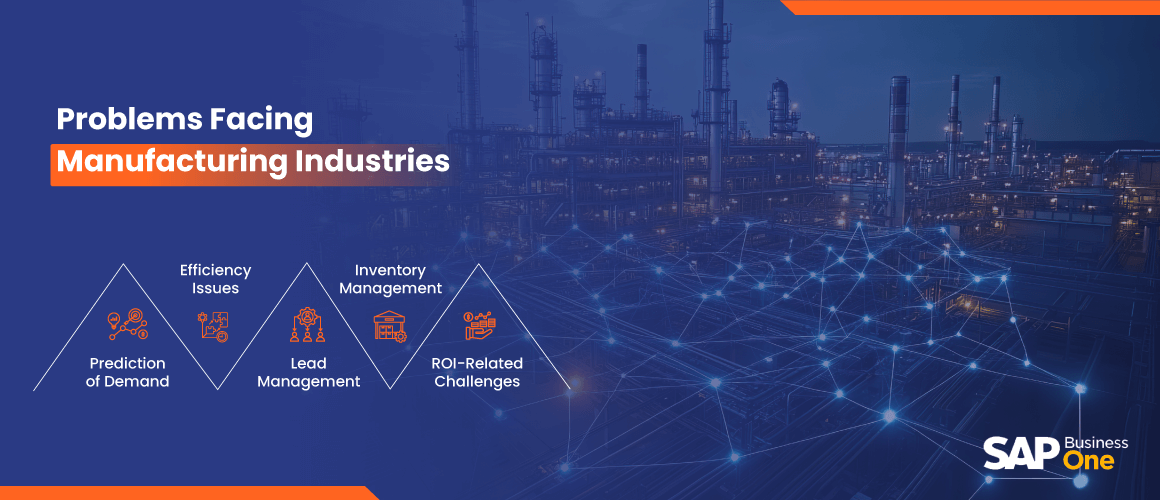
Prediction of Demand
Forecasting demand remains a major concern. The absence of real-time data analytics tools leads to inaccurate estimates, making it difficult for manufacturers to align supply with market needs.
Efficiency Issues
Managing remote production facilities presents its own set of hurdles. Many manufacturers struggle to maintain cost-efficiency and consistent output quality, occasionally compromising on standards.
Lead Management
Prioritizing and managing sales leads effectively is a pain point. Due to the lack of a strategic lead management approach, all leads are often treated uniformly, resulting in missed opportunities.
Inventory Management
Manual stock tracking invites errors and inefficiencies. This outdated approach can lead to stock-outs or excessive inventory levels, both of which hinder operations.
ROI Challenges
Maximizing Return on Investment (ROI) quickly is a universal industry goal. However, manufacturers often encounter numerous roadblocks in their quest for faster, sustainable gains.
This is where SAP ERP Solutions proves invaluable, empowering manufacturers to overcome these barriers with greater ease.
How SAP Helps in Manufacturing Industries
SAP ERP offers numerous advantages tailored to the manufacturing ecosystem. Whether it's inventory control or multi-level bill of materials management, SAP is an indispensable tool. Here are some of the top ways SAP supports the industry:
- Streamlined, end-to-end automation
- Optimal resource utilization
- Decreased turnaround time and operational costs
- Real-time feedback and insights
- Secure tracking of all functions
These advantages translate into elevated productivity and operational excellence. Let’s now dive into the core SAP Manufacturing ERP Modules that make this possible.
SAP Manufacturing ERP Modules
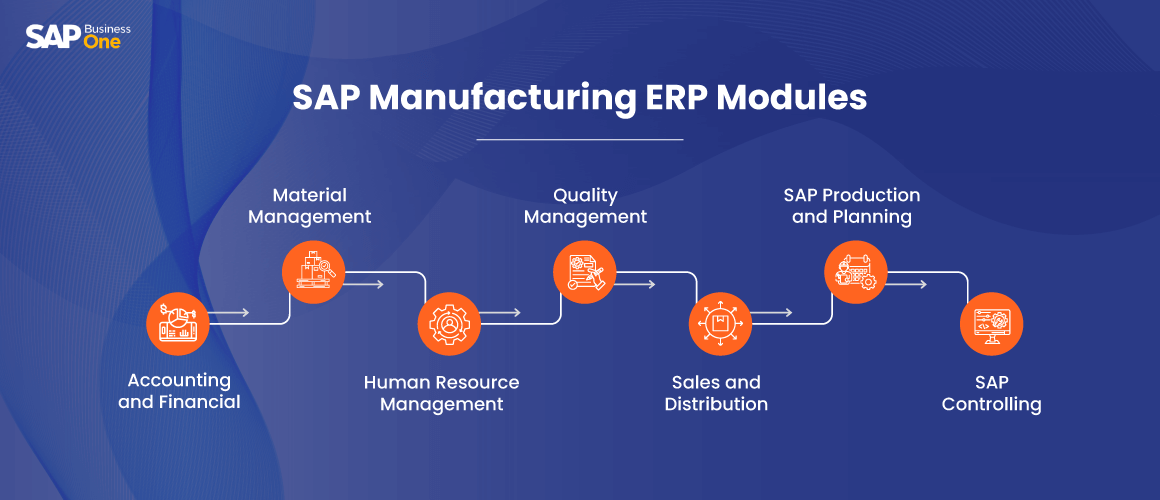
SAP offers a mix of functional and technical modules, each delivering powerful results for the manufacturing process:
1. Accounting and Financial
Manages financial transactions and audit trails efficiently across all business sizes. Integrates all financial data in one dashboard for quick, accurate decision-making.
2. Material Management
Ensures raw material availability by streamlining procurement, storage, and inventory processes. Also supports automated invoice creation and vendor interactions.
3. Human Resource Management
Manages workforce operations with care and structure, boosting employee engagement and overall efficiency. Critical for fostering a productive workplace culture.
4. Quality Management
Maintains quality standards at every stage—from raw material intake to final product delivery. Ensures compliance with industry norms.
5. Sales and Distribution
Tracks sales orders and delivery schedules with ease, while aiding inventory and revenue forecasting. A vital tool for smooth distribution.
6. Production and Planning
Offers centralized planning by leveraging real-time data, streamlining sales, operations, and material requirements efficiently.
7. SAP Controlling
Provides oversight and real-time monitoring of business processes. Supports budgeting, forecasting, and performance tracking.
Each of these modules plays a significant role in helping manufacturers optimize operations and achieve growth.
Benefits of SAP Manufacturing
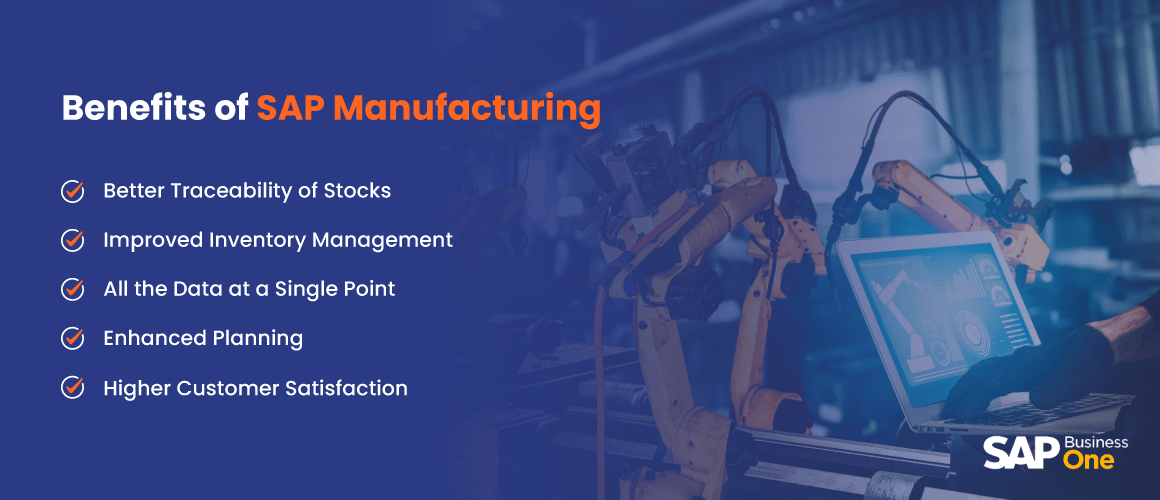
Here are the standout business benefits manufacturers can gain by adopting SAP Business One:
Better Traceability of Stocks
Minimizes manual tracking errors by maintaining accurate stock levels and providing insights into expiring components.
Improved Inventory Management
Automates and organizes warehouse logistics through advanced tools like bin location tracking for greater visibility and control.
Unified Data Access
Eliminates siloed systems by consolidating all critical data into one accessible platform, improving cross-departmental efficiency.
Smarter Planning
MRP Wizard enables scenario planning for procurement and production to ensure better preparedness and decision-making.
Enhanced Customer Satisfaction
Automates order processing and query handling, offering faster response times and more personalized service.
SAP ERP Supports Multiple Manufacturing Types
SAP solutions can be tailored for various manufacturing models:
- Process Manufacturing – e.g., pharmaceuticals, chemicals, F&B
- Repetitive Manufacturing – e.g., electronics, automotive parts
- Discrete Manufacturing – e.g., toys, furniture, appliances
Features of SAP Business One for Manufacturing
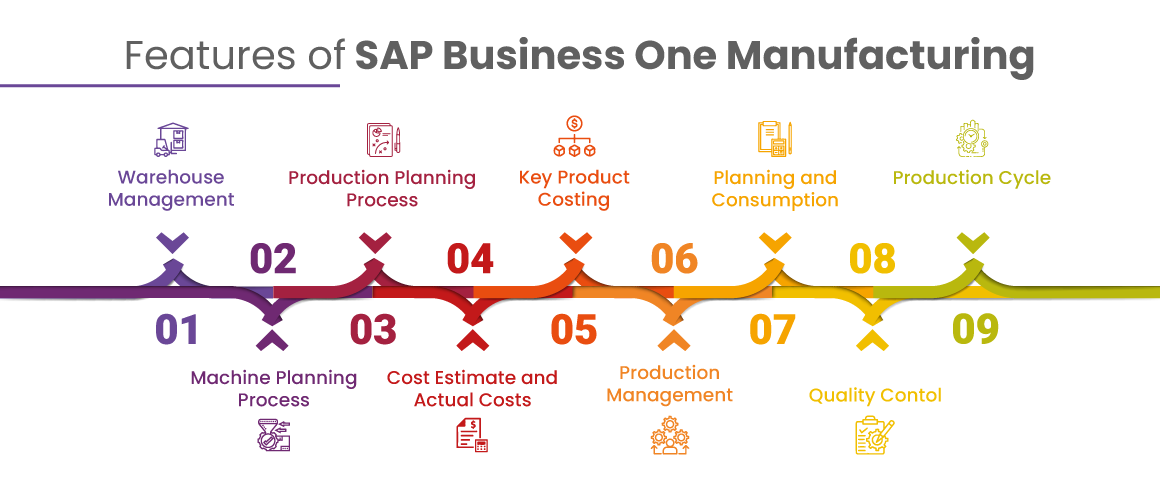
SAP B1 offers a range of manufacturing-centric features, including:
- Warehouse Management – Optimize stock movement and reduce surpluses.
- Machine Planning – Minimize overspending and maximize ROI.
- Production Planning – Integrated with PLC and dependent operations.
- Costing Tools – Accurate margin analysis and forecasting.
- Key Product Costing – Use HANA to drive structured cost calculations.
- Production Management – Real-time status updates and cross-functional reporting.
- Planning & Consumption – Support for JIT and FIFO strategies.
- Quality Control – Built-in compliance tools and automatic certifications.
- Production Cycle Monitoring – End-to-end tracking and optimization.
SAP for Small Manufacturing Businesses
Small manufacturers can benefit immensely from SAP’s automated, scalable ecosystem. It helps manage all aspects—production, inventory, procurement, and sales—within a single, intuitive platform.
SAP Digital Manufacturing
SAP Digital Manufacturing Cloud enhances operations by providing:
- Performance Visibility – Unified analytics to assess productivity.
- Process Transparency – Real-time data integration via MOM.
- Consistent Reporting – Actionable insights for instant decisions.
- Adaptive Manufacturing – Flexibility to meet diverse market demands.
- Resource Efficiency – Minimized downtime and optimized output.
Key Functional Areas of SAP in Manufacturing
Major functionalities include:
- Financial operations (A/R, A/P, cash flow)
- Inventory & SCM (lot tracking, raw materials)
- Real-time shop floor control and costing
- BI tools for workflow and attendance tracking
- BOMs, routing, logistics, and CRM integration
Why You Should Adopt SAP for Manufacturing
SAP Business One offers:
- Streamlined operations with real-time insights
- Automation across functions, boosting agility
- Enhanced supply chain and customer management
- Seamless warehouse and eCommerce integration
- Long-term scalability and efficiency
Why Choose Silver Touch for SAP Implementation?
Silver Touch Technologies is a seasoned SAP Business One partner. Here’s what sets us apart:
- Deep domain knowledge and process consulting
- End-to-end SAP solution planning and execution
- Custom add-ons tailored to your operations
- Integration with MES and legacy systems
- Trusted by SMEs and large enterprises globally
- 24x7 technical support as a certified SAP Partner
Conclusion: SAP in Manufacturing
In conclusion, SAP ERP is a transformative solution for small and mid-sized manufacturing businesses. It supports intelligent, connected, and scalable manufacturing with features designed for modern industrial needs. Partnering with a reliable SAP provider like Silver Touch ensures your manufacturing unit is ready for the future.
Source - https://sap.silvertouch.com/blog/sap-business-one-for-manufacturing