There is a terrifying moment every boat owner dreads: looking in the rearview mirror on a bumpy highway only to see a vessel swaying violently because the haulage gear underneath cannot handle the pressure.
Unlike flat-bottomed motorboats that sit easily on generic rollers, a vessel defined by a deep, heavy keel and an elegant hull requires a tailored structural foundation.
Choosing the wrong rig does not just mean dealing with an annoying headache at the boat ramp; it can lead to catastrophic structural damage before you even catch sight of the coastline.
That’s why finding something that’s able to balance heavy-duty safety with seamless launching requires you to take a deep look into what makes a premium sailboat trailer actually "premium."
Key Takeaways
● Keel Weight Optimization: Matching the frame construction to handle deep, highly concentrated center-of-gravity loads safely.
● Corrosion-Resistant Metal Coatings: Selecting advanced hot-dipped galvanized steel frames to survive punishing salt-water submersions.
● Dynamic Supporting Systems: Utilizing heavy-duty adjustable screw jacks and padded bunks to protect delicate fiberglass hulls.
What are the Markers of a Perfect Sailboat Trailer?
● Distributes Extreme Keel Weight Across Heavy-Duty Mainframes
The architectural design of a sailing vessel naturally concentrates thousands of pounds of lead or iron into a single, narrow keel stretching far beneath the hull.
If a haulage frame is built with standard, thin-walled tubing, this immense downward pressure will bend the metal over time, which permanently throws the alignment out of whack.
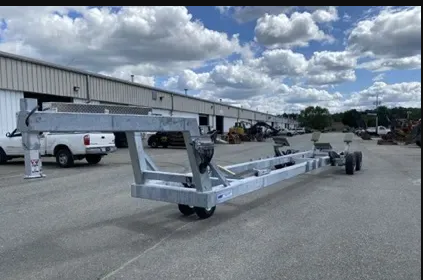
A high-quality rig sidesteps this by making use of thick-walled box beam steel paths that run the entire length of the chassis.
This is a heavy-duty frame that locks down the heaviest point of the boat so you don't have to worry about dangerous weight shifts on the road. Prioritizing the structural frames' depth when shopping for a sailboat trailer is a mandatory rule to keep the long-distance hauls 100% stress-free.
● Hot-Dipped Galvanized Coatings to Repel Saltwater Damage
Back at the boat ramp, backing a haulage rig deep into the coastal brine is a recipe for instant rust if the metal lacks industrial protection. Raw steel or cheap powder coatings will flake apart within the stretch of a couple of seasons, hiding dangerous structural rot beneath the surface.
True marine-grade rigs undergo a full hot-dipped galvanization process, inside and out, creating a resilient metallurgical shield that actively repels salt-water corrosion.
This special coating means the inside of the tubular frame stays as clean as the outside, even after years of regular ramp immersions. That’s why investing in a fully galvanized chassis protects the initial capital and keeps the structural foundation rock-solid for years to come.
● Adjustable Screw Jacks & Custom-Contoured Hull Support Bunks
Because every hull mold features unique curves and specific draft depths, relying on a rigid, one-size-fits-all bunk system is an easy way to puncture the fiberglass.
The hull needs a customized network of wide, heavily padded support bunks paired with telescoping screw jacks that can be adjusted to mirror the exact shape of the boat.
Supporting pads are placed in areas to support the sides of the sailboat trailer bed without putting pressure on the keel so that the boat can rock from side to side during aggressive highway maneuvers.
End Statement
When it's time to take a prized boat out of the water, it's important to select a transport rig that meets the specific engineering requirements of a deep-keeled hull.
Heavy-wall box beams, hot-dipped galvanized coatings and adjustable screw jacks take care of all the typical trailering problems.
So, if you're planning to upgrade your marine fleet with commercial-grade transport equipment designed for the unique dimensions of the ship, be sure to look below the surface levels and search for quality custom boat trailers for sale.