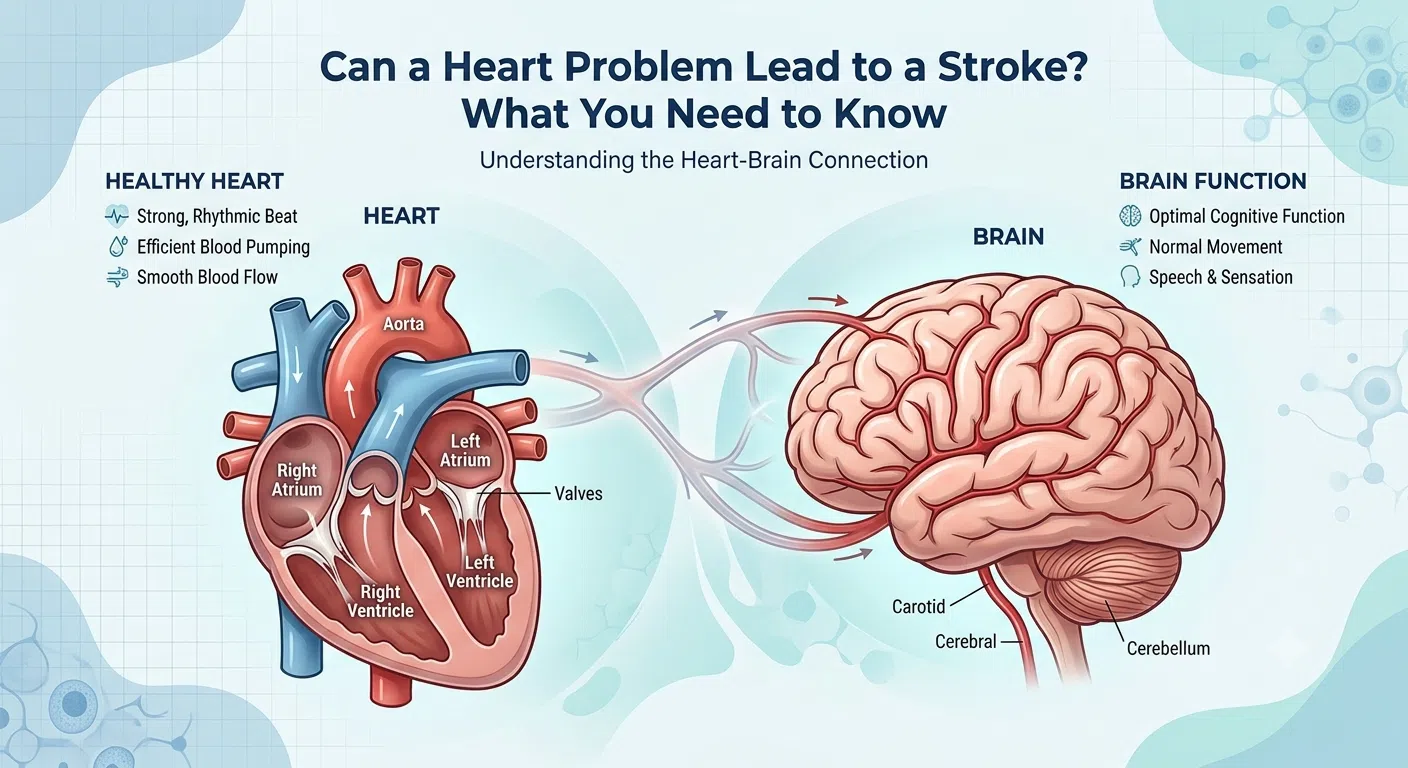
Picture a 55-year-old man who has never really been ill. He gets a little breathless on the stairs, puts it down to age, and carries on. Then one morning his right arm goes limp and his words come out jumbled. The family assumes something is wrong with his brain. And it is. But the trouble started somewhere else entirely: his heart.
So, can a heart problem lead to a stroke? Yes, and more often than most people think.
Same blood, same risk
Your brain doesn’t make its own blood supply. Everything it gets is pushed up by the heart. When that pump misbehaves, the brain pays for it. A stroke is what happens when blood flow to part of the brain is cut off by a clot, or when a weakened vessel bursts and bleeds.
How a heart ends up causing one
The usual story is a clot. If the heart quivers instead of beating steadily, blood can sit in the upper chambers and thicken. Sooner or later a piece may break off, ride the bloodstream up the neck, and jam in a small artery in the brain. That’s an ischemic stroke, the most common kind.
Atrial fibrillation is the big name here. People living with it face roughly five times the stroke risk of people with a normal rhythm, says one of the best hospitals in Gwalior. What makes it sneaky is that plenty of patients feel nothing. Maybe a flutter now and then. Maybe a tiredness they blame on work.
There are other culprits: leaky or replaced valves, a heart muscle weakened by an old heart attack, and small holes between chambers that some people are born with. Then there’s the slow damage from high blood pressure and cholesterol, which narrow arteries everywhere, including the ones heading to the brain.
Don’t wait on the warning signs
Stroke doesn’t build up politely. It shows up suddenly: one side of the face drooping, an arm that won’t rise, speech that slurs. If you see any of that, don’t wait for it to pass. Get to a hospital right away, because every minute costs brain cells.
Some people get a mini-stroke, where symptoms fade within the hour. It’s tempting to call it a false alarm. It usually isn’t. Treat it as a warning that a bigger one may follow.
Why screening is worth the hassle
Because rhythm problems can be silent, a basic ECG is one of the cheapest ways to catch trouble early. It matters most if you’re over 50, diabetic, a smoker, or have heart disease in the family. When you look for a cardiologist in Gwalior, pick one who studies your whole picture rather than a single report, and who explains the findings in words you can follow.
If something turns up, treatment is often simpler than people fear. Blood thinners cut clot risk sharply. Tablets for blood pressure and cholesterol, a procedure to fix a rhythm or a valve, and regular follow-ups do the rest.
Small habits that add up
Nobody needs a dramatic overhaul. Walking briskly for half an hour most days helps. So does eating less salt and fewer fried snacks, and quitting tobacco, which harms arteries faster than most people realise. Keep an eye on your weight and sugar levels. Sleep properly. None of it is exciting, and all of it works.
When the brain needs its own doctor
If a stroke has already happened, or you’re having sudden numbness, odd vision changes, bouts of dizziness, or memory slips, you’ll want a neurologist in Gwalior involved. Scans, assessing how much damage there is, and planning rehabilitation are their territory, and starting early can limit lasting disability. Often the best results come when your heart doctor and brain doctor actually talk to each other, since the cause of a stroke so frequently lives in the heart.
The bottom line
A heart problem can lead to a stroke, but it doesn’t have to. Once the underlying issue is found and managed, most of these strokes can be prevented. So check your pulse, know your numbers, and don’t ignore the small signals. Get tested before an emergency does the asking.
Useful Links:
https://many.link/rjnapollohospitals
https://go.bubbl.us/f40f74/5c56?/Top-Hospitals-in-Gwalior
https://linkfly.to/80903aitWNL9j
https://beacons.ai/rjnapollohospitals
https://www.diigo.com/profile/rjnapollo