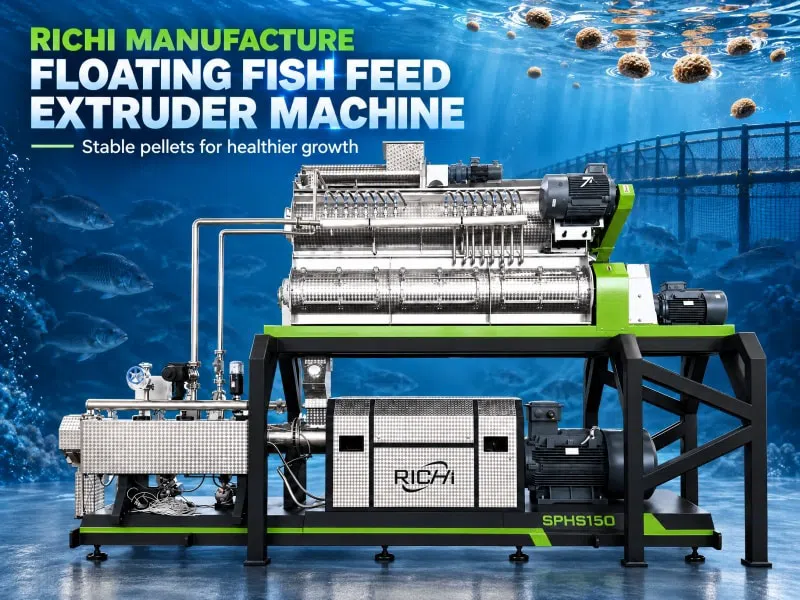
Automation in aquatic feed manufacturing is most valuable when it improves process consistency rather than simply replacing manual work. Raw-material dosing, feeding rates, extrusion conditions and downstream handling all influence finished feed. A modern floating fish feed extruder machine can therefore benefit greatly from being integrated into a coordinated control system.
Consistency Begins Before the Extruder
Accurate batching is one of the first areas where automation can make a practical difference. Feed formulas depend on controlled proportions, and repeated weighing errors can affect nutritional consistency as well as processing behavior.
Automated batching transfers measured ingredients into the mixing section according to stored formulations. After mixing and fine grinding where required, controlled feeding helps maintain a steady material flow toward extrusion.
In an automatic floating fish feed production line, these sections are coordinated so that upstream equipment supplies material at a rate appropriate for extrusion while downstream equipment remains ready to receive the resulting pellets.
Extruder Control Requires More Than an On-Off Switch
Extrusion is a dynamic process. Feeding rate, moisture, conditioning, screw operation, temperature and cutting all influence pellet formation. PLC and touch-screen systems allow operators to monitor important parameters and make controlled adjustments.
Automation does not eliminate the need for skilled operators. Instead, it gives them better tools for maintaining repeatable settings and recognizing changes in production conditions.
A useful web link to technical equipment information can also help plant planners understand which control features are available before deciding how much automation their facility genuinely requires.
Downstream Coordination Matters
Extruded pellets leave the machine with elevated temperature and moisture. They must move into the drying stage without excessive accumulation or delay. Automated conveying helps synchronize this transition.
Drying control is especially important because insufficient moisture removal can affect storage stability, while excessive drying wastes energy and may influence pellet characteristics. After drying, liquid spraying can be integrated into the process according to production requirements.
Cooling then reduces product temperature before screening and packaging. Sensors and controlled conveying can help maintain a steady flow across these stages.
Automation Should Match Plant Scale
A small feed plant does not necessarily need the same control architecture as a large industrial factory. Excessive automation can increase investment and maintenance complexity without delivering proportional benefits.
At higher capacities, however, manual coordination becomes increasingly difficult. More raw-material bins, formulas, conveyors and processing sections must operate together. Centralized control can reduce communication gaps between sections and make production data easier to monitor.
The correct automation level is therefore determined by throughput, product variety, labor availability and management requirements.
The Difference Between Extrusion and Pelletizing Still Matters
Automation cannot compensate for choosing the wrong processing technology. A conventional pellet machine compresses conditioned material through a die and is widely used for livestock and some aquatic feeds. Extrusion subjects material to a different combination of heat, pressure and shear and is central to expanded floating feed production.
Facilities producing both conventional pellets and extruded products may include both technologies. Their control systems should reflect the different operating requirements of each process.
Data Can Support Better Production Decisions
Modern control systems can make operating information more visible. Operators can compare production settings between batches, monitor equipment loads and identify unusual changes before they develop into serious problems.
This information is particularly valuable when a plant produces several pellet sizes or formulations. Repeatable recipes can shorten changeover time and reduce reliance on memory alone.
Automation can also support maintenance planning. Monitoring motor loads, operating hours and alarms gives maintenance teams additional information for scheduling inspections.
Build Automation Around the Process
The strongest automated feed plant is not necessarily the one with the greatest number of sensors. It is the one where controls support a well-designed process.
Grinding capacity must still match mixing requirements. The extruder must still suit the formulation and target output. The dryer must still have enough capacity to handle wet pellets. Packaging must still keep pace with production.
When those fundamentals are correct, automation can connect the sections into a more consistent production system. For commercial floating feed producers, this combination of sound process engineering and practical control technology can reduce unnecessary manual intervention, improve repeatability and make a growing factory easier to manage over the long term.