Starting a chicken feed manufacturing business involves several interconnected investment decisions. Investors need to understand the local poultry industry, estimate feed demand, select suitable raw materials, and determine the production capacity that can support their business objectives. Machinery is a major part of the investment, but the building, utilities, storage facilities, installation, and operating arrangements also influence the total project cost.
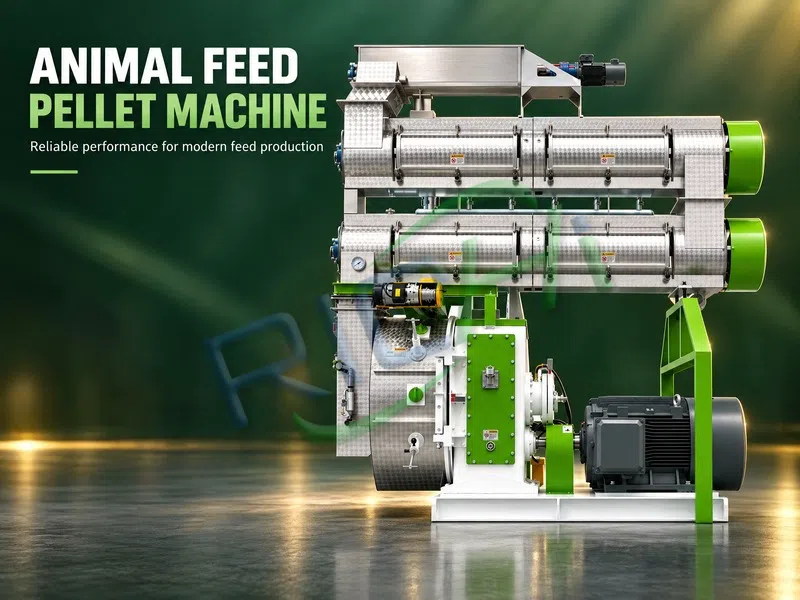
A properly selected animal feed pellet machine is an important investment because it performs the central operation of converting formulated mash into finished pellets. However, its selection should follow an assessment of the entire factory rather than being treated as an isolated purchasing decision.
Evaluating the Business Opportunity
The first step is to understand who will purchase the finished feed. Some investors plan to manufacture feed for their own poultry farms, while others intend to supply independent farms, agricultural cooperatives, distributors, or regional wholesalers.
These business models can require different production arrangements. An integrated poultry farm may prioritize a stable supply of feed for its own birds. A commercial feed manufacturer may need to produce multiple formulations and accommodate orders from customers with different requirements.
The intended product range also affects the project design. Broiler feed, layer feed, breeding feed, and starter feed may require different formulations and physical characteristics. If the business plans to supply several poultry growth stages, the factory should be designed with sufficient flexibility for formula changes and different pellet specifications.
Estimating Production Demand
Investors should estimate the amount of feed they expect to sell rather than selecting machinery based only on an attractive capacity specification. Daily demand, operating hours, seasonal changes, and potential market expansion all need consideration.
A factory that operates one shift may have different equipment requirements from a facility designed for continuous production. Buyers should also account for maintenance periods, cleaning, product changes, and the time required to prepare and pack finished products.
Understanding the Main Equipment Investment
A complete chicken feed manufacturing facility requires several processing sections. Raw material receiving and storage equipment handles incoming grains and other ingredients. Cleaning machines remove impurities, while hammer mills reduce selected materials to the required particle size.
The batching and mixing section measures ingredients according to the formulation and distributes them uniformly. After mixing, the materials enter the pelleting section, where conditioning and compression transform powder feed into pellets.
A typical chicken feed manufacturing plant also requires cooling, screening, conveying, and packaging equipment. The exact configuration depends on production capacity, the variety of products, and the level of automation required.
Selecting the Main Pelletizing Equipment
The pellet mill should be selected according to target output, raw material characteristics, pellet diameter, and expected operating hours. Ring die machines are commonly used in commercial feed manufacturing because they are suitable for continuous production.
Important components include the ring die, press rollers, feeder, conditioner, transmission system, and motor. Buyers should ask suppliers about the available die specifications, compression ratios, wearing parts, and maintenance requirements.
The conditioner deserves particular attention. Steam treatment affects the material's moisture and temperature before compression. Its dimensions and mixing arrangement should provide sufficient conditioning for the intended production rate.
Factory Building and Utility Requirements
The available workshop influences how equipment can be arranged. A new factory may allow investors to design the building around the intended production process, while an existing workshop may require adjustments to accommodate machine height, conveying routes, and storage facilities.
Multi-level arrangements are often considered when gravity can help move materials between processing sections. However, the final layout should account for foundation requirements, equipment access, structural loading, and maintenance space.
Electricity and steam are also essential considerations. Major machines require appropriate power supplies, while the conditioning section needs a suitable steam source. Dust collection, compressed air, lighting, and ventilation may also be necessary depending on the factory configuration.
Investors who already own a building should provide its dimensions and structural information before requesting an engineering proposal. This allows suppliers to assess whether the planned equipment can fit within the available space.
Automation and Operating Expenses
The level of automation influences both initial investment and long-term management. A basic system may rely on more manual material handling, while an automated factory can coordinate weighing, batching, conveying, and selected production operations through a centralized control system.
PLC controls can improve the consistency of batching and simplify the management of different feed formulas. Nevertheless, automation should be selected according to the actual production scale and available technical personnel.
Operating costs should also be evaluated. Electricity consumption, steam usage, labor, maintenance, packaging materials, and spare parts all contribute to the cost of producing each ton of feed. A machine with a lower purchase price may not necessarily offer the lowest operating cost over its service life.
Comparing Equipment Suppliers
Before selecting a supplier, investors should examine manufacturing experience, technical capabilities, equipment specifications, project references, and after-sales support. It is useful to request a detailed equipment list showing the model, capacity, power, and function of each machine.
Buyers can use this link to review equipment information and understand the range of machinery available, but a final proposal should be based on their own project details. Suppliers should be able to explain why a particular configuration is suitable rather than simply recommending the largest model.
Developing a Practical Investment Plan
The most reliable investment plan connects market demand with technical requirements. It should identify the expected production capacity, finished feed specifications, raw material sources, building conditions, and future expansion possibilities.
A complete pellet production line should be engineered so that all major processing sections operate in coordination. Richi manufacture provides animal feed pellet machinery and customized poultry feed manufacturing solutions, helping investors develop equipment configurations according to their production objectives.
Careful planning before purchasing machinery can reduce unnecessary expenses, avoid equipment mismatches, and create a more practical foundation for a profitable feed manufacturing business.