Pine is one of the wood materials that manufacturers may consider when developing plant-based cat litter. It can be obtained from sawdust, shavings, and other suitable by-products of wood processing. However, pine material should not be treated as identical to every other type of wood. Its particle characteristics, natural resin content, moisture, and storage history can influence how it behaves during processing.
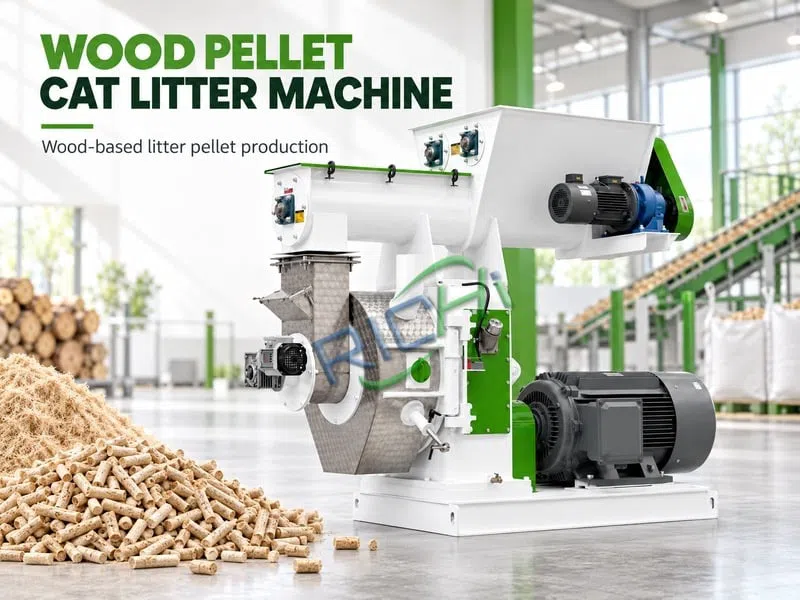
A wood pellet cat litter machine can form prepared pine material into pellets, but the production process needs to account for the characteristics of the raw material. Before equipment is selected, manufacturers should understand the source of the pine, the condition in which it arrives, and the product specifications they want to achieve.
Assess the Pine Material Supply
The first task is confirming that the expected raw material supply is suitable for the intended product. Pine sawdust from a controlled woodworking source may have a relatively predictable particle size, while material collected from several suppliers may vary more widely. Some batches may contain fine powder, others may include longer shavings or larger fragments.
Manufacturers should request representative samples and inspect them before finalizing the production design. Moisture, particle distribution, bulk density, and visible contaminants should be checked. The factory should also establish supplier requirements for material origin and cleanliness.
Pine material may have a distinctive natural smell. This characteristic should be considered during product development and market evaluation. Manufacturers should not assume that the natural odor of a raw material automatically meets the preferences of every customer. Product testing and feedback are useful for determining whether additional material selection or process controls are needed.
Remove Oversized Pieces and Foreign Objects
Pine sawdust and shavings may require size reduction before pelletizing. A crusher or hammer mill can process larger fragments into a more suitable particle range. The equipment should be selected according to the material's original form and the desired throughput.
The process should avoid unnecessary size reduction. Excessive crushing may increase energy consumption and generate additional fine powder. The correct target is a particle distribution that allows stable feeding and pellet formation.
Foreign objects should be controlled before they reach the main equipment. Wood-processing by-products can sometimes contain metal fragments, plastic, stones, or other unwanted materials. Screening and suitable separation devices can reduce the risk of damage, but incoming inspection and supplier control remain important.
Control Moisture During Processing
Pine material may arrive with different moisture levels depending on the supplier, weather, storage conditions, and production source. Moisture should therefore be measured rather than estimated by appearance or touch.
If drying is required, the dryer should be sized according to the incoming moisture, required output, and operating schedule. The drying process should provide reasonably uniform results across the material flow. Uneven drying can create differences between batches and may cause operators to make repeated adjustments at the pelletizing stage.
Material should also be protected after drying. If prepared pine material is exposed to rain or humid conditions, its moisture content may change before it reaches the pelletizing machine. Storage and conveying systems should be designed to reduce unnecessary exposure.
Consider the Characteristics of Pine During Pelletizing
The behavior of pine material during compression depends on its particle structure, moisture, and composition. The machine's die, rollers, feeding system, and operating conditions must be matched to the prepared material. A configuration that works well for another wood material may need adjustment when processing pine.
During commissioning, operators should begin with controlled test runs. They can observe machine load, feeding stability, pellet appearance, and the amount of broken material. Adjustments should be made systematically so that the effect of each change can be understood.
The production team should avoid changing several variables at once. If the feeding rate, moisture, and machine settings are all changed simultaneously, it becomes difficult to identify which adjustment caused an improvement or deterioration. A controlled test procedure makes product development more efficient.
Cooling and Screening After Forming
Pine pellets should be cooled before they enter the finished-product handling stage. Cooling helps bring the pellets closer to the required storage condition and supports more stable downstream operation. The cooling system should match the output of the pelletizing machine to prevent bottlenecks.
Screening removes loose powder and broken pieces. The amount of fines should be recorded because a sudden increase may indicate a change in raw material condition, pelletizing settings, or equipment wear. Recovered material should be handled according to an established reuse procedure rather than being returned automatically without inspection.
The finished pellets should be checked for dimensions, appearance, moisture, durability, and other product requirements. If the factory sells several pine-based products, each product should have its own specification and quality-control record.
Plan the Complete Pine Cat Litter Production Process
A pine cat litter factory may require receiving and storage equipment, crushing, screening, drying, conveying, pelletizing, cooling, finished-product screening, and packaging. The exact configuration depends on the incoming material. A factory receiving already prepared pine sawdust may need a different arrangement from one receiving larger wood-processing residues.
The capacity of each machine should be considered together. The dryer, crusher, conveyors, and packaging system need to support the intended production rate. Otherwise, a high-capacity pelletizer may spend too much time waiting for material or may produce more pellets than the cooling and packaging sections can handle.
Manufacturers should also consider future product development. If the factory plans to process different pine materials or offer multiple pellet sizes, the equipment layout should provide practical access for cleaning, inspection, and component changes.
A pine cat litter production line should therefore be designed around the characteristics of pine material and the manufacturer's intended product range. It should not simply copy a general wood-processing layout without checking the actual raw material.
Evaluate Operating Costs and Maintenance
Operating costs include electricity, drying energy, labor, replacement parts, material losses, and packaging. These costs should be estimated using realistic operating conditions rather than the nominal capacity of individual machines. A production trial can help establish more reliable figures.
Maintenance planning is also essential. Dies, rollers, bearings, screens, and conveying components may require regular inspection. Pine dust can accumulate around equipment, so cleaning access and dust-management arrangements should be considered during workshop design.
Manufacturers should ask equipment suppliers about recommended maintenance intervals, common wear parts, replacement procedures, and the availability of technical support. These questions can help prevent unexpected downtime after the factory begins regular production.
Develop a Process Based on Actual Material Tests
A successful pine cat litter project begins with representative raw material testing. The factory should confirm how the material responds to crushing, drying, feeding, and compression. It should then test finished pellets under consistent quality-control conditions.
When researching equipment configurations, manufacturers can use click reference to review related technical information and compare different processing arrangements. A useful equipment discussion should cover the full process rather than focusing only on the pelletizing machine.
Richi Pelletizer can be included in the evaluation of pelletizing equipment for a pine cat litter project. The final selection should be based on material characteristics, target output, product dimensions, and the required level of automation. With these factors established early, manufacturers can build a more practical production system and reduce the need for major changes after installation.