Dust management is an important consideration in wood cat litter manufacturing. Fine particles may be generated during crushing, conveying, pelletizing, screening, and packaging. Excessive dust can affect the working environment and may also influence the appearance and handling quality of the finished product.
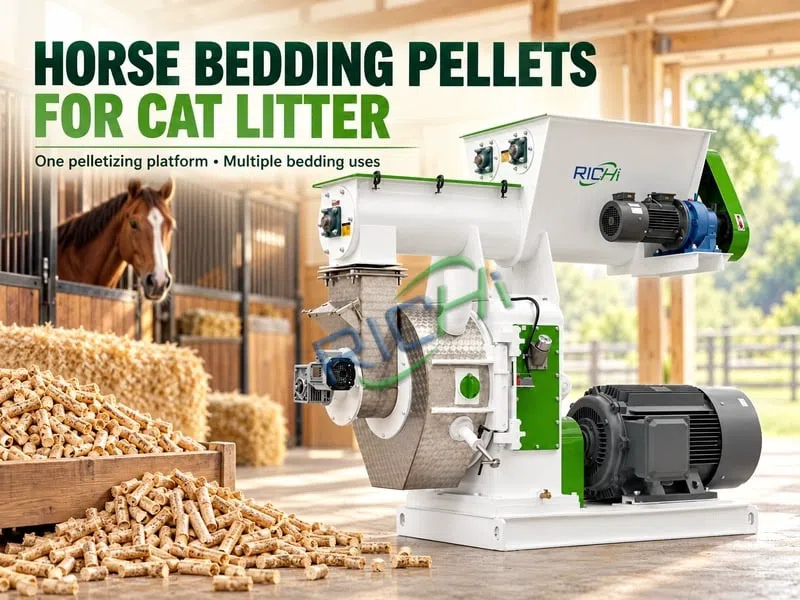
Some buyers search for horse bedding pellets for cat litter because both products are associated with wood pellets. However, cat litter manufacturers need to assess dust performance according to household pet product requirements. A product designed for horse bedding should not automatically be considered suitable for cat litter.
Identify Where Dust Is Generated
Dust can enter the production process with the incoming raw material. Sawdust and wood shavings may contain different proportions of fine particles, depending on the source and processing history.
Additional dust may be generated during crushing and screening. Conveying systems can also create fine particles if material falls from excessive heights or experiences repeated impacts.
The pelletizing and finishing sections should be inspected as well. Weak pellets may break during cooling, screening, packaging, and transportation, increasing the amount of fines in the finished product.
Improve Raw Material Preparation
The first step is to inspect the incoming wood material. Manufacturers should identify whether excessive fines are already present before processing begins.
Crushing equipment should be selected according to the size of the incoming material. Over-crushing should be avoided because it can create unnecessary fine particles and increase energy consumption.
Screening helps separate oversized particles and unwanted materials. Depending on the raw material, an additional screening arrangement may be useful for controlling the proportion of fines before pelletizing.
Maintain Suitable Moisture Conditions
Moisture influences the behavior of wood material during processing. Material with unsuitable moisture conditions may affect feeding and pellet formation.
If drying is required, the dryer should be selected according to the initial moisture and planned capacity. Operators should check the material after drying to confirm that it is suitable for pelletizing.
Consistent material conditions help reduce fluctuations in the forming process. However, moisture adjustment alone cannot solve every dust problem. Manufacturers should also examine pellet durability and downstream handling.
Improve Pellet Formation
The pelletizer compresses prepared wood material through a die. The forming process should produce pellets with the required dimensions and sufficient durability for subsequent handling.
A wood cat litter production line should be tested using representative raw materials to confirm the performance of the forming equipment. Trial production can help identify whether the machine produces excessive fines or unstable pellets.
The die specification, feeding system, and operating settings should be evaluated together. If the product breaks easily, operators should investigate the material condition and forming process before changing multiple parameters at once.
Control Dust Around the Equipment
Dust collection may be required around crushing, screening, transfer, and packaging points. The system should be designed according to the equipment arrangement and actual dust generation.
Enclosed transfer points and suitable extraction arrangements can help reduce dust escaping into the workshop. Regular inspection is necessary to keep the dust collection system operating effectively.
The plant should also establish cleaning and maintenance procedures. Accumulated dust should be managed safely and in accordance with applicable workplace requirements.
Screening and Finished Product Inspection
After cooling, pellets pass through screening equipment to separate fines and particles outside the required dimensions. This stage improves product consistency, but it should not be used to compensate for poor pellet formation.
Manufacturers should record the amount of fines collected at different stages. Comparing these figures can help identify where product breakage occurs.
Finished-product inspection should include samples taken after packaging. This provides a more realistic picture of the product that reaches the customer.
Packaging and Transportation
Packaging equipment should minimize unnecessary impacts during filling. Finished bags should be handled carefully during stacking and transportation.
Storage conditions should protect the pellets from moisture and physical damage. If the product is exposed to unsuitable conditions, its physical properties may change before use.
Businesses can look here to review related cat litter equipment and compare different machine configurations.
Richi Pellet Mill equipment can form part of a complete wood cat litter manufacturing solution. Combining appropriate raw material preparation, stable pelletizing, dust collection, and careful handling helps manufacturers improve product consistency and maintain a cleaner production environment.