Corn stalks are often the primary material considered when farmers look at small biomass pellet production. However, agricultural operations rarely have only one type of residue. Depending on the region, wheat straw, rice husks, grass, peanut shells, and other materials may also be available. This raises an important question: can a small pellet machine provide enough flexibility to process different biomass materials?
view details: https://www.richimanufacture.com/corn-stalk-pellet-machine/
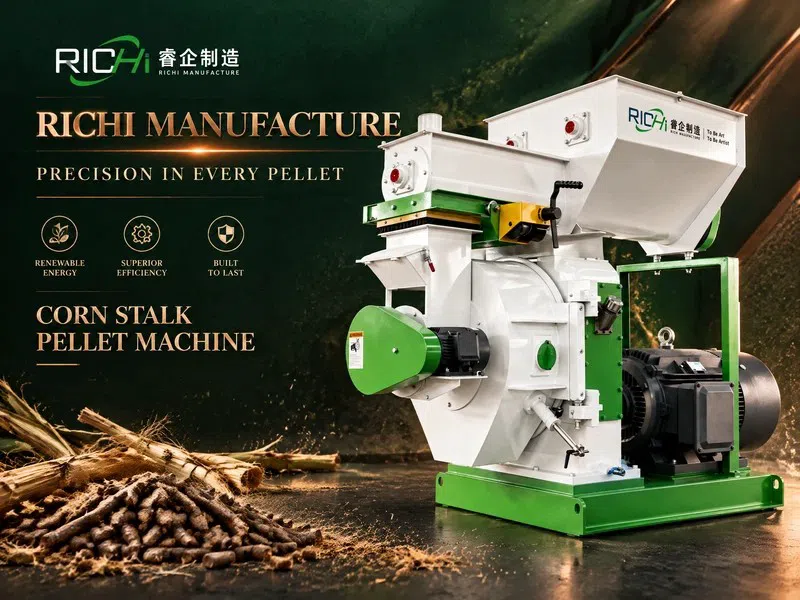
Corn Stalks as the Starting Material
Corn stalks can become difficult to transport and store when left loose. Pelletizing changes the physical form of the material, increasing its bulk density and making handling more convenient.
For a small operation, the goal may be to use the pellets locally rather than build a large commercial supply network. In this situation, the machine should be selected according to the actual material available and the intended use of the pellets.
Agricultural Residues Are Not Identical
Different biomass materials behave differently during processing. Some are more fibrous, some contain more moisture, and some have a naturally different particle structure. Even when several materials can be pelletized using similar equipment, the preparation process may need adjustment.
This is why a biomass straw pellet machine should be viewed as part of a material-processing system. Crushing, drying, mixing, and feeding conditions can all affect the final pellet.
When Multiple Feedstocks Make Sense
Using more than one agricultural residue can improve equipment utilization. A machine that only operates during the corn harvest season may remain idle for much of the year. If other locally available biomass can be processed, the production schedule may become more flexible.
For example, a farm cooperative might process corn stalks after harvest and use another agricultural residue during a different period. The feasibility depends on material availability, preparation requirements, local demand, and pellet quality expectations.
Comparing Agricultural Biomass With Wood
Wood residues are another possible pellet feedstock, but they should not automatically be treated as interchangeable with corn stalks. Wood chips, sawdust, and agricultural stalks differ in particle structure and moisture behavior.
A wood pellet machine may be configured around wood-processing requirements, while agricultural residue projects may need different upstream preparation. The correct choice therefore depends on the dominant feedstock rather than the general term “biomass.”
Avoiding Unnecessary Flexibility
Flexibility sounds attractive, but adding equipment simply to process every imaginable material may increase project cost and complexity. A small operator should first identify materials that are realistically available.
The best system may process two or three reliable local feedstocks rather than ten occasional materials. An anonymous online recommendation may suggest broad flexibility, but the actual project should be based on material tests and operating conditions.
Managing Material Changes
If feedstock changes during production, operators should monitor moisture, particle size, feeding behavior, and pellet appearance. A sudden change in material can alter the load on the pellet mill.
Keeping production records can help operators identify patterns. Over time, the facility can establish practical operating ranges for its common raw materials.
Building a Flexible Small Operation
A small pellet facility does not need to be designed like a major industrial plant to handle multiple biomass materials. Good preparation, appropriate feeding, suitable storage, and clear operating procedures can provide useful flexibility.
The key is to design around realistic local resources. If the supply of agricultural residues is strong and consistent, a small pellet project can become a practical way to convert several types of low-density biomass into a more manageable product.