The quality of paper cat litter depends on more than the appearance of the finished pellets. Manufacturers need to consider raw material cleanliness, fiber condition, moisture, pellet dimensions, durability, and the amount of fines produced during handling.
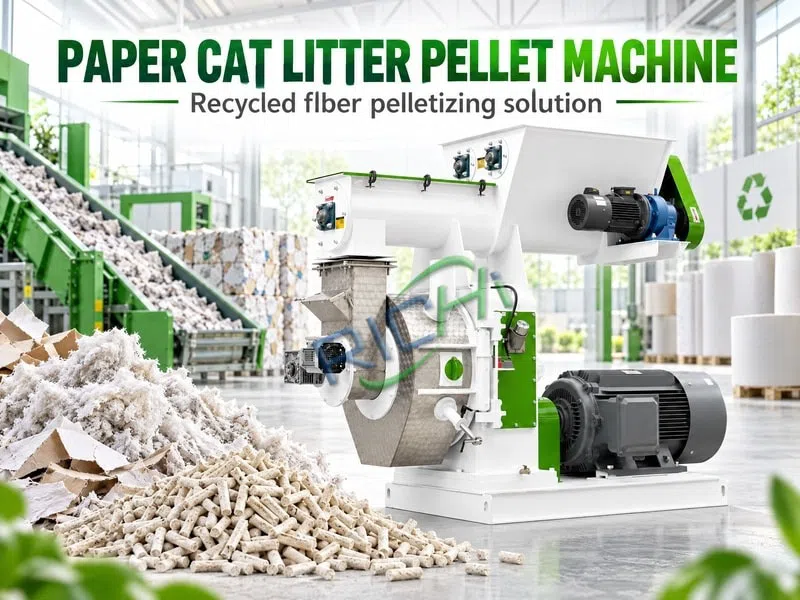
A paper cat litter pellet machine plays an important role in shaping the product, but consistent quality requires coordination between material preparation and downstream processing. If the incoming material is inconsistent, even suitable forming equipment may struggle to maintain stable results.
Raw Material Cleanliness
Recovered paper can contain unwanted materials such as plastic, adhesive, metal, and other contaminants. These materials should be identified and removed where necessary before processing.
Raw material inspection should be carried out when paper enters the facility. Manufacturers using multiple suppliers should establish clear acceptance requirements so that incoming material remains within an appropriate range.
Cleanliness is important not only for the finished product but also for equipment protection. Unwanted materials may interfere with shredding, fiber processing, conveying, or forming operations.
Fiber Size and Uniformity
Paper fibers may vary depending on the source and preparation method. If the material contains large pieces or unevenly processed fibers, feeding and forming may become less consistent.
Shredding and further fiber treatment can help create a more uniform feedstock. However, the target condition should be determined according to the forming equipment and intended product. Excessive processing can increase energy consumption and may not improve the finished product.
Operators should inspect the prepared material regularly and monitor changes when the paper source or processing settings are adjusted.
Moisture and Forming Stability
Moisture influences how prepared paper material behaves during forming. The appropriate condition depends on whether the production process uses wet fiber treatment, mechanical preparation, or another route.
If moisture is not controlled, the forming machine may experience unstable feeding or inconsistent pellet formation. Manufacturers should measure material condition at relevant stages and adjust the preparation process according to test results.
The forming equipment should also be evaluated using the actual paper material. General specifications cannot fully describe how a particular paper source will behave during production.
Pellet Dimensions and Durability
The required pellet diameter and length should be established before selecting the forming equipment. The die or forming components determine the product dimensions, while cutting and operating settings may influence the final length.
Durability is another important indicator. Pellets should withstand normal conveying, screening, packaging, and transportation without excessive breakage. However, manufacturers should not focus on strength alone. Other product characteristics, including absorption performance and handling properties, should also be evaluated.
A wood cat litter production line provides a useful comparison because wood and paper materials have different physical properties. Equipment settings and preparation requirements should be developed for each material rather than copied directly from one process to another.
Screening and Dust Control
Screening removes excessive fines and separates pellets outside the required size range. The screen specification should match the intended product dimensions and production capacity.
Dust control should be considered around shredding, screening, and material transfer points. Suitable collection arrangements can help maintain a cleaner working environment and reduce the accumulation of fine material around equipment.
Operators should also inspect the screening equipment regularly. Worn or damaged screens may affect separation performance and cause unwanted particles to enter the finished product.
Inspecting Quality at Different Stages
Finished-product inspection alone may not identify where a quality problem begins. Manufacturers can collect samples after forming, cooling, screening, and packaging to compare the condition of the material at each stage.
If the product is acceptable after forming but contains excessive fines after packaging, the cause may be related to conveying or handling. If pellets are weak immediately after forming, the preparation and forming stages should be reviewed.
This approach helps operators identify the actual source of quality changes rather than making unnecessary adjustments throughout the line.
For further equipment information, manufacturers can visit site and compare the functions of different machines with their production requirements.
Richi Pelletizer equipment can be considered as part of a complete paper cat litter project. By controlling raw material quality, fiber preparation, moisture, forming, and screening, manufacturers can establish a more consistent process and improve the reliability of the finished product.