A realistic equipment budget starts with the product a factory intends to manufacture, not with the amount an investor hopes a machine will cost. When researching floating fish feed extruder machine price, it is important to distinguish the cost of the central extrusion unit from the investment required to turn raw ingredients into packaged feed.
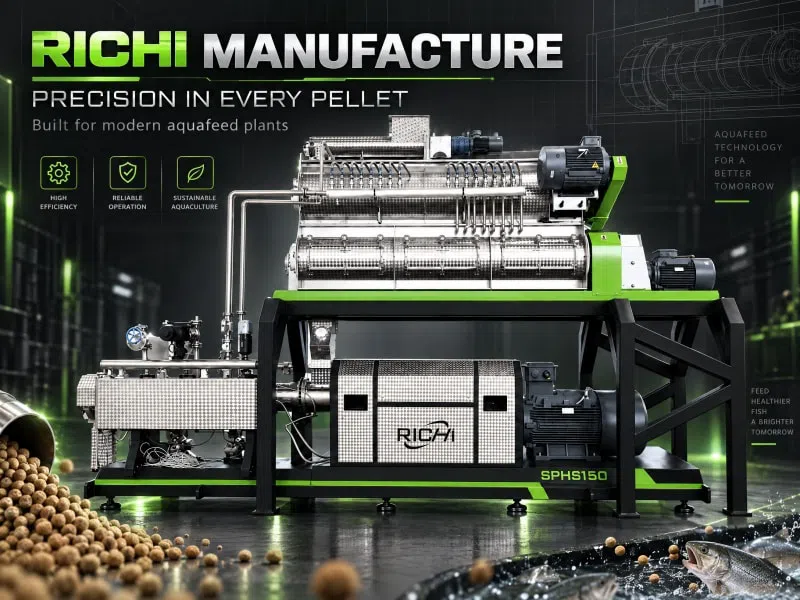
Separate Essential Equipment From Optional Upgrades
Every floating feed project needs certain fundamental processing functions. Ingredients require suitable size reduction and mixing before extrusion, while freshly extruded pellets require moisture reduction afterward.
Other equipment depends more strongly on project requirements. Micro-grinding, automatic batching, advanced liquid spraying, centralized controls, and automatic packaging may add substantial value in some factories while being unnecessary in others.
When evaluating a floating fish feed production line for sale, buyers should therefore identify which equipment is essential to the intended product and which items represent improvements in efficiency, automation, or future flexibility.
Build the Budget Around Finished Feed
The required pellet specifications influence the process configuration. A factory producing several aquatic feed sizes may need greater flexibility than one producing a limited product range.
Expected daily output also determines how much machinery is required. Higher capacity affects not only the extruder but also the size of crushers, mixers, dryers, conveyors, coolers, and packaging equipment.
For early-stage investors, why not try this out as a budgeting method: define the finished products and annual sales target first, then work backward to the equipment required to achieve them.
Do Not Forget Utility Infrastructure
Machine quotations are only part of the investment. The factory needs enough electrical capacity to operate the complete process.
Wet extrusion requires steam conditioning, which can mean investing in a boiler and steam distribution system. Drying requires thermal energy as well, and the most practical heat source depends on local conditions.
Compressed air, water, electrical cabling, and control wiring may add further costs depending on the configuration.
These expenses can be overlooked when an investor focuses exclusively on machinery.
Existing Buildings Can Save or Create Costs
Using an existing workshop may reduce construction investment, but only if the building is suitable for the proposed process.
Limited ceiling height can complicate conveying. Poor equipment access may increase installation cost. Insufficient electrical infrastructure may require upgrades.
A new building adds capital expenditure but allows the production layout to be designed around efficient material flow from the beginning.
Budget for Installation and Commissioning
Equipment does not begin producing immediately after delivery. Machinery must be unloaded, positioned, connected, tested, and commissioned.
Foundations, lifting equipment, local labor, piping, and electrical work should be included in the project budget.
Training also deserves consideration. Operators who understand extrusion settings and maintenance can reduce production mistakes and avoid unnecessary downtime.
A low-cost pellet maker machine or extruder provides little economic advantage if poor commissioning prevents it from reaching stable output.
Keep a Contingency for Project Changes
Industrial projects rarely proceed without any adjustments. Building modifications, additional conveyors, utility changes, or local compliance requirements may appear after detailed engineering begins.
A reasonable contingency prevents these changes from disrupting the entire financing plan.
Spare and wear parts should also be included in the initial budget. Having critical components available can reduce the risk of long shutdowns after production starts.
Spend According to Production Priorities
A limited budget does not automatically require low-quality equipment. It requires clearer priorities.
A smaller project may reduce automation, simplify material handling, or begin with moderate capacity while maintaining the essential processing stages needed for reliable feed production.
Future expansion can be considered in the workshop layout so that additional capacity can be added when the market supports it.
A realistic budget therefore balances immediate production needs with long-term plans. Instead of attempting to purchase every available feature, investors should direct money toward the parts of the process that determine product quality, capacity, and reliability.
When the budget is built around actual production rather than isolated machine prices, unexpected costs become easier to control and equipment investment is more likely to support a financially sustainable feed business.